


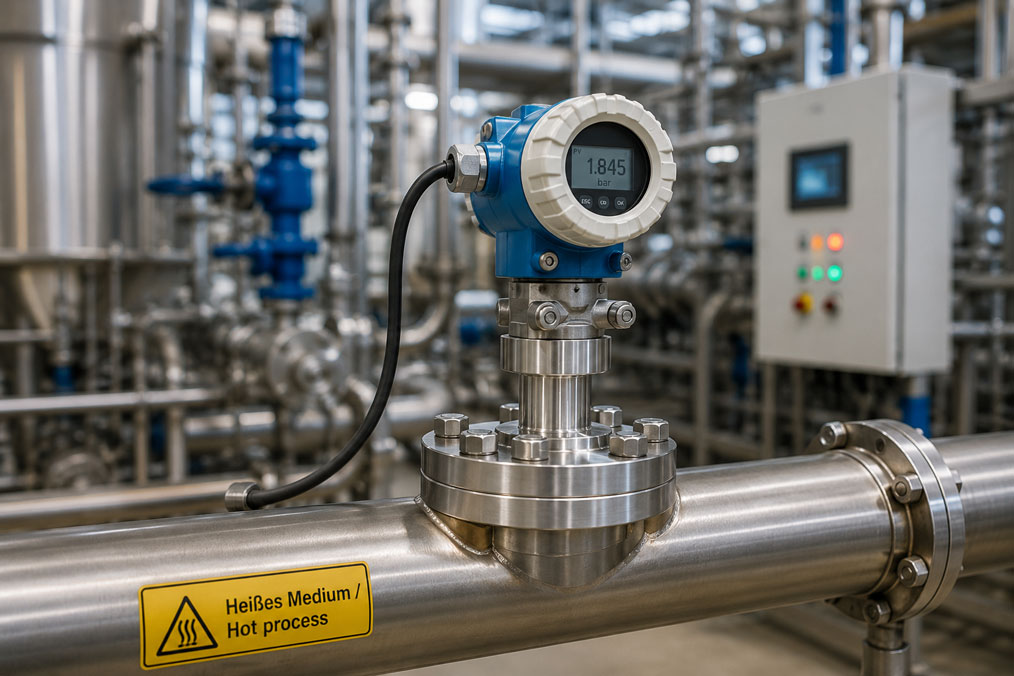
Process transmitters are used in the process industry when pressure must be measured reliably, with long-term stability and often under difficult conditions. In many applications, however, a directly screwed-in pressure transmitter is not sufficient. Hot, aggressive, viscous, crystallizing, contaminated or hygienically demanding media can clog the pressure connection, damage the measuring cell or make the measurement unreliable.
This is exactly where diaphragm seals come into play. A diaphragm seal separates the measuring instrument from the process medium and transmits the pressure to the process transmitter via a diaphragm and a suitable fill fluid. This allows pressure measurement to be implemented even where direct contact between the medium and the measuring cell would be problematic.
This article explains when process transmitters with diaphragm seals are useful and what role the diaphragm, fill fluid, capillary line, temperature, response time, process connection, hygienic design, corrosion resistance and vacuum use play. Important: diaphragm seal systems should always be designed specifically for the application. Medium, temperature, pressure range, process connection, cleaning and required dynamics must be evaluated together.
Table of contents
- Basics: what is a process transmitter with diaphragm seal?
- Why diaphragm seals are necessary for difficult media
- Diaphragm and pressure transmission: separating the process medium
- Fill fluid: temperature range, compatibility and response time
- Capillary line and remote seal: distance from heat, vibration and installation point
- Correctly evaluating hot, aggressive, viscous and crystallizing media
- Hygienic connections for food, pharmaceutical and biotechnology applications
- Vacuum, fast processes and the limits of diaphragm seal design
- Output signal, PLC connection and testing the measurement chain
- Practical example: pressure measurement in a viscous product line
- Which measuring instruments / products are suitable?
- Conclusion: diaphragm seals must be designed for the application
- FAQ: frequently asked questions about process transmitters with diaphragm seals
Basics: what is a process transmitter with diaphragm seal?
A process transmitter converts the applied process pressure into an electrical signal, for example 4–20 mA, HART or another output signal. It is frequently used in chemical plants, food processes, pharmaceutical plants, the paper industry, energy plants, tank and pipeline systems or test benches. The measuring instrument is intended to reliably detect the process pressure and transmit it to a PLC, control system, data logger or display.
In direct pressure measurement, the process medium is applied directly at the pressure connection or measuring cell of the transmitter. This works well with clean, non-aggressive media at uncritical temperatures. However, as soon as the medium is sticky, crystallizes, contains solids, is highly corrosive or becomes very hot, a direct connection can become problematic.
A diaphragm seal separates the process transmitter from the medium. A thin diaphragm is located on the process side. Behind this diaphragm is a fill fluid that transmits the pressure to the transmitter. The medium therefore does not touch the sensitive measuring cell of the transmitter, but only the diaphragm and process connection of the diaphragm seal designed for this purpose.
The diaphragm seal is therefore not just an accessory, but an important part of the measurement chain. Its design influences accuracy, response time, temperature behavior, cleaning, resistance and long-term stability. A well-selected diaphragm seal can make a measuring point reliable; an incorrectly designed diaphragm seal, on the other hand, can lead to sluggish measurement, drift, damage or misinterpretation.
| Measurement setup | Typical use | Advantage | What to pay attention to? |
|---|---|---|---|
| Directly connected process transmitter | Clean, non-aggressive media with moderate temperature | Fast response, simple setup, low additional error | Medium must not damage or clog the measuring cell and pressure channel. |
| Process transmitter with flush diaphragm seal | Viscous, pasty, contaminated or crystallizing media | Less dead space, better cleanability, reduced clogging risk | Select diaphragm material, process connection and cleaning concept appropriately. |
| Process transmitter with capillary line | Hot media, strong vibration, difficult-to-access measuring points | Transmitter can be mounted away from the process | Carefully design capillary length, fill fluid and temperature error. |
| Hygienic diaphragm seal | Food, beverages, pharmaceuticals, biotechnology | Cleanable, low dead space, suitable for CIP/SIP concepts | Consider hygienic connection, surface, seal and fill medium. |
Why diaphragm seals are necessary for difficult media
Many pressure measurement problems are not caused by the transmitter itself, but by the process connection. Conventional pressure connections often have small bores or pressure channels. With thin, clean media, this is uncritical. With viscous, sticky, contaminated or crystallizing media, however, these channels can become clogged. The transmitter then no longer measures the actual process pressure, but a delayed or trapped pressure condition.
A diaphragm seal shifts contact with the medium to a larger, usually flush-mounted diaphragm. As a result, there are fewer narrow pressure channels in which product residues, solids or crystals can accumulate. This can be decisive especially in dosing systems, chemical processes, wastewater applications, food production, the paper industry and with pasty media.
Another reason is chemical resistance. A process medium can attack the measuring cell or seals of a normal transmitter. With a diaphragm seal, a suitable diaphragm material can be selected, for example stainless steel, Hastelloy, tantalum, Monel or a coated or lined version. The specific selection depends on medium, temperature, concentration, pH value, cleaning chemistry and operating conditions.
High temperatures are also a reason to use a diaphragm seal. The process may be so hot that the transmitter would be thermally overloaded directly at the connection. The transmitter can be thermally separated from the process using capillary lines, cooling elements or a suitable installation solution. However, it must be considered that such solutions influence response time and temperature behavior.
Diaphragm and pressure transmission: separating the process medium
The diaphragm is the central element of the diaphragm seal. It is in contact with the medium on the process side and deforms minimally due to the applied pressure. This movement is transmitted to the process transmitter via the fill fluid. The diaphragm must therefore be media-resistant, mechanically suitable, tight and sufficiently sensitive at the same time.
A large diaphragm can be advantageous for low pressures and sensitive measuring ranges because it enables better pressure transmission. A smaller diaphragm can be mechanically more robust or more space-saving, but is not suitable for every low pressure span. The smaller the measuring range, the more important the careful coordination of diaphragm diameter, fill volume, transmitter and temperature behavior becomes.
The diaphragm material must match the medium. Stainless steel 316L is suitable for many standard applications, but not for every aggressive medium. Special materials may be required for chlorides, strong acids, alkalis, solvents or special cleaning processes. Incorrect material selection can lead to corrosion, diaphragm damage, leakage or drifting measured values.
The surface also plays a role. In hygienic applications, smooth, cleanable surfaces are important. With viscous or sticky media, a flush diaphragm can prevent product from collecting in dead spaces. In abrasive media, it must also be checked whether diaphragm thickness, material and installation position can withstand the load.
Fill fluid: temperature range, compatibility and response time
The fill fluid transmits the pressure from the diaphragm to the measuring cell of the process transmitter. It must match the temperature range, application and safety concept. Typical fill fluids include silicone oils, synthetic oils, high-temperature fluids, food-grade fill media or special fluids for vacuum or low-temperature applications.
A fill fluid must not be selected only according to maximum temperature. Viscosity, expansion behavior, compressibility, compatibility in the event of failure and the desired dynamic measurement behavior are also decisive. A highly viscous fill fluid can make the measurement more sluggish, especially with long capillary lines or low temperatures.
In food and pharmaceutical applications, the selection of the fill fluid is particularly sensitive. If a diaphragm were damaged, the risk to product, process and cleaning concept must not be ignored. For this reason, suitable food-grade or hygienically assessed fill media are often used in such applications, provided they match the temperature range and measurement task.
Temperature changes affect the fill fluid. It expands or contracts. This can cause additional measurement deviations, especially with large fill volumes, long capillaries or strongly fluctuating ambient temperatures. Professional design attempts to keep fill volume and temperature influences as low as possible.
| Design feature | Influence on measurement | Typical consequence of incorrect selection |
|---|---|---|
| Diaphragm diameter | Influences sensitivity, pressure range and transmission behavior | A diaphragm that is too small can lead to higher errors at low pressures. |
| Diaphragm material | Determines media and corrosion resistance | Unsuitable material can corrode or become damaged. |
| Fill fluid | Influences temperature range, response time and system error | Incorrect fill medium can cause sluggish measurement, drift or temperature errors. |
| Fill volume | The larger the volume, the stronger temperature effects can be | Large volumes can potentially increase temperature errors and sluggishness. |
| Process connection | Determines installation, hygiene, cleaning and dead-space behavior | Unsuitable connection can cause deposits or cleaning problems. |
Capillary line and remote seal: distance from heat, vibration and installation point
A process transmitter does not always have to sit directly on the diaphragm seal. In so-called remote seal solutions, the diaphragm seal is connected to the transmitter via a capillary line. This is useful when the process is very hot, the measuring point is difficult to access, strong vibrations occur or the transmitter should be mounted in a more accessible position for maintenance reasons.
However, the capillary line is not a neutral connecting component. It contains fill fluid and therefore increases the total fill volume of the system. The longer the capillary, the more strongly temperature changes and dynamic effects can influence the measurement. A long capillary can extend the response time and make the measurement more sensitive to ambient temperatures.
In differential pressure measurements with two diaphragm seals, capillary design is particularly critical. Different capillary lengths, different temperatures along the capillaries or asymmetrical installation conditions can cause measurement errors. Both sides must therefore be carefully designed and installed.
Remote seal systems are very useful when they are correctly designed. However, they should not automatically be considered the best solution. If direct mounting with a cooling element or suitable installation position is possible, it may be more favorable in terms of dynamics and measurement performance. The decision depends on temperature, accessibility, measuring range, vibration, process connection and maintenance concept.
Correctly evaluating hot, aggressive, viscous and crystallizing media
Media evaluation is the most important step when selecting a diaphragm seal system. A medium can be hot, corrosive, viscous and crystallizing at the same time. In that case, it is not enough to specify only a suitable pressure range. It must be clarified how the medium behaves during operation, shutdown, cleaning and startup.
With hot media, thermal decoupling is the main focus. The transmitter must not overheat, and the fill fluid must match the maximum and minimum temperature. If temperatures fluctuate strongly, the temperature influence on measurement accuracy must also be evaluated.
With aggressive media, material selection is decisive. The diaphragm, seal and all wetted parts must be resistant. Corrosion is not only a durability issue, but also a safety and measurement accuracy issue. An attacked diaphragm can change its mechanical properties or become leaky.
With viscous, pasty or crystallizing media, the geometry of the measuring point is particularly important. Flush or inline diaphragm seals reduce dead spaces and make cleaning easier. If the medium crystallizes or hardens when cooling down, the shutdown situation must also be considered. A measuring point that works during hot operation can be blocked after cooling.
| Medium / process problem | Typical risk | Suitable design focus |
|---|---|---|
| Hot medium | Transmitter overheating, fill fluid limits, temperature errors | Evaluate cooling element, capillary line, high-temperature filling and mounting location. |
| Aggressive medium | Corrosion on diaphragm, seal or connection | Check diaphragm material, sealing material and cleaning chemistry. |
| Viscous or pasty medium | Clogging, adhesion, slow pressure transmission | Prefer flush diaphragm, large connection and short pressure transmission. |
| Crystallizing medium | Blocked pressure channels and delayed measured values after shutdown | Consider dead-space-free measuring point, temperature control and cleaning option. |
| Abrasive medium | Diaphragm wear due to solids or flow | Carefully evaluate material, installation position and flow load. |
Hygienic connections for food, pharmaceutical and biotechnology applications
In food, beverage, pharmaceutical and biotechnology plants, pressure measuring points must not only function technically, but also fit hygienically into the process. Dead spaces, gaps that cannot be cleaned, unsuitable seals or rough surfaces can lead to product residues, microbiological risks or cleaning problems.
Hygienic diaphragm seals are therefore often used with Tri-Clamp, Varivent, dairy pipe, aseptic or other suitable process connections. A flush diaphragm makes cleaning easier and reduces product deposits. In CIP and SIP processes, temperature, cleaning medium, seal and surface quality must also be considered.
The fill medium is also important in hygienic applications. Depending on the process, a suitable food-grade fill medium may be required. At the same time, it must cover the temperature range and required measurement dynamics. A purely hygienic selection without considering temperature and measuring range can lead to sluggish or inaccurate measurement.
Hygienic applications show particularly clearly that process transmitters and diaphragm seals must be considered as a complete system. Process connection, diaphragm, seal, fill medium, installation, cleaning and calibration must match. For quality-relevant measuring points, the system should be documented and checked regularly.
Vacuum, fast processes and the limits of diaphragm seal design
Diaphragm seals can also be used under vacuum or negative pressure, but not without careful examination. Under vacuum conditions, the fill fluid can outgas or the system can react differently than under positive pressure. The diaphragm must also be suitable for the pressure conditions that occur. Special design is required in critical vacuum applications.
Fast processes are another challenge. Every diaphragm seal combination has a certain transmission dynamic. Diaphragm, fill fluid, capillary line and transmitter together form a hydraulic transmission system. In slow level applications, this is often uncritical. In the case of fast pressure surges, control loops or safety shutdowns, however, response time can be decisive.
Low measuring ranges also place high demands on the design. The smaller the pressure span, the more strongly diaphragm stiffness, temperature effects and fill volume influence the measurement. A diaphragm seal that works without problems at 0–10 bar is not automatically suitable for 0–100 mbar. Particularly with small differential pressures, very careful design is required.
The limits of a diaphragm seal system should be evaluated openly. Not every process condition can be solved sensibly with every design. Sometimes a different measuring point, a different process connection, a special sensor, temperature control or another measuring principle is the better solution. Expert consultation is not an extra here, but an important part of technical design.
Output signal, PLC connection and testing the measurement chain
At the end of the measurement chain, a process transmitter with diaphragm seal provides an electrical signal, often 4–20 mA or 4–20 mA with HART. This signal is scaled in a PLC, control system, display or data logger. For the displayed value to be correct, pressure range, unit, output signal and scaling must match correctly.
With measuring points using diaphragm seals, it is particularly important not to consider only the sensor alone. The mechanical transmission system can detect the pressure correctly, but the PLC may be scaled incorrectly. Conversely, the electrical scaling can be correct, but the diaphragm seal may be too sluggish or shifted by temperature influence. Proper commissioning therefore checks the mechanical and electrical measurement chain together.
The UPS4E loop calibrator is suitable for testing 4–20 mA signals. It can be used to measure and simulate mA signals, test current loops and detect scaling errors between transmitter, PLC, display or data logger. This test is particularly helpful after replacing a process transmitter or changing the measuring range.
For safety- or quality-relevant measuring points, the complete measurement chain should be documented. This includes measuring range, diaphragm seal design, diaphragm material, fill fluid, capillary length, process connection, output signal, PLC scaling and calibration status. This is the only way to keep the measuring point traceable after maintenance or device replacement.
Practical example: pressure measurement in a viscous product line
In a production plant, the pressure of a viscous liquid is monitored in a pipeline. Initially, a normal pressure transmitter with a standard threaded connection is installed. During operation, the measuring point starts to show delayed and implausible values after some time. Especially after shutdown and restart, the transmitter reacts much more slowly than expected.
Inspection shows that product residues settle in the narrow pressure channel of the connection. After cooling down, the medium becomes more viscous and partially blocks pressure transmission. The transmitter itself is electrically in order, but it no longer measures the actual process pressure. Replacing it with the same transmitter would therefore only solve the problem for a short time.
The measuring point is converted to a process transmitter with a flush diaphragm seal. The diaphragm is directly exposed to the process, and narrow dead spaces are reduced. In addition, diaphragm material, seal and cleaning procedure are matched to the medium. After conversion, the measuring point reacts more stably and is easier to clean.
This example shows why the cause with difficult media is often not the transmitter, but the type of pressure connection. The diaphragm seal makes the measuring point suitable for the process when it is designed appropriately for the application.
Which measuring instruments / products are suitable?
For applications in the process industry, ICS Schneider Messtechnik offers the category process transmitters / differential pressure transmitters. These devices are suitable for demanding pressure measurement tasks in industrial plants, for example pressure, differential pressure, level, filter monitoring or process monitoring. With difficult media, selection should always be made together with the appropriate diaphragm seal design.
The category diaphragm seals is the central starting point when the process transmitter must be separated from the medium. Solutions for hot, viscous, aggressive, crystallizing and hygienically demanding media are relevant there. Depending on the application, diaphragm seals, inline diaphragm seals, flush connections, flanges, threaded connections, hygienic connections or remote lines with capillaries may be considered.
For electrical testing of the measurement chain, the UPS4E loop calibrator is also useful if the process transmitter provides a 4–20 mA signal. It can be used to test transmitter output, current loop and PLC scaling independently of the process. This is particularly useful during commissioning, troubleshooting, replacement or calibration.
The most important recommendation for process transmitters with diaphragm seals is: do not select just one device, but specify the complete system. This includes medium, temperature, pressure range, vacuum component, process connection, diaphragm material, fill fluid, capillary length, cleaning process, installation position, output signal and calibration requirement.
| Product / area | Typical use | Particularly relevant for |
|---|---|---|
| Process transmitters / differential pressure transmitters | Pressure and differential pressure measurement in process plants | Chemicals, energy, paper, pharmaceuticals, food, tank and pipeline processes |
| Diaphragm seals | Separation of the measuring instrument from the process medium | Hot, aggressive, viscous, crystallizing, contaminated and hygienic media |
| Diaphragm seal | Flush or flange-based pressure transmission | Chemicals, process industry, hygiene, viscous media and high temperatures |
| Inline diaphragm seal | Pressure measurement directly in the pipe cross-section | Flowing, viscous or hygienically cleanable media |
| UPS4E loop calibrator | Testing and simulation of 4–20 mA signals | Transmitter output, PLC scaling, commissioning, service and troubleshooting |
Conclusion: diaphragm seals must be designed for the application
Process transmitters with diaphragm seals are a very good solution when difficult media need to be measured safely and reliably. They protect the transmitter from direct media contact, reduce clogging risks, enable hygienic measuring points and allow pressure measurement even at high temperatures, with aggressive media or under unfavorable installation conditions.
The diaphragm seal is not just any accessory. Diaphragm, fill fluid, capillary line, process connection, seal, temperature range and cleanability directly influence measurement quality. Especially with low measuring ranges, vacuum, fast processes or long capillary lines, the design must be carried out carefully.
The most important recommendation is: always consider process transmitter and diaphragm seal as a complete system. Only when medium, temperature, pressure range, materials, fill fluid, connection, output signal and calibration match does a measuring point result that works reliably in everyday operation and remains maintainable in the long term.
FAQ: frequently asked questions about process transmitters with diaphragm seals
What is a process transmitter with diaphragm seal?
A process transmitter with diaphragm seal is a pressure measuring point where the transmitter is not in direct contact with the medium. The process pressure is transmitted to the transmitter via a diaphragm and a fill fluid.
When do you need a diaphragm seal?
A diaphragm seal is useful when the medium is hot, aggressive, viscous, crystallizing, contaminated, abrasive or hygienically critical. It protects the transmitter and can reduce clogging, corrosion and cleaning problems.
Why is a direct pressure connection problematic with viscous media?
Viscous or pasty media can clog narrow pressure channels or delay pressure transmission. As a result, the transmitter no longer displays the current process pressure. A flush diaphragm seal reduces such dead spaces.
What is the function of the diaphragm in the diaphragm seal?
The diaphragm separates the process medium from the fill fluid and the measuring instrument. It mechanically transmits the process pressure to the fill fluid without the medium entering the transmitter.
Which diaphragm material is suitable?
This depends on the medium, temperature, pH value, chloride content, cleaning chemistry and mechanical load. Stainless steel or special materials such as Hastelloy, tantalum, Monel or coated versions are often used.
What does the fill fluid do in the diaphragm seal?
The fill fluid transmits the movement of the diaphragm to the measuring cell of the transmitter. It influences temperature range, response time, measurement deviation and suitability for hygienic, high-temperature or vacuum applications.
Can the fill fluid distort the measurement?
Yes. Viscosity, expansion and compressibility of the fill fluid can influence response time and temperature behavior. The fill fluid must therefore be selected to match temperature, measuring range and dynamics.
When is a capillary line used?
A capillary line is used when the transmitter should be mounted away from the process, for example due to high temperature, vibration, poor accessibility or spatial separation. The capillary length should be as short as possible and as long as necessary.
How does a long capillary line affect measurement?
A long capillary line increases the fill volume and can extend the response time. Ambient temperatures along the capillary can also cause additional measurement deviations. Capillary length and routing must therefore be planned carefully.
Are diaphragm seals suitable for vacuum?
Yes, but only with suitable design. Fill fluid, diaphragm, pressure range and temperature must be suitable for vacuum. In critical vacuum applications, the design should always be technically checked.
What is a remote seal?
Remote seal refers to a diaphragm seal solution in which the diaphragm seal is connected to the transmitter via a capillary line. This allows the transmitter to be mounted away from the hot, vibrating or difficult-to-access process.
Which diaphragm seals are suitable for hygienic applications?
For hygienic applications, flush or inline diaphragm seals with suitable hygienic connections such as Tri-Clamp, Varivent or aseptic connections are often used. Smooth surfaces, suitable seals and cleanability are important.
What must be considered for CIP and SIP cleaning?
For CIP and SIP, temperature, cleaning medium, seals, diaphragm material, surface quality and fill fluid must match the cleaning process. The measuring point should be designed with minimal dead space and be fully cleanable.
Can a diaphragm seal impair response time?
Yes. Diaphragm, fill fluid, fill volume and capillary line influence the dynamics. With slow processes, this is often uncritical. With fast control loops, pressure surges or safety functions, response time must be evaluated precisely.
How is a process transmitter with diaphragm seal calibrated?
The system should, where possible, be calibrated as one unit consisting of diaphragm seal and transmitter because diaphragm, fill fluid and installation influence transmission. After changes to the system, calibration or at least a functional check should be repeated.
Which information is required for design?
Important information includes medium, concentration, temperature, pressure range, vacuum component, process connection, required accuracy, response time, cleaning procedure, installation position, ambient temperature, output signal and calibration requirement.
When is expert consultation particularly important?
Expert consultation is particularly important with aggressive media, high temperatures, vacuum, low measuring ranges, long capillaries, hygienic requirements, fast processes or when the measuring point is safety- or quality-relevant.