


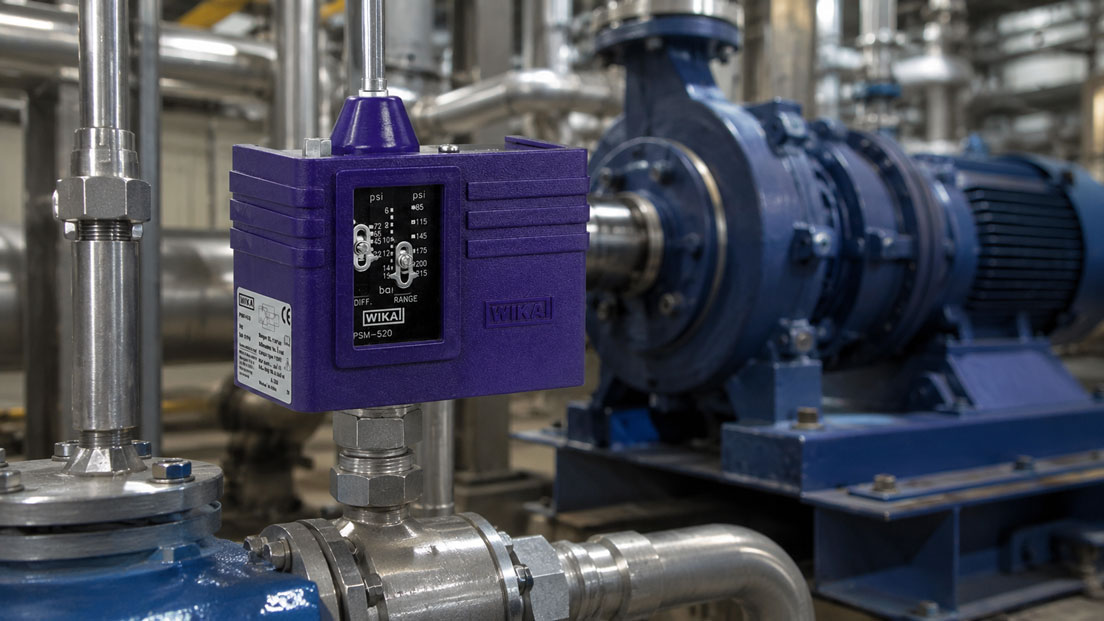
Pressure switches are among the most important monitoring and protection components in pump, compressor and compressed air systems. They switch at a defined pressure point and can therefore start or stop pumps, cycle compressors, monitor minimum pressure, limit maximum pressure or protect systems against dry running and impermissible operating conditions.
In practice, pressure switches are often viewed very simply: pressure falls or rises, and the switch reacts. However, this is not enough for reliable operation. Measuring range, switching point, switching differential, medium, process connection, switching capacity, electrical connection, installation situation and the behavior of the system are decisive. Especially with pumps and compressors, an incorrectly selected or incorrectly adjusted pressure switch can lead to frequent switching, contact wear, false shutdowns or insufficient protection.
This article explains how to select and use pressure switches for pumps and compressors correctly. The focus is on dry-running protection, minimum pressure monitoring, maximum pressure monitoring, pressure vessels, compressor cycling, switching capacity and the question of when a mechanical pressure switch is sufficient and when another type of pressure monitoring is more suitable.
Table of contents
- Basics: how a pressure switch works
- Pressure switches on pumps: monitoring dry running and minimum pressure
- Pressure switches on compressors: cut-in pressure, cut-out pressure and cycling
- Understanding switching point, switching differential and reset point correctly
- Medium and materials: water, air, oil and process media
- Switching capacity, contact type and electrical connection
- Avoiding frequent switching: pressure vessel, damping and hysteresis
- Installation position, pressure connection and practical errors
- Practical example: pump constantly switches on and off
- Which measuring instruments / products are suitable?
- Conclusion: the right pressure switch protects the system and process
- FAQ: frequently asked questions about pressure switches for pumps and compressors
Basics: how a pressure switch works
A pressure switch monitors a pressure and switches an electrical contact when a set limit value is reached. Depending on the design, this contact can start a pump, switch off a compressor, trigger a warning message, control a valve or send a signal to a controller. Unlike a pressure transmitter, a classic pressure switch does not provide a continuous pressure value, but a switching signal: pressure reached or pressure not reached.
Mechanical pressure switches usually work with a diaphragm, piston or another pressure-dependent measuring element. When the pressure rises or falls, this element moves and actuates a microswitch. Electronic pressure switches, on the other hand, work with a pressure sensor and electronic evaluation. They often offer a display, freely adjustable switching points and additional diagnostic functions. For many robust pump and compressor applications, however, mechanical pressure switches remain a very practical solution.
The function within the overall system is important. A pressure switch does not automatically protect every system simply because it is installed. The switching point must match the process, the reset point must be chosen appropriately, the electrical contact must match the load and the pressure connection must reliably detect the actual process pressure. Only then can the pressure switch reliably perform its task.
| Task | Typical application | What to pay particular attention to? |
|---|---|---|
| Dry-running protection | Pump should be shut down if there is no inflow or suction pressure is too low | Carefully select measuring point, minimum pressure, medium and response time. |
| Minimum pressure monitoring | Compressed air, water supply, hydraulics or process line should maintain minimum pressure | Do not set the switching point too close to normal pressure fluctuations. |
| Maximum pressure monitoring | Compressor, pump or line should shut down at excessive pressure | Observe permissible operating pressure and safety concept. |
| Compressor control | Compressor switches between cut-in and cut-out pressure | Switching differential and pressure vessel must match the system. |
| Alarm message | Undershooting or exceeding a limit is reported to the control system | Clearly document contact logic, normally closed / normally open and wiring. |
Pressure switches on pumps: monitoring dry running and minimum pressure
On pumps, pressure switches are often used to monitor a minimum pressure or to protect the pump against dry running. Dry running can occur when no more medium flows in, a tank is empty, a suction line draws air, a valve is closed or a filter is clogged. Depending on the pump type, dry running can lead to seal damage, overheating, cavitation, increased wear or pump failure.
In such cases, a pressure switch can detect that the pressure has fallen below a critical value. In a discharge line, insufficient delivery pressure can indicate that the pump is no longer delivering correctly. In a suction line, a pressure drop or vacuum condition can indicate missing inflow or a clogged suction side. The correct measuring point is decisive here. A pressure switch installed at an unfavorable point may detect a critical condition too late or not at all.
In water systems, it must also be considered that pressure fluctuations when starting and stopping the pump are normal. If the switching point is set too sensitively, the switch may trip at every small fluctuation. If it is set too insensitively, dry running may be detected too late. Especially in systems with pressure vessels, long pipelines or strongly fluctuating consumption, the setting must match the real operating behavior.
For dry-running protection, the pressure switch is often only one part of the protection concept. Depending on the application, level sensors, flow switches, motor protection, temperature monitoring or control logic may also be required. The pressure switch then provides important information, but it does not automatically replace every other protective measure.
Pressure switches on compressors: cut-in pressure, cut-out pressure and cycling
On compressors, the pressure switch is often directly integrated into the operating control. It monitors the pressure in the pressure vessel or compressed air network and switches the compressor on when the cut-in pressure is undershot. When the cut-out pressure is reached, the compressor stops again. This keeps the pressure within a defined working range.
The difference between cut-in pressure and cut-out pressure is decisive. If the difference is too small, the compressor switches on and off very frequently. This puts stress on the motor, contactors, pressure switch contacts and mechanical components. If the difference is too large, the system pressure fluctuates strongly, which can affect consumers, tools, pneumatic actuators or process steps.
A pressure vessel helps smooth out such fluctuations. It provides a volume in which compressed air is stored. This means the compressor does not have to start immediately with every small withdrawal. The pressure switch should therefore always be considered together with pressure vessel size, consumption profile, compressor output and desired working pressure.
Maximum pressure monitoring is also important on compressors. The pressure switch for operating control is not automatically an independent safety device. Depending on the system, safety valves, pressure limiters or other protective components may be required. The specific design depends on system type, pressure vessel, standards and safety concept.
Understanding switching point, switching differential and reset point correctly
A pressure switch has at least one switching point. When this pressure is reached, the electrical contact changes its state. Many mechanical pressure switches also have a switching differential, meaning the distance between switching point and reset point. This hysteresis prevents the switch from constantly switching on and off with the smallest pressure fluctuations.
For minimum pressure monitoring, for example, the switch can trip when the pressure falls below 2.0 bar and only reset when 2.3 bar is reached again. For maximum pressure monitoring, the switch can shut down at 8.0 bar and only release again at 7.5 bar. Which logic is appropriate depends on whether switching should occur on rising or falling pressure.
In practice, many errors occur because only the desired switching point is specified, but not the desired reset behavior. This is critical especially with pumps and compressors. A switch that trips at the correct pressure but resets too quickly can lead to cycling and contact wear. Conversely, an excessively large switching differential can cause the process to fluctuate too much.
| Term | Meaning | Practical example |
|---|---|---|
| Switching point | Pressure value at which the contact changes its state | Pump is shut down at 2.0 bar or compressor is stopped at 10 bar. |
| Reset point | Pressure value at which the contact returns to its initial state | Compressor starts again when pressure has fallen to 7.5 bar. |
| Switching differential | Distance between switching point and reset point | Prevents constant switching with small pressure fluctuations. |
| Normally closed / normally open | Contact logic of the electrical output | Alarm contact can open or close in the event of a fault. |
| Changeover contact | Contact with common connection and two switching states | Enables normally closed or normally open function depending on wiring. |
Medium and materials: water, air, oil and process media
The medium is a key factor in determining which pressure switch is suitable. Water, compressed air and oil are typical applications, but they place different demands on the device. Water can cause corrosion, deposits or pressure shocks. Compressed air can contain condensate and oil mist. Hydraulic oil can involve high pressures, fast pressure changes and temperature loads.
For non-corrosive media such as water, air or oil, many industrial pressure switches are suitable, provided that measuring range, seal and process connection match. For aggressive media, contaminated liquids, viscous media, steam or high temperatures, closer examination is required. Special materials, seals, diaphragm seals, siphons, cooling lines or other connection solutions may then be necessary.
The medium temperature is also important. A pressure switch may be designed for a certain ambient temperature range, but the medium at the process connection may be significantly hotter. With hot media, it must be ensured that the permissible temperature at the switching device is not exceeded. If necessary, the measuring point must be thermally decoupled from the process by means of a suitable line, siphon or distance.
Pressure peaks and vibrations also occur with pumps and compressors. Directly downstream of a pump or on a pulsating line, a pressure switch can be exposed to greater stress than at a calmer measuring point. Such conditions should be considered during selection and installation.
Switching capacity, contact type and electrical connection
A pressure switch does not only switch pneumatically or hydraulically, but also electrically. For this reason, the switching capacity must match the connected circuit. There is a major difference between a contact that only sends a signal to a PLC and one that directly switches a larger electrical load. If the permissible switching capacity is exceeded, contacts can wear, stick, burn or become unreliable.
In modern systems, the pressure switch is often not used directly for load switching, but as a signal transmitter for a control system. The PLC or a relay then handles the actual control of the motor, solenoid valve or contactor. This relieves the pressure switch contact and enables additional logic, for example time delays, interlocks or alarm messages.
The contact type must also match the application. A normally closed contact can be advantageous for safety logic because a wire break is more likely to be detected as a fault. A normally open contact can be useful when a signal is only required once pressure has been reached. A changeover contact offers more flexibility, but must be clearly documented so that no wiring errors occur during maintenance or replacement.
With DC voltage, inductive loads, contactors or solenoid valves, contact loads must be considered particularly carefully. Suppression elements, relay coupling or suitable input circuitry may be required. The permissible electrical values from the data sheet and operating instructions must always be observed.
Avoiding frequent switching: pressure vessel, damping and hysteresis
Frequent switching is one of the most common problems with pressure switches in pump and compressor systems. If the pressure fluctuates close to the switching point, the contact can open and close repeatedly. This leads to contact wear, faults, unstable system behavior and, in the worst case, damage to the pump, compressor or switching device.
The cause is often not only the pressure switch. An undersized pressure vessel, a defective diaphragm vessel, pulsating pumps, fast valves, air in the system or too small a switching differential can cause this behavior. An unfavorable measuring point directly on a pulsating line can also cause the pressure switch to react more strongly than is useful for the process.
A sufficiently large hysteresis helps prevent constant switching back and forth. With compressors, the distance between cut-in pressure and cut-out pressure is particularly important. With pumps, a pressure vessel or diaphragm vessel can stabilize the pressure profile. In some cases, damping or time-delayed evaluation via the control system is also useful.
It is important not to simply adjust the switching point without understanding the cause. If a pressure switch suddenly switches more frequently than before, the pressure vessel may be defective, a check valve may be leaking, a line may contain air or a consumer may be drawing pressure irregularly. Troubleshooting should therefore always include the entire system.
Installation position, pressure connection and practical errors
The pressure switch must detect the actual process pressure. An unfavorable installation position can result in the switch not seeing the relevant pressure. With pumps, the distinction between suction side and discharge side is decisive. Dry-running protection via pressure drop only works reliably if the measuring point actually reflects the critical condition.
Pressure shocks and pulsations can occur directly at pump outlets, compressor outlets or fast valves. This can place unnecessary stress on the switch or cause unstable switching. A calmer measuring point, suitable connection, damping or control logic may be useful depending on the application.
With liquids, care should be taken to ensure that the pressure connection is not clogged by dirt, limescale, sludge or crystallization. In compressed air systems, condensate and oil mist can play a role. In vertical lines, height differences or long connection lines, hydrostatic effects or delays may also occur.
Another practical error is insufficient documentation. If it is not clear whether the pressure switch operates as a minimum pressure, maximum pressure or operating pressure switch, troubleshooting becomes difficult. Switching point, reset point, contact logic and function in the control system should therefore be clearly documented.
Practical example: pump constantly switches on and off
In a water system, a pump is controlled by a pressure switch. After a short running time, the pump switches off, starts again a few seconds later and repeats this behavior continuously. The operator initially suspects a defective pressure switch because the contact is apparently switching very frequently.
During inspection, it becomes clear that the pressure switch is basically working correctly. It switches when the set pressure is reached and resets when the pressure drops. The real problem lies in the pressure profile of the system. The diaphragm vessel is almost ineffective because the pre-charge pressure is no longer correct. As a result, the pressure drops very quickly again after the pump is switched off.
In addition, the switching differential is set very small. The pump therefore operates within a narrow pressure band and has to restart immediately with every small withdrawal. After checking and adjusting the pressure vessel and adjusting the switching points, the pump runs much more smoothly. The pressure switch did not have to be replaced.
This example shows that frequent switching is not automatically a defect in the pressure switch. Often, the cause lies in the interaction between pressure vessel, consumption, switching point and switching differential. Systematic testing prevents unnecessary spare parts costs and at the same time improves system operation.
Which measuring instruments / products are suitable?
For industrial pump and compressor applications, the WIKA PSM-520 pressure switch is a suitable solution when a robust mechanical pressure switch is required for control, monitoring or alarm tasks. It is particularly suitable for applications with non-corrosive media such as water, air or oil and can be adjusted on site to the desired switching point.
The DCM3 universal pressure switch is interesting when a universal mechanical pressure switch is required for industrial gauge pressure monitoring. It is particularly suitable for applications in mechanical engineering, compressed air, water and process systems where a defined pressure point must be reliably monitored.
For general selection, it is also worth looking at the category pressure switches / differential pressure switches. There you will find different mechanical and electronic solutions for gauge pressure, differential pressure, pneumatics, hydraulics, filter monitoring, pump control, compressor control and process monitoring.
When selecting, not only the desired switching point should be specified. Medium, pressure range, maximum permissible pressure, switching differential, contact type, switching capacity, process connection, ambient temperature, medium temperature, protection class, installation position and the question of whether the pressure switch should switch directly or only provide a signal to a control system are important.
| Product / area | Typical use | Particularly relevant for |
|---|---|---|
| WIKA PSM-520 pressure switch | Mechanical pressure monitoring in industrial applications | Pumps, compressors, water, air, oil, control and alarm functions |
| DCM3 universal pressure switch | Universal gauge pressure monitoring in machinery and plant applications | Minimum pressure, maximum pressure, compressed air, water technology, process monitoring |
| Pressure switches / differential pressure switches | Selection of suitable pressure and differential pressure switches | Pneumatics, hydraulics, filters, pumps, compressors, building services and industry |
Conclusion: the right pressure switch protects the system and process
Pressure switches are simple but very effective components for monitoring pumps and compressors. They can prevent dry running, report minimum pressure, monitor maximum pressure, cycle compressors or trigger alarm functions. For this to work reliably, switching point, switching differential, medium, contact type and installation situation must match the application.
Considering the overall system is particularly important. A pump that constantly switches does not necessarily have a defective pressure switch. A compressor with unstable cycling may have a problem with the pressure vessel, consumption profile or setting. Dry-running protection only works if the measuring point actually detects the critical condition.
The most important recommendation is: do not select pressure switches only by pressure range. Function, medium, switching logic, electrical load, process connection and operating behavior are decisive. Only when these points match does a simple limit switch become a reliable protection and monitoring component.
FAQ: frequently asked questions about pressure switches for pumps and compressors
What does a pressure switch do on a pump?
A pressure switch can switch a pump on or off depending on pressure, monitor a minimum pressure or report a fault when pressure drops. In many applications, it is used to detect dry running, missing inflow or insufficient delivery pressure.
How does dry-running protection with a pressure switch work?
For dry-running protection, a critical pressure condition is monitored. If the pressure falls below a defined value or the pump does not build up sufficient pressure, the pressure switch can shut down the pump or trigger a fault message. The measuring point must be selected appropriately for this.
Can every pressure switch be used as dry-running protection?
Not automatically. Pressure range, switching logic, medium, installation point and response time must match the system. In some applications, a level sensor, flow switch or motor protection may also be required.
What is the difference between cut-in pressure and cut-out pressure?
The cut-in pressure is the value at which a pump or compressor starts. The cut-out pressure is the value at which the device stops again. The distance between the two values determines how strongly the pressure fluctuates and how frequently switching occurs.
Why is the switching differential so important?
The switching differential prevents the pressure switch from constantly switching back and forth with small pressure fluctuations. A differential that is too small can lead to frequent switching. A differential that is too large can cause the process pressure to fluctuate too much.
Why does my pump constantly switch on and off?
Common causes include an undersized or defective pressure vessel, incorrect pre-charge pressure in the diaphragm vessel, too small a switching differential, leakage, backflow, air in the system or an unfavorable measuring point. The pressure switch itself is not always the cause.
How is a pressure switch used on a compressor?
On a compressor, the pressure switch usually monitors vessel or network pressure. It starts the compressor when the cut-in pressure is undershot and stops it when the cut-out pressure is reached. This keeps the compressed air supply within a defined range.
May a pressure switch directly switch a motor?
This depends on the permissible switching capacity of the pressure switch and the motor load. In many industrial applications, it is better to use the pressure switch only as a control signal and switch the motor via a contactor, relay or control system.
Which media can be monitored with a pressure switch?
Typical media are water, air and oil. Depending on the pressure switch, other liquids or gases are also possible. Material compatibility, seal, temperature, pressure range and whether the medium is corrosive, contaminated or viscous are decisive.
What must be considered in compressed air systems?
In compressed air systems, condensate, oil mist, pressure vessels, compressor cycling, pressure fluctuations and contact load are important. The pressure switch should be set so that the compressor does not start unnecessarily often.
What must be considered with water pumps?
With water pumps, dry running, pressure vessel, check valves, air in the system, pressure shocks and deposits are important points. The pressure switch should be installed at a point where it reliably detects the relevant pressure condition.
What happens if the switching point is set too low?
With minimum pressure monitoring, a switching point that is too low can cause a critical condition to be detected too late. With compressors or pumps, the system may also operate outside the desired working range.
What happens if the switching point is set too high?
A switching point that is too high can lead to unnecessary shutdowns, frequent switching or excessive load on pump, compressor and lines. With maximum pressure monitoring, the switching point must always match the permissible operating pressure of the system.
Why is the pressure vessel important for the pressure switch?
A pressure vessel smooths pressure fluctuations and reduces switching frequency. Without a sufficiently effective vessel, pressure can drop again very quickly after shutdown, causing the pump or compressor to restart constantly.
When should a pressure switch be checked?
A pressure switch should be checked if the system switches unstably, the switching point no longer fits, after maintenance or modification, for safety-relevant functions or at fixed inspection intervals. Switching point, reset point and contact function should be checked.
Which pressure switch is suitable for pumps and compressors?
This depends on pressure range, medium, switching function, switching capacity, connection and operating conditions. For many industrial applications with water, air or oil, robust mechanical pressure switches such as the WIKA PSM-520 or universal pressure switches such as the DCM3 are suitable, provided that the technical data match the system.