


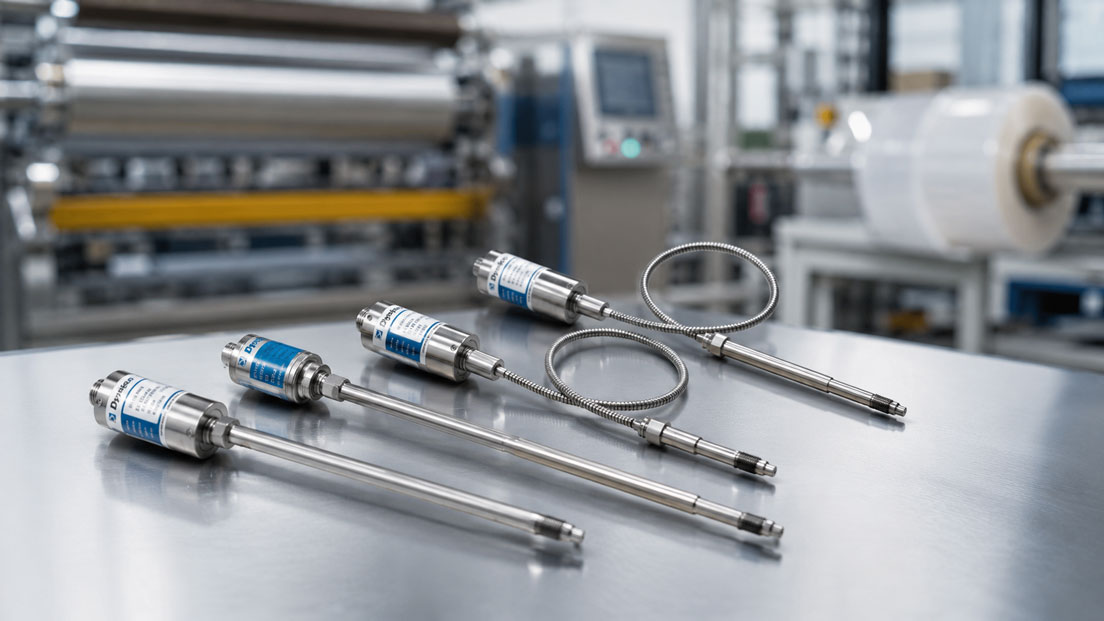
Melt pressure sensors measure pressure directly in the plastic melt. In extrusion lines, injection molding machines, food packaging, medical production or polymer processing, they are a central component of process monitoring. For a long time, mercury-filled melt pressure sensors were used in many applications because they could transmit high temperatures well. Today, however, many operators are specifically looking for mercury-free alternatives.
The reasons for this vary: stricter requirements for food safety, medical applications, packaging processes, internal sustainability targets, environmental aspects, occupational safety or the avoidance of critical filling media in the production process. At the same time, a replacement sensor must continue to work reliably at high temperatures, high pressure and under demanding installation conditions.
This article explains when mercury-free melt pressure sensors are useful, what role oil-based filling media play, when fill-fluid-free technology offers advantages and what should be considered when replacing sensors in existing systems. Particularly important is the right combination of process requirements, temperature range, diaphragm material, output signal and existing evaluation system.
Table of contents
- Basics: Why melt pressure sensors need a filling medium in the first place
- Why mercury-free sensors are becoming increasingly important
- Oil-filled melt pressure sensors: When they make sense
- Fill-fluid-free technology: When it can be the better solution
- Food, medical and packaging applications: Why the requirements are particularly strict here
- Signal types: Correctly classifying mV/V, 0–10 V and 4–20 mA
- Replacement in existing systems: What must be checked before switching
- Diaphragm, material and coating: Improving service life in the process
- Calibration, shunt calibration and signal testing
- Table: Oil filling or fill-fluid-free technology?
- Practical example: Replacing a mercury-containing sensor in a packaging line
- Table: Typical mistakes when replacing mercury-free melt pressure sensors
- Which measuring instruments / products are suitable?
- Conclusion: Mercury-free is not only a material question
- FAQ: Frequently asked questions about mercury-free melt pressure sensors
Basics: Why melt pressure sensors need a filling medium in the first place
Melt pressure sensors are screwed directly into the extruder, melt line or tool area. At the sensor tip there is a diaphragm that comes into contact with the plastic melt. The process pressure minimally deforms this diaphragm. This pressure information must be transmitted from the hot process area to the actual measuring cell.
In classic melt pressure sensors, this transmission often takes place via a filling medium in a capillary structure. The filling medium transfers the pressure from the process diaphragm to the measuring cell. Historically, mercury was often used for this because it enables good pressure transmission at high temperatures.
In sensitive applications, however, mercury is problematic. If a sensor is damaged, no critical filling medium must enter the process. Mercury-free sensors are therefore preferred in food, medical and packaging applications. Depending on the application, oil-based filling media, alternative filling media or fill-fluid-free sensor concepts may be considered.
Important: Mercury-free does not automatically mean that every sensor is suitable for every application. Temperature range, pressure range, diaphragm material, process connection, output signal, mechanical design and approval of the filling medium must always match the system.
Why mercury-free sensors are becoming increasingly important
Many operators want to remove mercury-containing melt pressure sensors from their systems or avoid using them in new systems altogether. In sensitive production areas, this is not only about technology, but also about risk minimization, product safety, environmental responsibility and internal plant standards.
Applications are particularly critical where possible sensor damage could affect the product, the system or the cleaning process. In food packaging, medical plastic parts, pharmaceutical-related processes or packaging with high hygiene requirements, acceptance of mercury-containing components is significantly lower than in many standard industrial processes.
Mercury-free solutions are also becoming more important in sustainability programs and RoHS-oriented procurement guidelines. Even if a sensor functions technically, it may no longer fit the operator’s internal material strategy.
When switching, however, “mercury-free” should not simply be used as the only selection criterion. The decisive question is which mercury-free technology suits the application: oil-filled, with an alternative filling medium or completely fill-fluid-free. Each solution has its own advantages, limits and design points.
Oil-filled melt pressure sensors: When they make sense
Oil-filled melt pressure sensors are a proven mercury-free alternative for applications in which an approved or suitable filling medium is required. Especially in food, medical and packaging applications, sensors with a corresponding oil filling can be a sensible solution if process conditions, temperature range and materials are suitable.
The advantage is that the measuring principle works in a similar way to classic filled sensors, but without mercury. This can make the switch easier in certain existing systems, provided that design, process connection, pressure range and output signal are compatible.
The question of the filling medium is particularly important in extrusion processes for food contact materials, medical tubing, films, packaging or sensitive polymers. The operator must ensure that the sensor suits the application, internal requirements and the requirements of the end product.
At the same time, technical limits also remain with oil filling. Temperature range, response behavior, mechanical load, diaphragm thickness and process conditions must be checked. An oil-based sensor is not automatically the best choice for every high-temperature or abrasive application.
Fill-fluid-free technology: When it can be the better solution
Fill-fluid-free melt pressure sensors do not use a transmission medium between the process diaphragm and the measuring system. This can be particularly interesting if the operator wants to avoid any risk from a filling medium or if sustainability, environmental aspects and robust diaphragm technology are the main priorities.
A fill-fluid-free sensor can be useful in applications where sensor damage should not lead to the release of filling fluid. At the same time, such designs can be made mechanically very robust, for example with stronger diaphragms or resistant coatings.
However, the selection must be made carefully. Fill-fluid-free technology must match the temperature, pressure range, process dynamics, medium and existing measuring chain. Especially in high-temperature applications, it should be checked whether the sensor achieves the required measuring accuracy, stability and response time in the specific process.
In practice, fill-fluid-free technology is often attractive when not only mercury is to be avoided, but no filling medium is desired at all. This can be a strong argument in sustainability programs, critical products or systems with high requirements for process safety.
Food, medical and packaging applications: Why the requirements are particularly strict here
In food, medical and packaging applications, pressure measurement in the plastic melt is particularly sensitive. The sensor is located directly in the process. If the diaphragm is damaged, it must be ensured that no problematic substances enter the product or the system.
For packaging films, medical plastic parts, tubing, seals or food contact materials, it is therefore not enough to check only the pressure range. Filling medium, wetted materials, cleanability, process connection and possible contamination risks must also be assessed.
Oil-filled mercury-free sensors can be a suitable solution here if the filling medium is appropriate for the application and the technical limits are observed. Fill-fluid-free sensors can also be interesting if the operator wants to fundamentally avoid the risk of a filling medium.
Clean documentation is important for operators. This includes sensor designation, version, filling medium or fill-fluid-free design, materials, pressure range, temperature range, output signal, calibration status and installation position. This documentation can be decisive especially during audits, complaints or product releases.
Signal types: Correctly classifying mV/V, 0–10 V and 4–20 mA
Melt pressure sensors can provide different output signals. Classic melt pressure sensors often work with an mV/V signal. This signal requires suitable evaluation electronics, a display or control instrument, or a measuring amplifier. This signal type is widely used especially in existing extrusion systems.
Other versions already provide an amplified signal, for example 0–10 V or 4–20 mA. A 4–20 mA signal is particularly robust for industrial signal transmission and can be connected well to PLCs, controllers or control systems. When replacing a sensor, it is therefore essential to check which signal the existing system expects.
If a 4–20 mA output is used, the current loop should be specifically checked during commissioning and troubleshooting. The UPS4E current loop calibrator / loop calibrator is suitable for this. With a loop calibrator, it can be checked whether the mA signal arrives correctly, whether the PLC is scaled correctly and whether 4 mA, 12 mA and 20 mA correspond to the expected pressure values.
With mV/V sensors, on the other hand, the focus is on suitable bridge excitation, shunt calibration and evaluation electronics. Here, a pure current loop calibrator is not the central test instrument. The measuring chain must match the sensor type: sensor, amplifier, display, controller and control system must be considered together.
Replacement in existing systems: What must be checked before switching
Replacing a mercury-containing melt pressure sensor with a mercury-free version should not be decided solely based on thread and pressure range. In existing systems, sensor, mounting bore, controller, display, cable, connector and calibration parameters are closely linked.
First, the existing sensor design should be checked. This includes process thread, diaphragm position, stem length, flexible capillary, connector, pressure range, temperature range, output signal and mechanical installation space. A sensor can be electrically suitable and still not fit cleanly into the existing measuring point mechanically.
The mounting bore is also critical. Deposits, damage, incorrect depth or a contaminated sealing surface can directly damage new sensors or cause measurement errors. Before installation, the mounting bore should be professionally checked and cleaned.
For systems with existing controllers, the scaling must also be adjusted. A different pressure range or a different output signal changes the evaluation. After replacement, therefore, not only the sensor should be installed, but the entire measuring chain should be checked.
Diaphragm, material and coating: Improving service life in the process
The diaphragm is the most sensitive area of a melt pressure sensor. It is in direct contact with the hot plastic melt and must withstand pressure, temperature, abrasion, chemical influences and mechanical stress. A mercury-free sensor is only a good solution if the diaphragm and materials also match the application.
In plastics processing, fillers, glass fibers, pigments, additives or aggressive polymer components can place stress on the diaphragm. An unsuitable diaphragm can wear, become damaged or lead to drift and measurement errors.
Robust materials such as Inconel and suitable coatings can improve service life. Especially with abrasive media or frequent cleaning processes, diaphragm quality should not be underestimated. The cheapest sensor is not always the most economical solution if it has to be replaced frequently due to wear.
Cleaning is also decisive. Melt pressure sensors must not be damaged with unsuitable tools or aggressive mechanical methods. A damaged diaphragm can render the sensor unusable and, in the worst case, create a process risk.
Calibration, shunt calibration and signal testing
Melt pressure sensors are often used in quality-relevant processes. The calibration status should therefore be known and should match internal test equipment monitoring. Especially after replacing a sensor, after process problems or in the case of unusual measured values, verification is useful.
Many classic mV/V melt pressure sensors have shunt calibration. This generates a defined electrical signal that can be used to check the evaluation electronics. It does not replace a full pressure calibration, but helps to quickly check the signal path and display.
For transmitters with a 4–20 mA output, the current loop can additionally be checked with a loop calibrator. The UPS4E is particularly helpful when mA values need to be measured, simulated or checked at PLC inputs. This makes it possible to distinguish whether a problem comes from the sensor, wiring, evaluation or scaling.
For a reliable assessment, the entire measuring chain should always be considered: process pressure, sensor, output signal, cable, evaluation instrument, controller, PLC and display. Only then can it be safely assessed whether the pressure measurement in the process is working correctly.
Table: Oil filling or fill-fluid-free technology?
| Criterion | Oil-filled mercury-free sensor | Fill-fluid-free sensor |
|---|---|---|
| Basic principle | Pressure transmission via suitable filling medium | Pressure measurement without filling medium |
| Typical application | Food, medical, packaging, sensitive extrusion processes | Sustainability programs, critical processes, applications where no filling medium is desired |
| Advantage | Proven measuring principle without mercury | No risk from escaping filling medium |
| To be checked | Suitability of the filling medium, temperature limits, process compatibility | Temperature range, response behavior, mechanical load capacity |
| Replacement in existing systems | Often possible if design and signal match | Design and compatibility must be checked particularly carefully |
| Signal types | Often mV/V, depending on the version also amplified signals | Depending on the device, mV/V, 0–10 V or 4–20 mA possible |
The table shows: There is not one single correct mercury-free solution for all applications. Oil-filled sensors can be particularly useful when an established alternative to mercury-containing sensors is required. Fill-fluid-free sensors are particularly interesting when no filling medium is desired in the sensor at all.
Practical example: Replacing a mercury-containing sensor in a packaging line
In a packaging line for plastic films, older mercury-containing melt pressure sensors are to be replaced. The system is running stably, but the operator wants to switch to mercury-free sensors for reasons of product safety and internal sustainability requirements.
First, the existing measuring point is recorded. Process thread, installation length, pressure range, temperature range, output signal, connector type and existing controller are documented. It is also checked whether the sensor bore is clean and whether deposits or mechanical damage are present.
Since the application is in the packaging sector, a mercury-free sensor with a suitable filling medium is evaluated. At the same time, it is assessed whether fill-fluid-free technology could offer long-term advantages. The decision does not depend only on the material question, but also on temperature, pressure, signal type, availability, replaceability and existing evaluation system.
After installation, the measuring chain is checked. With an mV/V sensor, the evaluation electronics are checked and shunt calibration is used. With a 4–20 mA transmitter, the current loop would additionally be checked with a loop calibrator so that PLC scaling and signal transmission can be reliably assessed.
Table: Typical mistakes when replacing mercury-free melt pressure sensors
| Mistake | Possible consequence | Better approach |
|---|---|---|
| Only pressure range compared | Sensor does not mechanically or electrically match the system | Check design, thread, length, signal and temperature range |
| Filling medium not assessed | Sensor does not meet internal requirements or process specifications | Clarify suitability for food, medical or packaging applications |
| Output signal overlooked | Controller or PLC displays incorrect values or no signal | Clearly distinguish between mV/V, 0–10 V and 4–20 mA |
| Sensor bore not cleaned | Diaphragm may be damaged during installation | Check, clean and professionally prepare the mounting bore |
| Scaling not adjusted | Pressure value is displayed incorrectly | Correctly parameterize measuring range and signal in controller or PLC |
| No measuring chain test after installation | Errors remain undetected until a production problem occurs | Check sensor, signal, display and control system together |
Which measuring instruments / products are suitable?
For sensitive applications in food, medical and packaging processes, mercury-free sensors / melt pressure sensors without mercury are particularly relevant. This category includes solutions for applications where mercury is not permitted or not desired.
A typical example is the PT418 / PT419 sensors with oil filling. They are designed for food, medical and packaging applications and offer a mercury-free alternative for extrusion processes where a suitable filling medium is required.
If no filling medium is desired at all, a fill-fluid-free sensor such as the Dynisco Vertex sensor can be interesting. This technology is particularly relevant when sustainability programs, robust diaphragm technology or the complete avoidance of filling media are the main priorities.
For applications with a 4–20 mA output, the UPS4E current loop calibrator / loop calibrator should also be planned. It supports testing of mA signals, PLC inputs and signal profiles and helps with commissioning, troubleshooting and regular checking of the 4–20 mA measuring chain.
In existing extrusion systems, it should always be checked before selection whether the new sensor matches the existing mounting bore, pressure range, temperature, evaluation system and process medium. Especially when switching from mercury-containing to mercury-free technology, a clean technical clarification is more important than a simple 1:1 comparison of the article designation.
Conclusion: Mercury-free is not only a material question
Mercury-free melt pressure sensors are particularly important for sensitive extrusion processes in food, medical and packaging applications. They help reduce risks from critical filling media and support operators who want to meet stricter requirements for product safety, environmental responsibility or sustainability.
However, the right solution depends on the application. Oil-filled sensors can be a proven mercury-free alternative if filling medium, temperature range and process requirements match. Fill-fluid-free sensors are particularly interesting if no filling medium is desired in the sensor at all.
When replacing sensors in existing systems, process connection, installation length, pressure range, temperature, output signal, diaphragm material, calibration and evaluation must be considered together. Only then does the wish for “mercury-free” become a technically reliable and long-term safe pressure measuring point.
FAQ: Frequently asked questions about mercury-free melt pressure sensors
What is a mercury-free melt pressure sensor?
A mercury-free melt pressure sensor measures the pressure in the plastic melt without using mercury as the pressure transmission medium. Depending on the design, an alternative filling medium or fill-fluid-free technology can be used.
Why were mercury-filled sensors used in the past?
Mercury was used for a long time because it enables good pressure transmission at high temperatures. In sensitive applications, however, it is increasingly undesirable due to environmental, safety and contamination aspects.
When is an oil-filled sensor useful?
An oil-filled sensor is useful when a mercury-free alternative is required and the filling medium is suitable for the application. This can be particularly relevant in food, medical and packaging processes.
When does fill-fluid-free technology make sense?
Fill-fluid-free technology makes sense when no filling medium is desired in the sensor at all. This can be important for critical products, sustainability programs or particularly high requirements for process safety.
Is a mercury-free sensor automatically suitable for food applications?
No. Mercury-free is only one criterion. In addition, filling medium, materials, temperature range, process connection, cleanability and internal requirements must match the food application.
What does FDA- or USDA-compliant oil filling mean?
It means that the filling medium used is designed for corresponding sensitive applications. Nevertheless, it must always be checked whether the specific sensor fits the respective system and product.
Can I simply replace a mercury-containing sensor 1:1?
Not without checking. Thread, installation length, pressure range, temperature range, output signal, connector, controller and sensor bore must be compared. Otherwise, the new sensor may not fit mechanically or electrically.
What is the difference between mV/V and 4–20 mA?
mV/V is an unamplified bridge signal and requires suitable evaluation electronics. 4–20 mA is an industrial current signal that can be connected directly to many PLCs, displays or control systems.
How do I test a melt pressure sensor with a 4–20 mA output?
The current loop can be checked with a loop calibrator. With the UPS4E, mA signals can be measured or simulated, allowing PLC scaling, wiring and signal processing to be checked.
How do I test an mV/V melt pressure sensor?
With mV/V sensors, bridge excitation, signal amplifier, display or controller must be checked. Many sensors support shunt calibration, which can be used to verify the electrical measuring chain.
Why is the sensor bore so important when replacing a sensor?
Deposits, incorrect depth or damaged sealing surfaces can damage the diaphragm of the new sensor or cause measurement errors. The bore should be professionally checked and cleaned before installation.
What role does the diaphragm play?
The diaphragm is in direct contact with the plastic melt and transmits the process pressure. It must match pressure, temperature, abrasion, medium and cleaning conditions.
What happens if the diaphragm is damaged?
A damaged diaphragm can lead to incorrect measured values, drift, signal failure or process risks. The sensor should then no longer be used as a reliable measuring point.
Is fill-fluid-free always better than oil-filled?
Not necessarily. Fill-fluid-free technology avoids filling media, but must match temperature, dynamics and mechanical load. Oil-filled sensors can be a very suitable solution in many sensitive applications.
Which solution is useful for packaging applications?
Mercury-free sensors with a suitable filling medium or fill-fluid-free sensors are often considered. Product requirements, process conditions, temperature, pressure, signal type and the operator’s internal approval are decisive.
Why should the entire measuring chain be checked after sensor replacement?
Because the sensor is only one part of the measuring point. Cables, connectors, controllers, PLC scaling, output signal and calibration parameters can also cause errors. A complete check prevents misinterpretations during operation.