


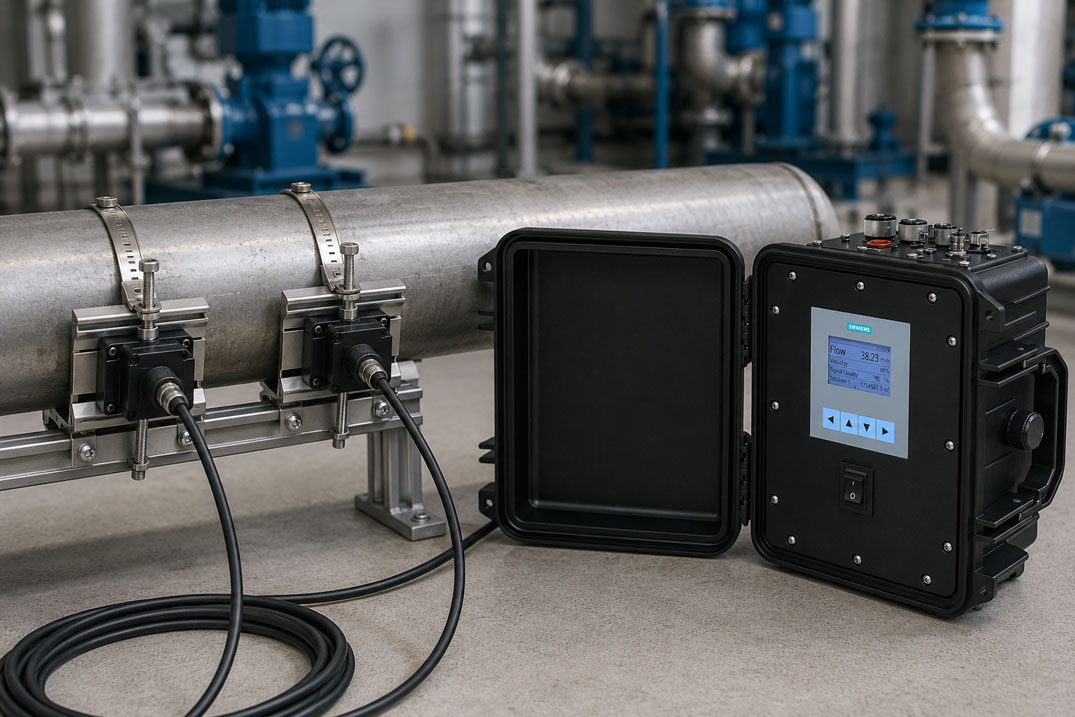
Ultrasonic flow meters are a very flexible solution for measuring the flow of liquids. Clamp-on devices in particular can be retrofitted without cutting into the pipe or interrupting the process. In practice, however, it often happens that an ultrasonic flow meter displays incorrect, fluctuating or implausible values.
The cause is often not the measuring device itself, but incorrect pipe data, an unfavorable sensor position, poor coupling, inlet runs that are too short, air bubbles, deposits or a pipe that is not completely filled. Especially with clamp-on ultrasonic flow meters, correct parameterization is crucial because the volume flow is calculated from pipe geometry, sound path and flow velocity.
This article explains why ultrasonic flow meters can display incorrect values, which parameters are particularly critical and how typical errors in pipe data, sensor position, inlet run and installation can be avoided.
You can find an overview of suitable devices in our category
Ultrasonic flow meters.
For stationary clamp-on measurements, the
SITRANS FS220 clamp-on ultrasonic flow meter
is particularly relevant. For temporary test measurements, troubleshooting and check metering, the
SITRANS FS290 ultrasonic flow measurement system
can be a suitable solution.
Table of contents
- Why does an ultrasonic flow meter display incorrect values?
- Pipe data: Why diameter, wall thickness and material are decisive
- Internal pipe diameter: small error, major measurement error
- Consider lining, deposits and corrosion
- Check medium, temperature and sound velocity
- Inlet run and outlet run: Why the flow profile is important
- Select the correct sensor position and pipe installation
- Coupling: surface, coupling gel and contact pressure
- Air bubbles, partial filling and solids as error sources
- Zero point check and plausibility check
- Typical fault patterns and causes
- Which ultrasonic flow meters are suitable?
- Practical examples from industry, water, HVAC and service
- Troubleshooting checklist
- Conclusion
- FAQ: Frequently asked questions about incorrect measured values with ultrasonic flow meters
Why does an ultrasonic flow meter display incorrect values?
An ultrasonic flow meter does not simply measure the volume flow directly. In many devices, the flow velocity is determined first. The volume flow is then calculated from flow velocity and pipe cross-section. This is why incorrect pipe data directly affects the displayed flow rate.
With clamp-on systems, the sensors are mounted externally on the pipe. The ultrasound must pass through the pipe wall, through the medium and back to the sensor. Poor coupling, incorrect sensor spacing, incorrect pipe parameters or unfavorable flow conditions can influence the signal.
| Error source | Effect | Typical result |
|---|---|---|
| Incorrect pipe diameter | Pipe cross-section is calculated incorrectly. | Volume flow is permanently too high or too low. |
| Incorrect wall thickness | Sound path and internal diameter do not match. | Measurement deviation or weak signal. |
| Unfavorable sensor position | Flow profile is not representative. | Measured value fluctuates or is not plausible. |
| Inlet run too short | Turbulence influences the measurement. | Unsteady or systematically incorrect measured values. |
| Poor coupling | Ultrasonic signal is dampened. | Signal loss, unstable display or no measurement. |
| Air bubbles / partial filling | Ultrasonic signal is disturbed. | Jumping values or signal interruptions. |
Troubleshooting should therefore always be carried out systematically: first check pipe data and parameterization, then assess measuring point, sensor position, coupling, medium and operating conditions.
Pipe data: Why diameter, wall thickness and material are decisive
Correct pipe data is the basis for every reliable ultrasonic flow measurement. The measuring device needs this information to calculate the sensor spacing, sound path and pipe cross-section. This is particularly important for clamp-on devices, as the sensors are not located directly in the medium.
In practice, pipe data is often taken from old drawings, parts lists or nominal size information. This can be problematic if the actual pipe differs, has a different wall thickness, is lined or has been modified over the years.
| Pipe parameter | Why important? | Typical practical error |
|---|---|---|
| Outside diameter | Basis for pipe geometry and sensor position. | Nominal size DN is confused with the actual outside diameter. |
| Wall thickness | Determines the internal pipe diameter and sound path. | Wall thickness is estimated or not measured. |
| Pipe material | Influences sound velocity and damping in the pipe. | Material is selected incorrectly or not reliably identified. |
| Lining | Changes the internal diameter and acoustic properties. | Rubber, plastic or cement lining is not considered. |
| Pipe condition | Deposits, corrosion or build-up change signal and cross-section. | Ageing condition of the pipeline is ignored. |
| Temperature | Influences pipe, medium and coupling material. | Temperature range is not considered when selecting sensor and gel. |
A good measurement therefore does not begin with switching on the device, but with the careful recording of the actual pipe data on site.
Internal pipe diameter: small error, major measurement error
The internal pipe diameter is particularly important because the volume flow is calculated from the flow velocity and the pipe cross-section. Even small errors in the internal diameter can have a significant effect on the calculated volume flow.
The internal diameter is calculated from the outside diameter minus the wall thickness and, if applicable, minus a lining. If only the nominal size is used, for example, the actual cross-section can differ significantly.
| Information | Meaning | Risk if entered incorrectly |
|---|---|---|
| Nominal size DN | Standard designation of pipe size. | Does not automatically correspond to the actual internal diameter. |
| Outside diameter | External pipe dimension. | If entered incorrectly, sensor position is calculated incorrectly. |
| Wall thickness | Material thickness of the pipe wall. | Internal diameter and sound path are calculated incorrectly. |
| Lining | Additional internal layer in the pipe. | Effective flow cross-section is overestimated. |
| Deposits | Build-up on the inside pipe wall. | Effective cross-section may be smaller than assumed. |
In the case of implausible measured values, it should therefore always be checked whether the internal diameter entered in the device really matches the actual pipeline.
Consider lining, deposits and corrosion
Many pipelines do not consist of a simple metal wall only. They may be internally lined, for example with plastic, rubber, cement or other protective layers. Deposits, corrosion or product build-up can also influence the effective internal pipe diameter and ultrasonic transmission.
If such factors are not taken into account, the ultrasonic flow meter may receive a signal but still calculate an incorrect volume flow. This is particularly critical in older plants, wastewater lines, cooling circuits, process liquids or media with a tendency to form deposits.
| Influence | Possible effect | Practical check |
|---|---|---|
| Rubber lining | Changes sound path and internal diameter. | Consider lining thickness and material in the device. |
| Plastic lining | Can significantly change acoustic properties. | Record pipe and liner material correctly. |
| Cement lining | Can dampen the signal and change the cross-section. | Check signal quality and internal dimension. |
| Deposits | Reduce the effective cross-section. | Assess pipe condition and check maintenance history. |
| Corrosion | Changes wall thickness and surface. | Measure wall thickness and deliberately select measuring point. |
For difficult pipelines, it may be useful to check different measuring points or perform a temporary comparative measurement with a mobile device.
Check medium, temperature and sound velocity
Ultrasonic flow meters require a medium through which the ultrasonic signal can be transmitted reliably. Sound velocity in the medium, temperature, viscosity, gas content, solids and concentration can influence the measurement.
With clean liquids such as water or cooling water, measurement is usually easily possible. With heavily loaded media, air bubbles, solids, suspensions or changing concentrations, it must be checked more carefully whether the measuring principle used is suitable for the application.
| Medium property | Influence on measurement | Typical error |
|---|---|---|
| Temperature | Influences sound velocity and material behavior. | Temperature is not entered correctly or fluctuates strongly. |
| Viscosity | Can influence flow profile and signal behavior. | Medium is treated like water although it is significantly more viscous. |
| Air bubbles | Disturb or weaken the ultrasonic signal. | Measuring point is selected in an area with gas content. |
| Solids | Can scatter the signal or influence the measuring principle. | Transit-time measurement is expected with an unsuitable medium. |
| Concentration | Changes can alter sound velocity. | Medium data is assumed to be constant. |
| Multiphase flow | Gas-liquid mixtures are often critical. | Measuring device displays jumping or unstable values. |
If the medium fluctuates strongly or contains air bubbles, the measuring point should be selected so that conditions are as stable as possible. If necessary, another measuring principle or another measuring point must be checked.
Inlet run and outlet run: Why the flow profile is important
Ultrasonic flow meters require a flow profile that is as representative as possible. Directly downstream of pumps, bends, valves, tees, reductions or throttling points, the flow can be highly turbulent, asymmetrical or pulsating. In this case, the sensor does not measure the representative average value of the pipe cross-section.
Sufficient inlet and outlet runs help to stabilize the flow. If these runs are not available, the measurement may become less accurate or fluctuate more strongly.
| Disturbance point | Possible influence | Practical recommendation |
|---|---|---|
| Pump | Pulsation, swirl and unsteady flow. | Select measuring point at a distance from the pump. |
| Pipe bend | Asymmetrical flow profile. | Use a straight pipe section wherever possible. |
| Valve / throttle | Strong turbulence and pressure loss. | Do not install sensor directly downstream of fittings. |
| Tee | Mixing and uneven flow. | Select measuring point after a calming section. |
| Reduction / expansion | Acceleration or flow separation. | Maintain sufficient distance from the change in shape. |
| Partially filled line | No representative cross-section. | Select measuring point in a fully filled pipe section. |
If no ideal measuring section is available, the measuring point should be selected deliberately and the result checked for plausibility. A mobile comparative measurement can help to find the best position.
Select the correct sensor position and pipe installation
In addition to the inlet run, the sensor position around the pipe circumference is also important. With horizontal pipes, installation directly on top is often unfavorable if air bubbles can collect there. Installation directly at the bottom can be problematic if dirt or deposits collect there.
A side-mounted installation is often more favorable because air accumulations and sediments have less influence there. However, the specific position depends on the medium, pipe orientation and manufacturer specifications.
| Installation position | Possible advantage | Possible risk |
|---|---|---|
| On top of the pipe | Mechanically easy to access. | Air bubbles can disturb the signal. |
| At the bottom of the pipe | Good wetting in some applications. | Deposits or dirt can influence the signal. |
| At the side of the pipe | Often a good compromise for horizontal lines. | Check accessibility and sensor fastening. |
| Near pipe bend | Sometimes selected due to space limitations. | Flow profile can be strongly distorted. |
| In vertical line | Full pipe condition is often easier to ensure. | Check flow direction and installation conditions. |
The sensor spacing must also exactly match the calculated sound path. Installation “by eye” often leads to poor signal quality or incorrect measured values.
Coupling: surface, coupling gel and contact pressure
With clamp-on sensors, the ultrasound must be transmitted from the sensor into the pipe wall. There must be no air gap between sensor and pipe, as air strongly dampens ultrasound. For this reason, coupling media, clean surfaces and stable contact pressure are required.
Dirt, rust, thick paint layers, uneven surfaces, loose brackets or unsuitable coupling gel can significantly worsen signal quality. In high-temperature applications, it must also be checked whether sensors, mounting accessories and coupling medium are suitable for the temperature.
| Installation point | Why important? | Typical error |
|---|---|---|
| Clean pipe surface | Dirt, rust and paint dampen the signal. | Sensor is mounted directly on an unsuitable surface. |
| Use coupling gel | Prevents air gap between sensor and pipe. | Too little, old or unsuitable gel is used. |
| Secure contact pressure | Sensor must rest stably on the pipe. | Belt, rail or bracket is too loose. |
| Maintain sensor spacing | Sound path must match the pipe geometry. | Sensors are not positioned exactly. |
| Check temperature range | Sensor and coupling medium must be temperature-suitable. | Standard sensor or standard gel is used at too high a temperature. |
In the case of unstable measured values, not only the parameterization but also the mechanical sensor installation should therefore be checked.
Air bubbles, partial filling and solids as error sources
An ultrasonic flow meter requires suitable sound transmission in the medium. Air bubbles, gas content, foaming, partial filling or high solids content can disturb the signal. The result is fluctuating values, signal interruptions or implausible measurements.
Measuring points directly downstream of pumps, at high points, in lines with gas separation or in areas where the line is not completely filled are particularly critical.
| Influence | Possible result | Practical solution |
|---|---|---|
| Air bubbles | Signal is scattered or interrupted. | Select measuring point in an area with fewer bubbles. |
| Partial filling | Pipe cross-section is not completely filled by flow. | Ensure fully filled pipeline. |
| Foam | Very poor sound transmission possible. | Check process conditions and measuring principle. |
| Solids | Signal can be scattered or dampened. | Assess medium and select suitable measuring principle. |
| Deposits in the pipe | Cross-section and signal path change. | Check pipe condition and relocate measuring point. |
If signal quality fluctuates strongly, it should always be checked whether the pipe is actually fully filled and whether gas content or solids are present in the medium.
Zero point check and plausibility check
A zero point check can help to assess the measurement. However, it must only be carried out when there is actually no flow. If the zero point is set while residual flow is present, the measurement can be systematically distorted during operation.
In addition, ultrasonic measured values should always be checked for plausibility in the plant context. Pump curves, existing meters, level changes, energy balances, consumption values or comparative measurements can be used for this purpose.
| Check | Why important? | Note |
|---|---|---|
| Zero point at standstill | Detects offset or residual display. | Only carry out when flow standstill is ensured. |
| Comparison with plant values | Helps with plausibility checking. | Consider pump performance, valve position and operating condition. |
| Check signal quality | Shows whether sensor coupling and measuring point are suitable. | If signal is weak, check installation and pipe data. |
| Compare several measuring points | Helps identify unfavorable positions. | Particularly useful with mobile devices. |
| Document measured values | Makes later assessment easier. | Record pipe data, sensor position and operating condition as well. |
Typical fault patterns and causes
The following table shows typical fault patterns with ultrasonic flow meters and possible causes. It can serve as an initial guide for troubleshooting.
| Fault pattern | Possible cause | Practical check |
|---|---|---|
| Measured value permanently too high | Incorrect internal pipe diameter, incorrect parameterization or incorrect sensor spacing. | Check pipe data, wall thickness, lining and sensor spacing. |
| Measured value permanently too low | Incorrect cross-section, deposits not considered or unfavorable measuring point. | Compare pipe condition and configured parameters. |
| Measured value fluctuates strongly | Air bubbles, turbulence, partial filling or poor coupling. | Check measuring point, medium and signal quality. |
| No signal | Wrong sensor, wrong pipe material, poor coupling or unsuitable measuring point. | Check sensor selection, surface, coupling gel and pipe data. |
| Signal temporarily drops out | Air content, changing process conditions or loose sensor fastening. | Observe medium condition, fastening and operating states. |
| Measured value does not match plant meter | Different measuring locations, incorrect pipe data or unsteady flow profile. | Document comparison conditions and installation locations. |
| Zero point is not stable | Residual flow, incorrectly set zero point or unstable signal quality. | Ensure standstill and repeat zero point check. |
Which ultrasonic flow meters are suitable?
The suitable device selection depends on whether stationary measurement, mobile test measurement, temporary troubleshooting, retrofitting or permanent connection to PLC, control system or energy management is required.
| Product | Especially relevant for | Note |
|---|---|---|
| SITRANS FS220 clamp-on ultrasonic flow meter | Stationary clamp-on flow measurement in liquid processes | Suitable when permanently installed, non-invasive flow monitoring is required. |
| SITRANS FS290 ultrasonic flow measurement system | Temporary measurements, check metering, troubleshooting and test measurements | Interesting when measuring points need to be evaluated, existing meters checked or flows measured flexibly. |
| Portaflow C | Portable flow measurement externally on pipelines | Useful for service work, mobile measurements and short-term plant tests. |
| Time Delta C – ultrasonic flow meter | Stationary ultrasonic measurement with non-invasive setup | Suitable for applications where low-maintenance measurement without moving parts is required. |
| WIKA Type FLC-CS4 clamp-on ultrasonic flow meter | Non-invasive process liquid measurement with two independent streams | Relevant when two streams need to be measured, data logged or process liquids monitored non-invasively. |
You can find a complete overview in the category
Ultrasonic flow meters.
Practical examples from industry, water, HVAC and service
Example 1: Incorrect wall thickness in a cooling water line
A clamp-on ultrasonic flow meter displays significantly higher values than expected. During the check, it turns out that the wall thickness of the pipeline was taken from old documents, but the actual wall thickness differs. After correcting the pipe data, the measured value becomes more plausible.
Example 2: Sensor installed directly downstream of a pump
The measured values fluctuate strongly. The sensors were installed directly downstream of a pump due to lack of space. Due to pulsation and turbulence, the flow profile is not stable there. A new measuring point with a better inlet run improves measurement stability.
Example 3: Air bubbles in the heating or cooling circuit
The ultrasonic flow meter temporarily loses the signal. The cause is air bubbles that collect at the measuring point. A side-mounted sensor position or another measuring point with better venting can improve signal quality.
Example 4: Comparative measurement with mobile device
An existing flow meter displays implausible values. With a mobile device such as the
SITRANS FS290
or the
Portaflow C
an independent comparative measurement is carried out. Pipe data, sensor position and operating condition are documented so that the comparison can be evaluated meaningfully.
Example 5: Measurement on an old pipeline with deposits
In an older process line, the actual internal diameter is smaller than assumed due to deposits. The ultrasonic flow meter calculates the volume flow based on a cross-section that is too large. As a result, the measurement appears permanently implausible. In such cases, pipe condition and measuring point must be assessed more carefully.
Troubleshooting checklist
This checklist can be used to systematically check incorrect or implausible measured values with ultrasonic flow meters.
| Check question | Why important? | Practical recommendation |
|---|---|---|
| Are outside diameter and wall thickness correct? | They determine internal pipe diameter and sensor spacing. | Measure on site and do not simply take values from drawings. |
| Has a lining been considered? | Linings change internal diameter and sound path. | Enter liner material and liner thickness in the device. |
| Is the pipe fully filled? | Partial filling leads to unreliable measurement. | Select measuring point in a fully filled pipe section. |
| Is the medium suitable for ultrasound? | Air bubbles, solids or foam can disturb the signal. | Check medium condition and signal quality. |
| Is there sufficient inlet run? | Turbulence causes measurement deviations. | Check distance to pumps, bends, valves and tees. |
| Are the sensors positioned correctly? | Sensor spacing and sound path must be correct. | Observe mounting aid, device data and manufacturer specifications. |
| Is the coupling sufficient? | Poor coupling leads to weak signal. | Clean surface, renew coupling gel, check contact pressure. |
| Was the zero point checked correctly? | Incorrectly set zero point distorts all measured values. | Check zero point only when standstill is ensured. |
| Is the measured value plausible in the plant context? | A single value is often not sufficient for evaluation. | Compare pump data, existing meters or energy balance. |
Conclusion: Incorrect values are often caused by parameterization, measuring point or installation
If an ultrasonic flow meter displays incorrect values, the cause is often not the device itself. Especially with clamp-on systems, accurate pipe data, correct sensor spacing, suitable measuring point, good coupling, sufficient inlet run and a suitable medium are decisive.
The most important check points are outside diameter, wall thickness, pipe material, lining, pipe condition, medium, temperature, air bubbles, partial filling, inlet run and sensor position. If these factors are checked carefully, many measurement errors can be avoided or quickly narrowed down.
For stationary clamp-on measurements, the
SITRANS FS220
can be a suitable solution. For temporary measurements, troubleshooting and comparative measurements, the
SITRANS FS290
or the
Portaflow C
are particularly interesting. You can find a complete preselection in our category
Ultrasonic flow meters.
FAQ: Frequently asked questions about incorrect measured values with ultrasonic flow meters
Why does my ultrasonic flow meter display incorrect values?
Common causes are incorrect pipe data, incorrect wall thickness, lining not taken into account, poor sensor coupling, unfavorable sensor position, inlet run that is too short, air bubbles or a pipe that is not completely filled.
Why is the pipe diameter so important?
The volume flow is calculated from flow velocity and pipe cross-section. If the internal pipe diameter is entered incorrectly, the calculated volume flow will also be incorrect.
Why does the wall thickness need to be known?
The wall thickness influences the internal pipe diameter and the sound path. Incorrect wall thickness can lead to incorrect sensor spacing, poor signal quality and incorrect measured values.
What happens if the inlet run is too short?
If the inlet run is too short, the flow profile can be disturbed by pumps, bends, valves or tees. As a result, the measured value may fluctuate or deviate systematically.
Why do air bubbles disturb ultrasonic measurement?
Air bubbles scatter or dampen the ultrasonic signal. This can reduce signal quality, cause the measured value to jump or cause the device to temporarily lose the signal.
Can an ultrasonic flow meter measure in partially filled pipes?
Many clamp-on ultrasonic flow meters require a fully filled pipeline. In the case of partial filling, the pipe cross-section is not completely filled by the flow and the measurement becomes unreliable.
How can I recognize poor coupling?
Typical indications are weak signal quality, unstable measured values or temporary signal interruptions. Causes can include dirt, rust, paint, missing coupling gel or insufficient contact pressure.
When should the zero point be checked?
The zero point should only be checked when flow standstill is ensured. If the zero point is set while residual flow is present, the measurement can be distorted during operation.
When is a mobile ultrasonic flow meter useful?
A mobile device is useful when existing measured values need to be checked, different measuring points compared or implausible flow values temporarily investigated.
Which ultrasonic flow meters are suitable for troubleshooting and comparative measurement?
For stationary clamp-on measurements, for example, the
SITRANS FS220
is suitable. For temporary measurements, check metering and troubleshooting, the
SITRANS FS290
or the
Portaflow C
may be suitable. You can find an overview in the category
Ultrasonic flow meters.