


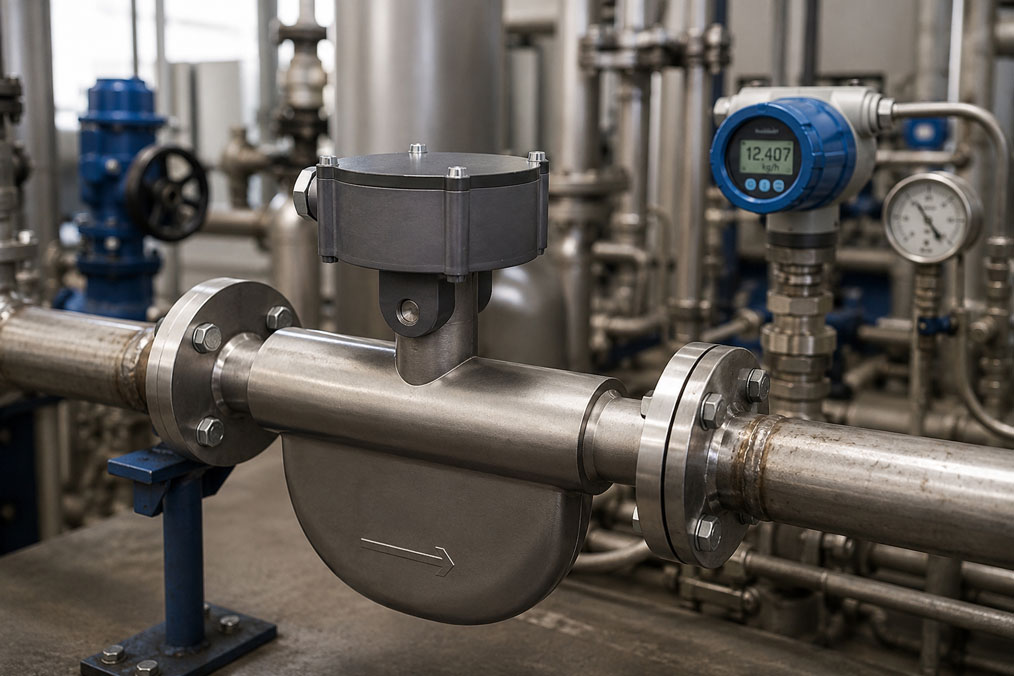
When selecting a flow meter for liquids, many operators, plant manufacturers and maintenance teams face the same question: should a magnetic-inductive flow meter, known as MID, be used, or is a Coriolis flow meter the better solution? Both measuring principles are established in industry, both can work very reliably, but they do not measure the same thing and they place different requirements on the medium, installation, accuracy and budget.
A MID measures the volumetric flow of conductive liquids. It is particularly interesting for water, wastewater, chemical liquids, conductive process media and many applications with larger pipe sizes. A Coriolis flow meter, on the other hand, directly measures mass flow and can additionally measure density and often temperature. This is especially valuable for dosing tasks, recipes, billing, high-accuracy measurements and media whose density or composition can fluctuate.
This article explains the key differences between MID and Coriolis, shows typical selection criteria and helps classify the suitable measuring principle for liquids. The focus is on conductivity, volumetric flow, mass flow, accuracy, pressure loss, hygiene, dosing, process requirements, costs and typical practical examples.
Table of contents
- Basics: MID and Coriolis measure different quantities
- MID: Magnetic-inductive flow measurement for conductive liquids
- Coriolis: Mass flow, density and high accuracy
- Conductivity of the medium: The most important criterion for MID
- Volumetric flow or mass flow: Which quantity is really needed?
- Accuracy, repeatability and process stability
- Installation, pressure loss and pipe conditions
- Hygiene, cleaning and demanding process media
- Costs, benefits and typical decision situations
- Signal, evaluation and testing the measurement chain
- Practical example: Dosing a liquid with fluctuating density
- Which measuring instruments / products are suitable?
- Conclusion: MID or Coriolis depends on the measuring task and medium
- FAQ: Frequently asked questions about Coriolis or MID
Basics: MID and Coriolis measure different quantities
The most important difference between MID and Coriolis lies in the measured variable. A magnetic-inductive flow meter measures the volumetric flow of an electrically conductive liquid. The result is typically output in l/h, m³/h or a comparable volume unit. For many applications, this is exactly the required value, for example in water distribution, cooling circuits, wastewater, process lines or simple quantity measurement.
A Coriolis flow meter, however, directly measures mass flow. The result is output, for example, in kg/h, t/h or g/min. Depending on the version, a Coriolis device can also measure density and temperature. This makes it particularly interesting when not only the volume, but the actual mass of a medium is important. This is relevant, for example, for recipes, chemical dosing, product balancing, filling, test benches or value-based billing.
The decision should therefore not be made first based on price or habit, but based on the measuring task. Anyone who only needs to know how much conductive liquid flows through a pipe per hour is often very well served with a MID. Anyone who needs to dose mass with high accuracy, detect density changes or capture several process variables at the same time should consider Coriolis.
| Criterion | MID | Coriolis |
|---|---|---|
| Directly measured quantity | Volumetric flow | Mass flow |
| Additional measured variables | Depending on the device, mainly flow and quantity | Often additionally density and temperature |
| Medium requirement | Liquid must be electrically conductive | No electrical conductivity required |
| Typical strength | Robust volumetric flow measurement of conductive liquids | High-accuracy mass flow measurement and density information |
| Typical application | Water, wastewater, conductive process media, large pipes | Dosing, recipes, filling, chemicals, hygiene, test benches |
MID: Magnetic-inductive flow measurement for conductive liquids
A MID works according to the magnetic-inductive measuring principle. Put simply, a magnetic field is generated in a measuring tube. When an electrically conductive liquid moves through this magnetic field, a measurable voltage is generated that is proportional to the flow velocity. The volumetric flow is calculated from flow velocity and pipe cross-section.
The major advantage of a MID is that no moving parts are required in the measuring tube. This makes the measuring principle particularly robust for many industrial liquid applications. In addition, a MID usually causes only very low additional pressure loss, since the measuring tube can be designed without a turbine wheel, orifice plate or restriction.
MID devices are frequently used for water, wastewater, slurries, cooling water, process water, conductive chemicals, food products or other aqueous liquids. Especially with larger nominal diameters and continuous process flows, a MID is often economically and technically very attractive.
The clear limitation of the measuring principle, however, is electrical conductivity. Non-conductive liquids such as many oils, hydrocarbons, solvents or demineralized media with very low conductivity cannot be measured with a MID, or only to a limited extent. In addition, the pipe must be completely filled, as gas bubbles or partially filled pipes can influence the measurement.
Coriolis: Mass flow, density and high accuracy
A Coriolis flow meter directly measures mass flow. The medium flows through one or more vibrating measuring tubes. The mass flow creates a measurable deformation or phase shift from which the mass flow is calculated. In addition, the density of the medium can often be determined from the vibration behavior.
The major advantage is that the measured value does not first have to be calculated from volumetric flow and density. When mass is decisive, Coriolis directly provides the appropriate value. This is particularly important for media with fluctuating density, changing temperature, concentration changes or processes in which an exact product quantity must be dosed.
Coriolis devices are therefore often found in chemicals, pharmaceuticals, food production, dosing technology, filling systems, test benches, additive dosing and high-value process applications. They are also suitable for many non-conductive liquids, provided that medium, pressure, temperature, viscosity, gas content and process conditions match the device version.
Compared with MID, a Coriolis flow meter is often more expensive and, depending on size, measuring tube and application, can cause higher pressure loss. With very large pipe sizes, Coriolis can become economically or structurally demanding. In return, the measuring principle often offers very high accuracy, additional process information and a very direct statement about the actual transported mass.
Conductivity of the medium: The most important criterion for MID
The electrical conductivity of the medium is one of the first selection criteria. If the liquid is not sufficiently conductive, a MID is usually ruled out. This applies to many oils, fuels, organic solvents, some demineralized liquids and certain special media. In such cases, another measuring principle must be checked, often Coriolis, ultrasonic, turbine, positive displacement or another suitable method.
If, on the other hand, the medium is sufficiently conductive, MID is often a very good solution. This applies particularly to water-based media, many chemicals, wastewater, slurries or conductive food products. However, it is important that conductivity is sufficient not only under laboratory conditions, but also in the real process state. Temperature, concentration, mixing and product changes can alter conductivity.
Another point is coating formation on the electrodes. With strongly adhering media, grease, coatings or deposits, the measuring signal can be impaired. Gas bubbles, foam or incompletely filled pipes can also lead to implausible measured values. The MID is robust, but not independent of medium and installation situation.
| Medium / situation | MID suitable? | Coriolis suitable? | Note |
|---|---|---|---|
| Drinking water, process water, wastewater | Very often suitable | Technically possible, often economical only with special accuracy requirements | MID is often the obvious solution here. |
| Conductive chemicals | Often suitable | Well suited when mass, density or high accuracy is required | Check materials, liner and electrode material. |
| Oils and non-conductive liquids | Usually not suitable | Often suitable, depending on viscosity and process data | Conductivity is usually the exclusion criterion for MID here. |
| Media with fluctuating density | Volumetric flow measurement possible, mass only calculated | Very interesting because mass flow is measured directly | Coriolis provides additional process information. |
| Large pipe sizes with conductive medium | Very often economically and technically sensible | Technically possible, but often more cost-intensive | MID often has advantages with large pipes. |
Volumetric flow or mass flow: Which quantity is really needed?
Many selection errors occur because it is not clearly defined which quantity is actually needed. A volumetric flow answers the question of how much spatial volume per time flows through the pipe. A mass flow answers the question of what amount of substance or mass per time is being transported. With liquids of stable density, the difference may seem small in everyday practice. With changing media, temperature changes or recipes, however, it can be decisive.
A MID is ideal when the volumetric flow is directly required. Typical examples are water supply, cooling circuits, wastewater treatment, rinsing processes or simple process quantities. If the density is constant and the volume quantity is sufficient as a process variable, MID provides a very sensible and economical solution.
Coriolis is stronger when mass matters. When dosing chemicals, additives, concentrates, food products or pharmaceutical liquids, it is often not the volume but the actual mass that is decisive. A recipe can otherwise fluctuate if density or temperature changes. Coriolis reduces this uncertainty because the mass flow is measured directly.
Mass flow can also be relevant for billing or product balancing. If the value of the medium is defined by mass or density changes are expected, Coriolis often provides the more reliable basis. If, on the other hand, water is distributed in large quantities, the additional benefit of a mass flow meter is often lower.
Accuracy, repeatability and process stability
Accuracy is an important point, but should not be considered in isolation. A very accurate flow meter only delivers good results when medium, installation, operating conditions and evaluation match. An incorrectly installed or incorrectly parameterized device can deliver poor values despite a high-quality measuring principle.
Coriolis often offers advantages when very high accuracy, good repeatability and additional density information are required. This is particularly interesting for dosing, recipes, test benches, filling processes or quality processes. Direct mass flow measurement reduces conversion errors that can occur with volumetric measurement and fluctuating density.
MID, on the other hand, offers very good and robust volumetric flow measurement if the medium is conductive and the installation conditions are suitable. For many water and process applications, the achievable accuracy is completely sufficient. Especially with larger flow rates and stable process conditions, MID can offer a very good ratio of measuring performance, robustness and cost.
Repeatability is also important. In some processes, it is more important that a measuring device always reacts in the same way than that the absolute measured value is extremely accurate. In dosing and batch processes, however, both can be decisive: repeatability and absolute accuracy. The measuring task should therefore be described precisely before selecting the device.
| Requirement | More likely MID | More likely Coriolis |
|---|---|---|
| Conductive medium and volumetric flow is sufficient | Very suitable | Possible, but often not necessary |
| Mass flow is required directly | Only via calculation with density | Very suitable |
| Density changes should be detected | Not the typical strength | Very suitable |
| Large pipe with water or wastewater | Very suitable | Usually more cost-intensive |
| High-accuracy dosing of small to medium quantities | Possible depending on medium | Often the better solution |
Installation, pressure loss and pipe conditions
Installation is a major factor in whether a flow meter works reliably. MID devices usually require a completely filled pipe and a sufficiently stable flow profile. Inlet and outlet runs may be required depending on design and manufacturer specifications. Air bubbles, partially filled pipes, heavy deposits or unfavorable grounding can impair the measurement.
Coriolis flow meters are often less critical with regard to flow profile dependency than many other measuring principles because mass flow is detected via the vibration behavior of the measuring tubes. Nevertheless, installation, filling, vibrations, mechanical stresses, gas content and process conditions must be observed. A Coriolis device should be installed free of mechanical stress, and the pipe must mechanically accommodate the measuring device properly.
There are often differences in pressure loss. A MID can cause very low pressure loss with a suitable design. Coriolis devices have measuring tubes whose geometry and nominal size must match the measuring range. Depending on version, medium and flow, pressure loss can be higher. With high-viscosity media or energy-sensitive processes, this point should be evaluated early.
Nominal size also plays a role. For large pipes with conductive medium, MID is often economically and structurally advantageous. For small to medium flow rates, dosing or high-value media, Coriolis can be useful despite higher acquisition costs because the measurement information is more accurate and more comprehensive.
Hygiene, cleaning and demanding process media
In food, beverage, pharmaceutical and biotechnology processes, hygiene, cleanability and process safety play a central role. Both MID and Coriolis can be available in hygienic versions, provided that process connection, materials, surfaces, seals and cleaning concept match the application.
A hygienic MID can be very well suited for conductive food products, beverages, CIP media or process water. Important factors include a suitable liner, appropriate electrode materials, hygienic connections and a measuring section that remains completely filled. With products that form deposits, it must be checked whether electrodes or measuring tube remain clean in the long term.
Coriolis is particularly interesting in hygienic applications when mass flow, density or concentration indications are required. In recipes, filling, high-accuracy dosing or product changes, the additional density information can offer significant added value. Non-conductive or weakly conductive hygienic media can also be a reason to choose Coriolis instead of MID.
With demanding media such as viscous liquids, suspensions, media with gas content or abrasive components, closer examination is required. No measuring principle is automatically suitable for every difficult medium. Medium data, particle size, viscosity, temperature, cleaning procedure, required accuracy and permissible pressure loss are decisive.
Costs, benefits and typical decision situations
The cost question is decisive in many projects. For conductive liquids and larger nominal diameters, a MID is often economically very attractive. It offers robust volumetric flow measurement, low pressure loss and a wide range of designs. If the measuring task is clearly designed for volumetric flow, MID can be the best technical and economical solution.
Coriolis is usually more cost-intensive, but offers more measurement information. Mass flow, density and temperature can be available in one device. This can make a Coriolis device economically sensible even though the purchase price is higher. This applies especially when product losses can be reduced, dosing accuracy improved, recipes stabilized or additional density measurements replaced.
A good decision therefore does not only look at the device price. Process value, measurement uncertainty, rejects, product quality, energy consumption, maintenance, installation effort, calibration concept and downtime costs are also relevant. For simple water applications, Coriolis is often oversized. For high-value media or precise dosing, a MID may provide too little information.
In many cases, the best question is not: “Which flow meter is better?”, but: “Which measured variable do I really need, and what process conditions are present?” Only then does it become clear whether MID or Coriolis is the better fit.
Signal, evaluation and testing the measurement chain
Regardless of the measuring principle, the flow meter must be correctly integrated into the control system or evaluation. Typical output signals are 4–20 mA, pulse/frequency signals, digital interfaces or fieldbus communication. The decisive factor is that measuring range, unit, output signal and scaling are correctly parameterized in the control system or PLC.
With MID, the volumetric flow is often scaled, for example 0–100 m³/h. With Coriolis, depending on parameterization, mass flow, volumetric flow, density or temperature can be output. Especially with Coriolis, it is therefore important to clearly document which process variable is assigned to which output. Otherwise, an electrically correct signal can be misinterpreted in the control system.
The UPS4E loop calibrator is suitable for testing 4–20 mA signals. It can be used to measure and simulate mA signals, test current loops and detect scaling errors between flow meter, transmitter, PLC, display or data logger. This is particularly helpful during commissioning, device replacement, parameter changes or troubleshooting.
A clean test of the measurement chain does not only consider the field device. PLC scaling, unit, damping, limit values, totalizers, density compensation, temperature reference and data logging must also match the measuring task. Many apparent measurement errors do not occur in the flow meter, but in parameterization or evaluation.
Practical example: Dosing a liquid with fluctuating density
A plant manufacturer is planning a dosing line for a liquid chemical. Initially, a MID is planned because the medium is generally conductive and magnetic-inductive flow measurement is already used in other plants. In the new application, however, not only a volumetric flow is to be monitored. The dosing is part of a recipe in which the actual mass of the added medium is decisive.
During operation, the density of the liquid can change due to temperature and concentration fluctuations. If only the volumetric flow is measured, the mass must be calculated using an assumed density. However, this assumption is not always the same. With changing batches, the actual dosing quantity can therefore deviate.
In this case, a Coriolis flow meter is checked. It directly measures mass flow and additionally provides density information. This allows dosing to be more accurate and reproducible. The higher device price is justified by better process reliability, fewer recipe deviations and easier documentation.
In another application, a large cooling water line with stable conductivity and the aim of monitoring only the volumetric flow, a MID would be the much more obvious solution. The example shows: the correct decision does not depend on the general reputation of the measuring principle, but on medium, measured variable and process objective.
Which measuring instruments / products are suitable?
For conductive liquids, water, wastewater and many industrial process media, the category magnetic-inductive flow meters / MID is the right starting point. MID devices are particularly suitable when the volumetric flow of conductive liquids is to be measured reliably, robustly and economically.
When mass flow, density information, high accuracy or hygienic applications are the focus, it is worth looking at the category Coriolis / Vortex. For Coriolis applications, the SITRANS FCS500 Coriolis flow sensor is particularly interesting when standard or hygienic applications with high measuring performance are to be implemented.
For general preselection, the higher-level category flow measurement technology is also useful. Different measuring principles can be compared there if neither MID nor Coriolis is clearly defined or if medium, conductivity, viscosity, gas content, pipe size or installation situation need to be evaluated more closely.
For selection, at least medium, conductivity, density range, viscosity, temperature, pressure, minimum and maximum flow, pipe size, required measured variable, accuracy requirement, hygiene requirements, output signal and installation conditions should be known. Only from this can it be determined whether MID or Coriolis is technically and economically the better fit.
| Product / area | Typical use | Particularly relevant for |
|---|---|---|
| Magnetic-inductive flow meters / MID | Volumetric flow measurement of conductive liquids | Water, wastewater, process water, conductive chemicals, larger pipe sizes |
| Coriolis / Vortex | Selection of Coriolis and vortex flow meters | Mass flow, density information, steam/gas/liquid applications depending on measuring principle |
| SITRANS FCS500 Coriolis flow sensor | Coriolis measurement in standard and hygienic applications | Mass flow, density, high accuracy, dosing, food, chemicals and process plants |
| Flow measurement technology | Higher-level selection of the suitable measuring principle | Comparison of MID, Coriolis, ultrasonic, turbine, vortex and other methods |
| UPS4E loop calibrator | Testing and simulation of 4–20 mA signals | PLC scaling, commissioning, device replacement and troubleshooting on analog outputs |
Conclusion: MID or Coriolis depends on the measuring task and medium
The decision between Coriolis and MID cannot be answered in general terms. A MID is often the best choice when a conductive liquid is to be measured as volumetric flow, the pipe is completely filled and a robust, economical solution is required. Especially with water, wastewater, process water and larger nominal diameters, MID is often very strong.
Coriolis, on the other hand, is particularly suitable when mass flow is directly required, when density information is important or when high accuracy, dosing, recipe reliability or billing are the main focus. Coriolis can also be the right solution for non-conductive liquids, provided that the process conditions match the device.
The most important recommendation is: first clarify the measuring task, then select the measuring principle. Conductivity, required measured variable, accuracy, medium, viscosity, pressure loss, hygiene, pipe size, installation and costs must be considered together. Only then can it be safely decided whether MID or Coriolis is better suited for liquid measurement.
FAQ: Frequently asked questions about Coriolis or MID
What is the most important difference between MID and Coriolis?
A MID measures the volumetric flow of a conductive liquid. A Coriolis flow meter directly measures mass flow and, depending on the device, can additionally capture density and temperature.
When is a MID the better choice?
A MID is often the better choice when an electrically conductive liquid is to be measured as volumetric flow. Typical examples are water, wastewater, process water, conductive chemicals and larger pipes.
When is Coriolis the better choice?
Coriolis is often the better choice when mass flow, density information, high accuracy, dosing, recipes or billing are important. Coriolis can also be suitable for non-conductive liquids.
Can a MID measure mass flow?
A MID directly measures volumetric flow. Mass flow can only be calculated if the density is known. If density fluctuates, this calculation can become inaccurate.
Why is conductivity important for MID?
The magnetic-inductive measuring principle requires an electrically conductive medium. If conductivity is too low, no reliable measuring signal can be generated.
Can a MID measure oil?
Many oils are not sufficiently electrically conductive and are therefore generally unsuitable for MID. Depending on the application, Coriolis, turbine, positive displacement, ultrasonic or other measuring principles are more likely to be considered for oil.
Does Coriolis also measure volumetric flow?
Coriolis directly measures mass flow. A volumetric flow can additionally be calculated from mass flow and density. Depending on the device and parameterization, both quantities can be output.
Which measuring principle is more accurate?
Coriolis often offers very high accuracy, especially for mass flow and dosing. MID can also be very accurate and stable for volumetric flow measurement of conductive liquids. Application, installation and calibration are decisive.
Which flow meter causes less pressure loss?
A MID often causes very low pressure loss with a suitable design. Coriolis devices can cause higher pressure loss depending on design, nominal size, medium and flow. This point should be checked during design.
Is Coriolis always better than MID?
No. Coriolis provides more measurement information, but is often more expensive and not automatically economically sensible for every application. For many conductive liquids and large pipes, MID is the better and more economical solution.
Is MID always cheaper than Coriolis?
Often yes, especially for larger nominal diameters and classic water or process media. However, the economic decision depends on measuring task, accuracy, product value, installation, maintenance and process benefit.
Which measuring principle is better suited for dosing?
If a mass must be dosed exactly, Coriolis is often at an advantage. If a conductive liquid is dosed volumetrically and density is stable, a MID can also be suitable.
Which measuring principle is suitable for hygienic applications?
Both measuring principles can be suitable for hygienic applications depending on the version. MID is interesting for conductive hygienic media, while Coriolis is particularly useful for mass flow, density information and high dosing accuracy.
What should be considered with partially filled pipes?
Both MID and Coriolis require defined process conditions. With MID, a completely filled pipe is particularly important. Partial filling, air bubbles or gas content can lead to incorrect measured values.
Which information is required for selection?
Important information includes medium, conductivity, viscosity, density, temperature, pressure, flow range, pipe size, required measured variable, accuracy requirement, hygiene requirement, output signal and installation situation.
How do you check whether the PLC scaling matches the flow meter?
With 4–20 mA signals, a loop calibrator can measure or simulate defined mA values. This makes it possible to check whether flow meter, transmitter, display and PLC use the same measuring range.
What is the most important decision aid?
The most important decision aid is the question of whether volumetric flow or mass flow is required and whether the medium is conductive. Accuracy, costs, installation, pressure loss, hygiene and process requirements follow after that.