


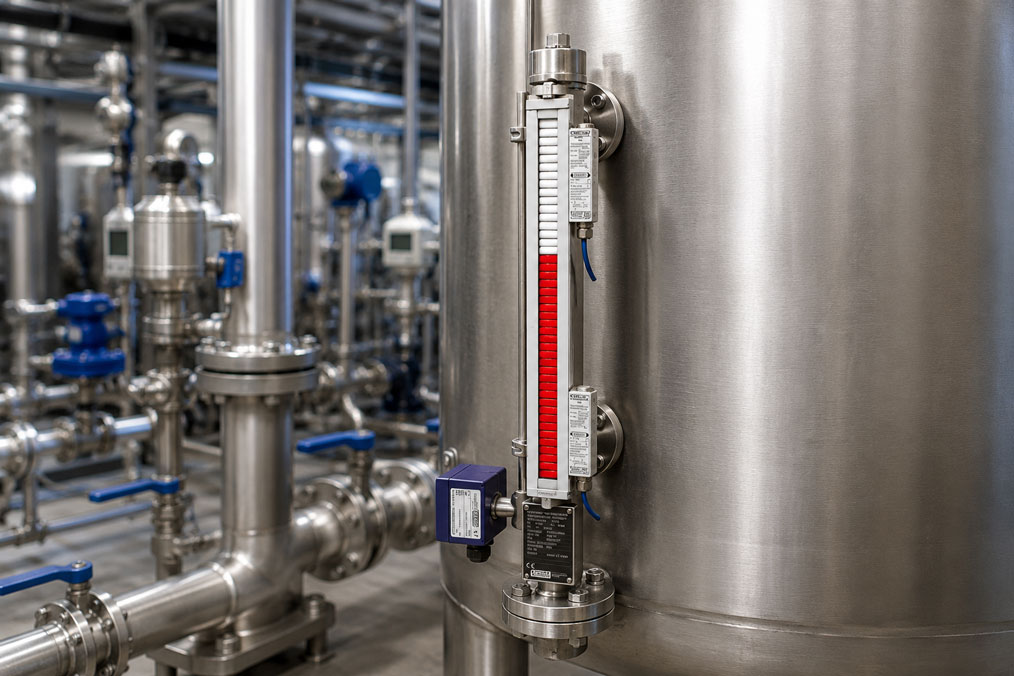
At first glance, level measurement seems simple: a sensor detects how full a tank, vessel or process container is. In practice, however, many measurement problems are not caused by the sensor itself, but by incorrect design for the medium and process conditions. Especially with difficult media, density, viscosity, temperature, pressure, foam formation, deposits, corrosion and cleanability must be carefully evaluated.
In chemicals, food production, pharmaceuticals, oil and water technology as well as in the general process industry, media can have very different properties. Some liquids are viscous, sticky or pasty. Others foam, crystallize, contain solids, attack materials or change their density with temperature and concentration. A level sensor that works reliably in water is therefore not automatically suitable for oil, acid, alkali, syrup, sludge or a hot process medium.
This article explains which influencing variables are particularly important with difficult media, why density and viscosity are often underestimated and how measuring principle, material, process connection, float selection, cleaning, hygienic requirements and hazardous areas influence the selection of the right level measurement solution.
Table of contents
- Basics: why difficult media influence level measurement
- Density: why it is particularly important for floats and hydrostatic measurement
- Viscosity: correctly evaluating viscous and sticky media
- Temperature and pressure: considering process conditions instead of laboratory values
- Foam, deposits and contamination
- Corrosion and materials: stainless steel, duplex, Hastelloy and titanium
- Measuring principles compared: float, hydrostatic, radar and point level
- Hygiene, cleaning and process connections
- Hazardous areas, safety and point level monitoring
- Signal, PLC connection and testing the measurement chain
- Practical example: level measurement in a viscous medium
- Which measuring instruments / products are suitable?
- Conclusion: the medium determines the suitable measuring principle
- FAQ: frequently asked questions about level measurement with difficult media
Basics: why difficult media influence level measurement
Reliable level measurement does not begin with selecting a sensor, but with describing the medium. The decisive factor is not only whether it is a liquid, but how this liquid behaves in the real process. A medium can be low-viscosity at room temperature, but become viscous at low temperatures. It can foam during operation, adhere to walls and probes, contain solids or place different requirements on materials due to cleaning chemicals.
The more difficult the medium is, the more important it becomes to select the right measuring principle. A float system requires sufficient density and free movement of the float. Hydrostatic measurement depends directly on density and the liquid column. Radar can be influenced by steam, foam or a strongly moving surface. Optical or capacitive point level sensors can have problems with deposits or coatings.
In addition, vessel geometry and process conditions play a major role. Agitators, internal fittings, heating coils, spray balls, condensate, pressure changes, vacuum, CIP/SIP cleaning or strong temperature gradients can influence the measurement. The measuring point should therefore always be considered as a complete system: medium, vessel, process, sensor, connection, signal and maintenance.
| Influencing variable | Typical problem | Why important for selection? |
|---|---|---|
| Density | Float sinks too deeply, hydrostatic measurement is calculated incorrectly | Many measuring principles require a defined media density. |
| Viscosity | Float moves sluggishly, medium adheres to sensors or guide tubes | Viscous media can influence mechanics and response time. |
| Temperature | Density, viscosity, material load and electronics limits change | The process condition can differ significantly from the laboratory condition. |
| Foam | Sensor detects foam instead of liquid surface or loses echo | The measuring principle must be able to distinguish between foam and actual level. |
| Corrosion | Materials, seals or sensor surfaces are attacked | Wetted parts must be chemically resistant. |
Density: why it is particularly important for floats and hydrostatic measurement
The density of a medium is a central design value for many level measurements. This becomes particularly clear with float measuring systems. A float must be designed so that it floats reliably in the respective medium and can move freely over the entire measuring range. If the density is too low or changes significantly, the float can immerse too deeply, get stuck or no longer generate sufficient buoyancy.
With continuous level measurement using a float, not only the tank diameter or measuring length is important. The minimum and maximum density of the medium are also decisive. With media mixtures, temperature changes or changing batches, density can change. If the float was designed only for an ideal condition, the measurement can become inaccurate or unreliable in real operation.
Hydrostatic level measurement also depends directly on density. It calculates the level from the pressure of the liquid column. If the density is known and constant, this principle works very well. However, if density changes due to temperature, concentration or product change, the hydrostatic pressure changes at the same level. Without density compensation, the displayed level can then deviate from the actual level.
With difficult media, the following should therefore always be asked: What density does the medium have during normal operation? What density can occur during startup, cooling, cleaning or product change? Is an interface, for example oil/water, being measured? Are there concentration changes? Only with this information can the suitable level technology be selected reliably.
Viscosity: correctly evaluating viscous and sticky media
Viscosity describes how easily a medium flows. For level measurement, it is particularly important because viscous or sticky media can influence sensors mechanically and metrologically. A low-viscosity medium quickly drains from a float, probe or vessel wall. A viscous medium, on the other hand, can adhere, form threads, drain slowly or slow down moving parts.
In float systems, high viscosity can cause the float to react sluggishly or adhere to a guide tube. In point level switches, sticky media can lead to coatings that falsify a switching state. In optical sensors, deposits on the tip can influence light refraction. Radar or ultrasonic measurements can also be indirectly affected if viscous media form heavy deposits, unstable surfaces or foam.
Viscosity is often highly temperature-dependent. Oil, syrup, resin, adhesive or concentrate can flow well during warm operation, but become significantly more viscous during downtime or at low ambient temperature. A measuring point that functions during the running process can become blocked or contaminated after cooling. Therefore, not only the operating temperature is relevant, but also the situation during startup and shutdown.
With viscous media, the measuring point should be designed so that dead spaces, narrow gaps and areas that are difficult to clean are avoided as far as possible. Flush, smooth, easily accessible or bypass-based solutions can be useful depending on the application. The decisive factor is that the medium can not only be measured, but that the measuring point can also be kept clean and functional in the long term.
| Media property | Typical effect | Suitable design focus |
|---|---|---|
| Low density | Float generates less buoyancy | Check float selection and minimum density carefully. |
| High viscosity | Sluggish movement, adhesion, delayed response | Evaluate mechanics, cleanability and installation position. |
| Temperature-dependent viscosity | Medium is significantly more viscous during startup or shutdown | Consider startup condition and shutdown situation. |
| Sticky media | Deposits on sensors, floats or vessel walls | Avoid dead spaces and plan cleaning options. |
| Solids content | Blockage, abrasion or incorrect point level detection | Evaluate particle size, sedimentation and flow behavior. |
Temperature and pressure: considering process conditions instead of laboratory values
Temperature and pressure influence both the medium and the sensor. In liquids, temperature changes frequently alter density, viscosity, vapor pressure, foam formation and chemical reaction rate. At the same time, high temperatures can stress seals, electronics, cables, process connections and wetted materials.
With hot media, it must be checked whether the sensor can be mounted directly on the process or whether thermal decoupling, a bypass, a cooling section or a special device version is required. Cleaning temperatures must also not be forgotten. In food and pharmaceutical plants, CIP or SIP processes can briefly generate significantly higher temperatures than normal operation.
Pressure is also important. A closed vessel, pressure tank or reactor places different requirements than an open storage tank. Pressure changes can influence density, foam formation, gas content and sensor seals. With radar or ultrasonic measurements, steam, condensate or strong process atmospheres can play a role. With float and bypass solutions, pressure rating, connection, seal and mechanical strength must match the plant.
The most important rule is: not only normal conditions count for the design. Minimum and maximum values must also be considered. These include startup, shutdown, cleaning, flushing, pressure relief, vacuum, product change and possible fault conditions. This is the only way to avoid a sensor appearing suitable in the data sheet but reaching its limits in the real process.
Foam, deposits and contamination
Foam is a challenge for many level measurements. Depending on the measuring principle, foam can be detected as the surface, dampen the measuring signal or lead to fluctuating readings. Foam formation occurs particularly often in food processes, wastewater plants, fermentation, chemical processes and cleaning processes. The decisive question is whether the process should detect the liquid level below the foam or the foam layer itself.
Deposits are another typical problem. Media containing sugar, starch, proteins, fats, resins, paints, sludge, lime, salts or crystals can coat sensors and vessel walls. As a result, a point level sensor can appear permanently “covered”, a float can become blocked or a measuring signal can be dampened. Such problems often do not occur immediately, but only after a longer operating period.
Contamination can also be caused by the process itself. Sedimentation, precipitation, particles, fibers or corrosion products accumulate at certain points depending on vessel shape and flow. If the sensor is installed there, the measuring point can become contaminated faster than expected. The installation position is therefore just as important as the measuring principle.
With media that form foam or deposits, the measuring point should be planned so that cleaning, visual inspection and maintenance remain possible. Depending on the application, a bypass, sight glass indicator, float system, non-contact measurement or a combination of continuous measurement and point level switch can be useful.
Corrosion and materials: stainless steel, duplex, Hastelloy and titanium
Difficult media are often not only viscous or hot, but also chemically demanding. Acids, alkalis, salt solutions, chlorides, solvents, cleaning chemicals or process mixtures can attack materials and seals. An unsuitable material selection not only leads to a shorter service life, but can also cause measurement errors, leaks and safety risks.
Stainless steel is suitable for many industrial applications, but not automatically for every medium. With chloride-containing media, high temperatures or highly corrosive chemicals, higher-grade materials such as duplex, Hastelloy, titanium or special coatings may be required. Selection depends on medium, concentration, temperature, pH value, pressure, cleaning chemistry and operating time.
Seals and process connections must also be considered. A sensor with a suitable metal material can still fail if the seal does not match the medium or cleaning process. In hygienic applications, surface quality, gap-free design and cleanability are also relevant. In aggressive processes, flanges, threaded connections, bypass chambers or floats may also require special materials.
Material selection is therefore always a technical evaluation, not a purely standard decision. If medium and process conditions are critical, resistance should be checked based on the specific operating data. General statements such as “stainless steel is sufficient” or “Hastelloy is always safe” are too imprecise for difficult applications.
| Material / version | Typical use | What to pay attention to? |
|---|---|---|
| Stainless steel | Many standard applications with water, oil, neutral media and food products | Check chlorides, temperature and cleaning chemistry. |
| Duplex | More demanding media with increased corrosion load | Always evaluate resistance specifically against medium and temperature. |
| Hastelloy | Many aggressive chemical media | Not generally suitable for all chemicals; consider concentration. |
| Titanium | Certain chloride-containing or highly corrosive applications | Check medium, temperature and possible reaction conditions. |
| Coated version | Corrosion protection or reduction of deposits | Observe mechanical load, cleaning and coating resistance. |
Measuring principles compared: float, hydrostatic, radar and point level
There is no single correct measuring principle for level measurement. The suitable solution depends on whether continuous measurement is required or only a point level is to be monitored, whether the medium is conductive, how strongly it foams, whether deposits form, whether the vessel is pressurized and what accuracy is required.
Float-based measuring systems are robust and easy to understand. They are particularly suitable for many liquids if density, viscosity and installation situation are suitable. With continuous measurement using a float, the position of the float can be converted into an electrical signal. With point level switches, a defined minimum or maximum level is detected. Very low densities, high viscosities, heavy deposits or media with particles that obstruct movement are critical.
Hydrostatic level measurement is particularly suitable when the level is to be detected via the pressure of the liquid column. It is robust and can be used in many tanks, shafts and vessels. The decisive point is density. If density changes, this must be taken into account. The application is simpler in open vessels than in closed or pressurized vessels, where pressure compensation may be required.
Non-contact measuring methods such as radar are interesting when no direct media contact is desired or moving parts are to be avoided. They can offer advantages with many difficult media, but must be evaluated with regard to foam, steam, internal fittings, vessel geometry, condensate and dielectric constant. Point level sensors, on the other hand, are ideal when only a minimum or maximum level needs to be reliably detected, for example as overfill protection or dry-running protection.
| Measuring principle | Strength | Critical with |
|---|---|---|
| Continuous measurement with float | Robust, easy to understand, suitable for many liquids | Low density, high viscosity, deposits and blocked float movement |
| Float switch | Simple min./max. point level detection | Viscous, sticky or heavily contaminated media |
| Hydrostatic measurement | Proven for tanks, shafts and liquid columns | Density changes, pressure overlay and deposits at the pressure connection |
| Radar | Non-contact, no moving parts | Strong foam, steam, condensate, internal fittings or unfavorable vessel geometry |
| Optoelectronic point level | Compact, fast, suitable for clear to slightly cloudy liquids | Strong deposits, coatings or very contaminated media |
Hygiene, cleaning and process connections
In food, beverage, pharmaceutical and biotechnology plants, level measurement must not only function technically, but also fit hygienically into the process. Dead spaces, gaps that cannot be cleaned, unsuitable seals or rough surfaces can lead to product residues, microbiological risks and cleaning problems.
Hygienic process connections such as clamp, Varivent, aseptic connections or suitable flange solutions may be required depending on the plant. The decisive factor is that sensor, connection, seal and installation position match the cleaning process. With CIP and SIP cleaning, temperature, cleaning medium, pressure, duration and chemical resistance must be considered.
With viscous or sticky food products, cleanability is particularly important. A sensor that measures correctly in the product flow can still be problematic if product residues collect in areas that are difficult to access. Floats, guide tubes, bypass chambers or probes must also be designed so that cleaning and visual inspection are possible.
Hygienic requirements should therefore be included early in the selection process. Retrofitting the process connection afterwards is often complex and can worsen measurement quality. It is better to plan measuring principle, connection and cleaning procedure together.
Hazardous areas, safety and point level monitoring
In many plants with flammable liquids, solvents, gas atmospheres or dust explosion risks, the hazardous area plays an important role. Level sensors, point level switches, transmitters, connection housings and electrical evaluation must then match the respective zone, type of protection and plant requirement.
Especially for overfill protection, dry-running protection, pump protection or safety-relevant shutdown, a clear distinction should be made between process measurement and protective function. A continuous level indicator is not automatically an independent safety device. Depending on the application, additional point level switches, redundant measuring points or approved safety functions may be required.
With difficult media, point level monitoring is often just as important as continuous measurement. A tank can, for example, be measured continuously by radar or float, while a separate point level switch serves as a maximum alarm. For pumps, a minimum point level can prevent dry running. Such combinations increase operational safety and make troubleshooting easier.
Design in hazardous areas requires clear information on medium, temperature class, process pressure, environment, zone, electrical connection and required function. Maintenance and testing must also be considered so that the protective function is maintained in the long term.
Signal, PLC connection and testing the measurement chain
Depending on the version, level sensors provide different signals: limit contacts, reed chains, potentiometer signals, 4–20 mA, HART, IO-Link, Modbus, switching contacts or digital communication interfaces. For plant integration, it is decisive that measuring range, unit, output signal and PLC scaling match correctly.
With continuous level measurement, a 4–20 mA signal is often used. It must be clearly defined which level corresponds to 4 mA and which level corresponds to 20 mA. In tanks with special geometry, additional linearization may be required if volume is to be calculated from filling height. Without correct scaling, the sensor can work electrically correctly while the display still shows incorrect values.
The UPS4E loop calibrator is suitable for testing 4–20 mA signals. It can be used to measure and simulate mA signals, test current loops and identify scaling errors between level sensor, display, PLC or data logger. This is particularly helpful during commissioning, device replacement, parameter changes or troubleshooting.
A clean measurement chain test does not only consider the sensor. Cable length, shielding, Ex barriers, power supplies, input cards, damping, limit values, volume calculation, alarm delay and data logging must also match the application. Many apparent level problems do not occur at the sensor, but in the electrical or software-based evaluation.
Practical example: level measurement in a viscous medium
In a production plant, the level of a heated tank with a viscous liquid is to be measured continuously. During warm operation, the medium flows well. During shutdown, however, it cools down and becomes significantly more viscous. In addition, the medium tends to adhere to the vessel wall and internal fittings.
Initially, a standard sensor is selected that would be well suited for water and simple liquids. During operation, however, the measurement shows delayed values. After longer shutdown periods, implausible readings also occur. The cause is not an electrical defect, but the combination of temperature-dependent viscosity, deposits and an unfavorable installation situation.
The measuring point is re-evaluated. Minimum and maximum density, viscosity in cold condition, cleaning, vessel geometry, temperature range and required output signal are taken into account. Instead of only replacing the sensor, the complete measurement concept is adapted. The solution includes a more suitable measuring point, suitable materials, an appropriate process connection and clearly documented scaling.
The example shows: with difficult media, it is not enough to know only the required measuring range. The behavior of the medium throughout the entire process determines whether the level measurement will function reliably in the long term.
Which measuring instruments / products are suitable?
For robust and application-specific level solutions, the category WIKA KSR Kuebler level technology is an important starting point. There you will find different solutions for continuous level measurement, point level detection, level indicators, sight glass indicators, float switches and accessories. Especially with difficult media, the correct design is decisive.
For applications in which a float is to be used for continuous detection, the category continuous measurement with float is particularly relevant. Here, density, viscosity, pressure, temperature, float material, guide tube, measuring length, process connection and signal type must be considered together.
If not only float solutions but also other sensor principles are to be examined, the category level sensors / level probes / submersible probes is also useful. It offers a broader entry point into continuous level and volume measurement for tanks, vessels and shafts.
For point level tasks such as dry-running protection, overfill protection or min./max. monitoring, float switches or optoelectronic switches can also be suitable. The selection strongly depends on whether the medium is clear, cloudy, viscous, adhesive, aggressive or hygienically critical.
| Product / area | Typical use | Particularly relevant for |
|---|---|---|
| WIKA KSR Kuebler level technology | Selection of robust level solutions for industrial applications | Vessels, tanks, process plants, point level and continuous measurement |
| Continuous measurement with float | Continuous level detection using the float principle | Density evaluation, float selection, bypass, tank measurement and process vessels |
| Float switches | Min./max. point level detection | Overfill protection, dry-running protection, pump protection and simple point level signals |
| Level sensors / level probes / submersible probes | Continuous level and volume measurement | Tanks, shafts, vessels, water technology and process applications |
| UPS4E loop calibrator | Testing and simulation of 4–20 mA signals | PLC scaling, commissioning, device replacement and troubleshooting on level signals |
Conclusion: the medium determines the suitable measuring principle
With difficult media, the required measuring range alone does not determine the correct level measurement solution. Density, viscosity, temperature, pressure, foam formation, deposits, corrosion, cleaning, hygienic requirements and hazardous areas determine which measuring principle works reliably and remains maintainable in the long term.
Density is particularly decisive for float-based systems. With hydrostatic measurement, density must be taken into account when converting pressure into level. With viscous and sticky media, mobility, adhesion and cleaning are important. With aggressive media, material, seal and process connection are the main focus.
The most important recommendation is: always design level measurement starting from the medium and the process. Only when media data, operating conditions, vessel geometry, measuring task, signal and maintenance concept are known can it be reliably decided whether a float, point level switch, hydrostatic sensor, radar or another measuring principle is the best solution.
FAQ: frequently asked questions about level measurement with difficult media
Why is level measurement with difficult media challenging?
Difficult media can be viscous, sticky, aggressive, hot, foaming, contaminated or strongly temperature-dependent. This influences sensors, floats, seals, process connections and measuring signals. The design must therefore match the real process.
What role does density play in level measurement?
Density is particularly important for float measuring systems and hydrostatic measurement. A float requires sufficient buoyancy, and with hydrostatic measurement the level is calculated from the pressure of the liquid column. If density changes, the displayed level can change.
Why is viscosity important?
High viscosity can slow float movements, cause deposits and contaminate sensors. Especially with media that become more viscous when cold, the behavior during startup and shutdown must also be considered.
Can a float be used with every medium?
No. A float requires sufficient density of the medium and must be able to move freely. Very viscous, sticky, contaminated or strongly adhesive media can impair function. Float selection must match the application.
Which media are critical for float measurement?
Critical media include those with low density, high viscosity, heavy deposits, solids, crystallization or sedimentation. Strong turbulence, agitators and unfavorable installation positions can also be problematic.
When is hydrostatic level measurement useful?
Hydrostatic measurement is useful when the level can be detected via the pressure of the liquid column and the density is known or sufficiently constant. With changing density, compensation or correction must be checked.
How does temperature influence level measurement?
Temperature can change density, viscosity, vapor formation, foam formation and material load. Sensor, seal, cable and process connection must also be suitable for operating and cleaning temperatures.
What happens with foam formation?
Depending on the measuring principle, foam can be detected as the surface, dampen a signal or cause measured values to fluctuate. It must be clarified whether the level of the liquid or the foam layer is relevant.
Which materials are used with aggressive media?
Depending on the medium, stainless steel, duplex, Hastelloy, titanium or coated versions may be considered. Medium, concentration, temperature, pH value, pressure, cleaning chemistry and mechanical load are decisive.
Why is stainless steel not always sufficient?
Stainless steel is versatile, but can be attacked by certain chlorides, acids, alkalis or high temperatures. With aggressive media, material resistance must be checked specifically.
What must be considered for hygienic level measurement?
Important factors include hygienic process connections, smooth surfaces, suitable seals, low-dead-space installation and cleanability. CIP and SIP conditions must be considered with regard to temperature, medium and duration.
When is a point level switch useful?
A point level switch is useful when a minimum or maximum level must be reliably detected. Typical applications are overfill protection, dry-running protection, pump protection or an additional alarm function alongside continuous measurement.
What is important in hazardous areas?
Sensor, connection housing, electrical evaluation and wiring must match the respective hazardous zone and type of protection. Temperature, medium, process pressure and safety function must also be considered.
How do you test a 4–20 mA level signal?
With a loop calibrator, defined mA values can be measured or simulated. This makes it possible to check whether sensor, display, PLC and data logger use the same measuring range and are correctly scaled.
Which information is required for selection?
Important information includes medium, density, viscosity, temperature, pressure, vessel geometry, measuring range, process connection, material requirements, hygienic requirements, Ex zone, signal type and desired function as continuous measurement or point level.
When should expert consultation be used?
Expert consultation is particularly useful with aggressive, hot, viscous, foaming, adhesive or hygienically critical media, as well as with Ex applications, safety functions, density changes or unclear vessel geometry.