


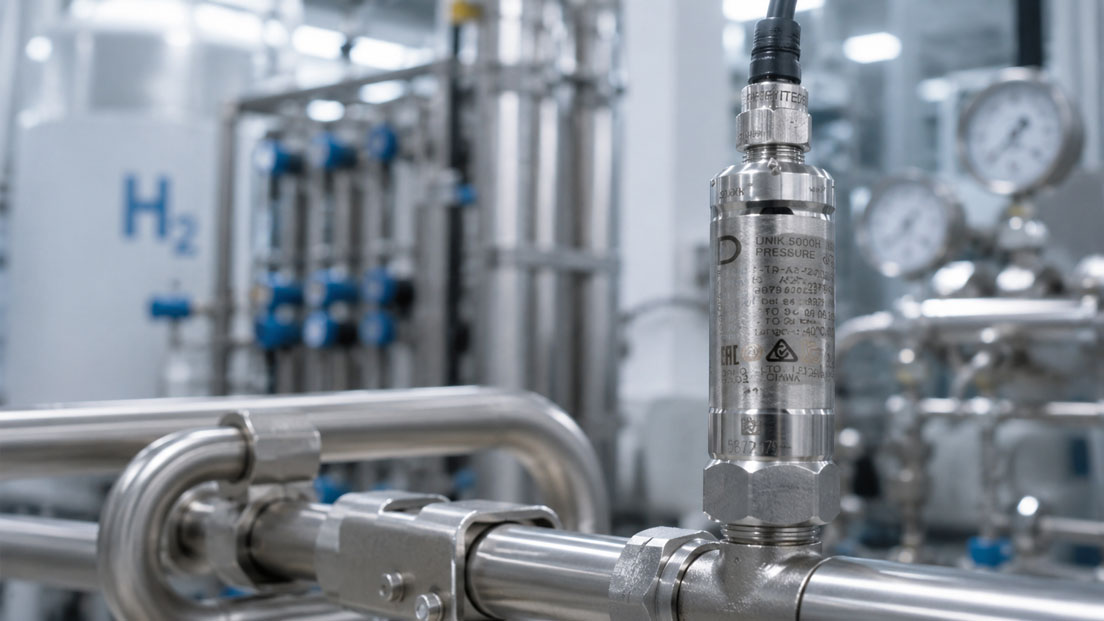
Hydrogen plants place high demands on measurement technology. Whether electrolyzer, compressor, storage system, test bench, fuel cell or supply line: in practice, a single measured variable is rarely sufficient to assess the condition of the plant safely and reliably. Pressure, temperature, flow, gas detection and process data must be considered together.
Especially with hydrogen, the correct measurement chain is crucial. The medium is light, highly diffusive, flammable in many applications and, depending on material and pressure range, can place special requirements on tightness, material selection and sensor design. At the same time, hydrogen plants are often operated dynamically: load changes, compression, pressure control, storage processes and changing flow rates directly affect the measured values.
This article explains which measured variables are important in hydrogen plants, why pressure, temperature and flow measurement should be evaluated together, and what role gas detection, data logging, process control technology, maintenance and calibration play. Planning, operation and testing of hydrogen plants may only be carried out by qualified personnel in compliance with applicable standards, safety concepts, explosion protection requirements and manufacturer specifications.
Table of contents
- Basics: why hydrogen plants require several measured variables
- Pressure measurement: electrolysis, compression, storage and supply
- Temperature measurement: process state, compression and component protection
- Flow measurement: monitoring production, consumption and balancing
- Evaluating pressure, temperature and flow together
- Gas detection and safety monitoring
- Signals, data logging and process control technology
- Maintenance, calibration and recurring inspections
- Practical example: correctly interpreting pressure rise in a storage system
- Which measuring instruments / products are suitable?
- Conclusion: hydrogen monitoring is always a system task
- FAQ: frequently asked questions about measurement technology in hydrogen plants
Basics: why hydrogen plants require several measured variables
Hydrogen plants often consist of several process areas. In an electrolyzer, hydrogen is generated, then dried, purified, compressed, stored, distributed or used in a fuel cell or test bench. Each of these areas places different demands on measurement. The pressure sensor on the storage system provides important information, but it does not automatically explain whether the mass flow is correct, whether a compressor is thermally overloaded or whether there is a leakage risk.
Pressure measurement indicates the operating state in a line, storage system or compressor. Temperature measurement helps detect thermal loads, compression effects, cooling and possible process deviations. Flow measurement shows whether hydrogen is being produced, consumed, delivered or unintentionally lost. Gas detection additionally monitors the environment and can provide safety-relevant indications if hydrogen occurs outside the closed system.
In practice, these measured variables are often considered separately. This can lead to misinterpretations. A pressure increase may result from actual compression, but also from a temperature increase. A low flow rate may indicate low production, closed valves, pressure control problems or measuring range errors. A stable pressure reading does not automatically mean that there is no leak if temperature, flow and operating state are not also evaluated.
| Measured variable | Typical information | Why not sufficient on its own? |
|---|---|---|
| Pressure | Condition of line, storage system, compressor or test setup | Pressure also depends on temperature, volume, flow and valve position. |
| Temperature | Thermal load, compression effect, cooling and process state | Temperature alone does not explain whether the required H₂ quantity is being transported. |
| Flow | Production, consumption, dosing, balancing and supply | Flow must be evaluated in relation to pressure and temperature. |
| Gas detection | Indication of escaping hydrogen in the environment | Does not replace process measurement inside the closed system. |
| Data logging | Trends, events and traceability | Data quality depends on sensor technology, calibration and correct scaling. |
Pressure measurement: electrolysis, compression, storage and supply
Pressure is one of the most important measured variables in hydrogen plants. It is monitored at electrolyzers, buffer storage systems, compressors, pressure control lines, test benches, valve blocks, safety lines and dispensing points. Depending on the application, this may involve low pressures in generation, medium pressures in supply lines or high pressures in storage and compression processes.
For hydrogen, a pressure sensor must not be selected based only on measuring range. Wetted materials, sealing concept, pressure connection, temperature range, long-term stability, overload resistance, output signal, approvals and installation situation are also decisive. Hydrogen can place special requirements on material selection and tightness. For this reason, sensors explicitly suitable for hydrogen applications should be used.
In practice, many measurement problems result from incorrect pressure type, incorrect scaling or unfavorable installation position. In storage and compression applications, it must also be considered that pressure and temperature are closely linked. After rapid filling, the pressure may initially appear higher because the gas has heated up. As it cools down, the pressure drops again without necessarily indicating a leak.
For safety-relevant functions, a clear distinction should be made between process measurement, monitoring, shutdown and an independent safety device. A pressure transmitter in the control system can provide process data, but it does not automatically replace a safety system required by standards. The specific design depends on the plant concept and applicable requirements.
Temperature measurement: process state, compression and component protection
Temperature measurement in hydrogen plants is more than a convenience function. Temperature influences pressure, density, flow calculation, material load, compressor operation, cooling and process stability. Especially during compression and rapid filling, temperature changes occur that must be considered when evaluating pressure and flow values.
Typical measuring points are located at compressor inlet and outlet, heat exchangers, storage systems, pipelines, electrolyzer components, cooling circuits, fuel cell modules and test benches. Depending on the location, resistance thermometers, thermocouples, screw-in sensors, surface sensors or temperature transmitters are used.
A common practical error is incorrect positioning of the temperature sensor. If the sensor is not positioned representatively in the medium, has poor thermal coupling or is influenced by ambient temperature, the displayed value can deviate significantly from the actual process state. With gases, it must also be noted that temperature changes can occur very locally, for example directly after compression, expansion or control valves.
Temperature measurement also helps with plausibility checks. If a storage system loses pressure after filling but cools down significantly at the same time, part of the pressure change can be explained thermally. If pressure, temperature and flow do not match, however, the plant should be examined more closely.
Flow measurement: monitoring production, consumption and balancing
Flow measurement shows how much hydrogen is produced, transported, dosed, consumed or delivered. In electrolysis plants, it is important for assessing generation output and system efficiency. In storage and compressor lines, it helps monitor filling and withdrawal processes. In fuel cell or test bench applications, it is crucial for supply, control and balancing.
For hydrogen and other gases, different measuring principles may be suitable depending on pressure, temperature, measuring range, accuracy requirement and installation situation. Thermal mass flow meters, Coriolis flow meters, differential pressure methods, ultrasonic methods or other technologies can be suitable depending on the application. The selection must always match the medium, pressure level, temperature range, required measuring range and safety concept.
The distinction between volumetric flow and mass flow is important. With gases, volume changes significantly with pressure and temperature. A volumetric flow without reference to standard conditions or current process conditions can therefore lead to misinterpretations. For balancing, consumption calculation and plant comparison, mass flow or normalized volumetric flow is often more useful.
Installation conditions are also decisive. Flow profile, pressure control, pulsations caused by compressors, dead volumes, leakage paths and valve position can influence the measurement. For this reason, flow measurement should not be planned in isolation, but together with pressure and temperature measurement as well as process control.
| Plant area | Important measured variables | Typical question |
|---|---|---|
| Electrolysis | Pressure, temperature, H₂ flow, cooling, electrical process data | Is the expected hydrogen quantity being generated stably? |
| Compression | Inlet and outlet pressure, temperature, flow, operating state | Is the compressor operating within the permissible and efficient range? |
| Storage | Storage pressure, gas temperature, filling and withdrawal flow | Is the storage condition plausible and safe? |
| Fuel cell | Supply pressure, temperature, H₂ flow, ambient gas monitoring | Is the supply stable and is hydrogen being used safely? |
| Test bench | Pressure, temperature, mass flow, data logging, safety contacts | Are measured values reproducible and documentable? |
Evaluating pressure, temperature and flow together
The most important point in hydrogen plants is the relationship between the measured variables. Pressure, temperature and flow influence each other. Especially with gases, a change in temperature directly leads to a change in density and therefore to a different interpretation of volumetric flow or storage pressure. Anyone who looks at only one measured value often cannot tell whether the process is truly stable.
One example: after filling a storage system, the pressure rises quickly. At the same time, the gas heats up. If the system then remains idle, the temperature drops and the pressure decreases. Without temperature measurement, this pressure drop could be mistakenly interpreted as a leak. With temperature data, it is easier to assess whether the trend is thermally plausible or whether there is actually an unexpected loss.
Another example concerns flow measurement. A compressor may show a fluctuating volumetric flow, while the mass flow must be evaluated differently due to pressure and temperature changes. For process control technology and balancing, it is therefore important to know which quantity is measured, calculated and displayed.
In plant monitoring, measured values should therefore not only be displayed individually, but linked meaningfully. Limit values, alarms and shutdowns must match the process. A single limit value without context can lead to false alarms or cause real problems to be detected too late.
Gas detection and safety monitoring
In addition to process measurement technology, gas detection is an important component of many hydrogen plants. While pressure, temperature and flow measurement describe the state inside the system, gas detection monitors the environment. It can provide indications of escaping hydrogen and is therefore an important element of the safety concept.
Hydrogen is very light and can spread quickly depending on the room, ventilation, plant geometry and release point. The positioning of gas detectors must therefore be planned carefully. Measuring points near possible leakage points, above components, in enclosures or in areas with insufficient ventilation may be relevant depending on the plant.
Gas detection should not be considered in isolation. If a gas detector responds, process values are important at the same time: is the pressure dropping? Is there unexpected flow? Has a valve opened? Has the temperature changed? By combining the data, it is easier to identify whether this is a local release, an operating state, a process fault or a sensor malfunction.
For safety-relevant applications, suitable sensor technology, regular functional testing, calibration, alarm concept, ventilation, shutdown and documentation are decisive. The specific implementation depends on the plant risk, applicable rules and risk assessment.
Signals, data logging and process control technology
In hydrogen plants, measured values are often transmitted to a PLC, control system, data logger or test bench software. Typical signals include 4–20 mA, voltage outputs, digital interfaces, fieldbuses or Ethernet-based communication. The decisive factor is that sensor, signal type, scaling and target system match.
4–20 mA signals in particular are widely used in process measurement technology. They are robust and well suited for industrial environments. Nevertheless, many errors occur due to incorrect scaling: for example, a pressure sensor is designed for 0 to 700 bar, but the PLC still calculates the input using 0 to 400 bar. The electrical signal is then correct, but the displayed pressure value is wrong.
The UPS4E loop calibrator is suitable for testing such current loops. It can be used to measure and simulate 4–20 mA signals and to check the scaling of PLC, data logger or control system. This is particularly helpful during commissioning, sensor replacement, maintenance and troubleshooting when it is unclear whether an error is in the sensor, wiring or evaluation.
Data logging is particularly important when hydrogen plants need to be evaluated, optimized or documented. Trend data show whether pressure, temperature and flow follow a plausible pattern together. They also help identify rare events, such as pressure peaks, temperature rises, flow interruptions or recurring alarm states.
| Signal / data point | Typical benefit | What to pay attention to? |
|---|---|---|
| 4–20 mA | Robust analog transmission of pressure, temperature or flow | Check measuring range, scaling, loop supply and load. |
| Digital signal / fieldbus | Transmission of several measured values and diagnostic information | Consider address, protocol, mapping, diagnostics and update rate. |
| Data logger | Trend recording, evidence, troubleshooting and plant optimization | Ensure measuring interval, timestamp, resolution and data quality. |
| Alarm contact / limit value | Warning, shutdown or release during plant operation | Limit values must match the process and safety concept. |
| Diagnostic data | Indications of sensor faults, range exceedance or signal interference | Do not ignore diagnostic messages, but compare them with process data. |
Maintenance, calibration and recurring inspections
Hydrogen plants require a well-planned maintenance and calibration concept. Sensors can age, drift, be mechanically stressed or be influenced by process conditions. Electrical connections, sealing points, valves, pressure lines and data processing can also change over time.
At pressure measuring points, zero point, measuring range, tightness, process connection and signal processing should be checked regularly. At temperature measuring points, installation position, thermal coupling, cables, transmitters and comparison measurements are relevant. At flow measuring points, installation conditions, contamination, sensor condition, zero point, measuring range and, where applicable, gas composition play a role.
Calibration should not only consider individual sensors if the plant uses a complete measurement chain. A sensor can be correctly calibrated while the PLC is scaled incorrectly. Likewise, a flow meter can work correctly while the process conditions are outside the intended range. For reliable plant monitoring, testing the entire measurement chain is therefore often useful.
Clear documentation is necessary, especially for safety-relevant functions. Test intervals, test points, limit values, calibration certificates, sensor replacements, parameter changes and alarm tests should be documented traceably. This helps with audits, fault analysis, maintenance and long-term plant optimization.
Practical example: correctly interpreting pressure rise in a storage system
An operator monitors a small hydrogen plant with electrolyzer, compressor and buffer storage. During a filling process, the storage pressure rises faster than expected. Initially, it is suspected that the pressure sensor is measuring incorrectly or that the compressor is regulating too high.
However, the pressure display alone does not provide a clear explanation. Only the temperature view shows that the storage system has heated up significantly during filling. At the same time, the flow measurement confirms that the mass flow is within the expected range. The pressure rise is therefore initially plausible and partly caused by the heating of the gas.
After filling ends, the temperature slowly drops again. The pressure also decreases. Because the flow drops to zero and the gas detection shows no abnormalities, there is no immediate indication of leakage. The trend data show a traceable relationship between filling, temperature rise and pressure profile.
This example shows why hydrogen plants should not be evaluated using a single sensor. Only the combination of pressure, temperature, flow, gas detection and time trend provides a reliable statement about the plant condition.
Which measuring instruments / products are suitable?
For selecting suitable measurement technology in H₂ applications, ICS Schneider Messtechnik offers the section hydrogen measurement technology. There, suitable solutions for pressure measurement, calibration, process monitoring and further measurement tasks in the field of hydrogen applications can be classified. The decisive factor is always that materials, measuring range, connection, output signal, approval and installation situation match the specific application.
For pressure measurement in hydrogen applications, the UNIK 5000H analog pressure sensor for hydrogen applications is particularly relevant. It is designed for demanding H₂ applications and is suitable for tasks where pressure must be reliably recorded and transmitted as an electrical signal. When selecting and specifying the sensor, measuring range, accuracy, pressure connection, output signal, media compatibility and plant requirements should be considered together.
For recording hydrogen quantities, consumption, generation output or supply flows, the category flow measurement technology is the right starting point. Depending on the application, different measuring principles may be considered. For gases and hydrogen, pressure, temperature, measuring range, desired reference quantity, accuracy and installation situation are particularly decisive.
If pressure, temperature or flow sensors are integrated into a PLC, control system or data logger via 4–20 mA, the electrical measurement chain should also be checked. The UPS4E loop calibrator helps measure and simulate mA signals and identify scaling errors between sensor and evaluation.
| Product / area | Typical use | Particularly relevant for |
|---|---|---|
| Hydrogen measurement technology | Overview of suitable measurement solutions for H₂ applications | Electrolysis, compression, storage, test benches, process monitoring and calibration |
| UNIK 5000H analog pressure sensor for hydrogen applications | Pressure measurement in demanding hydrogen applications | H₂ pressure monitoring, storage, compressors, test benches and plant integration |
| Flow measurement technology | Selection of suitable flow measurement methods | Production, consumption, balancing, supply lines and process control |
| UPS4E loop calibrator | Testing and simulation of 4–20 mA signals | Commissioning, PLC scaling, sensor replacement, maintenance and troubleshooting |
Conclusion: hydrogen monitoring is always a system task
Hydrogen plants cannot be reliably assessed using a single measured variable. Pressure, temperature, flow and gas detection each provide important information, but only together do they create a reliable picture of the plant condition. Especially with gases, pressure, temperature, density and flow are closely linked.
For operators and plant manufacturers, this means that measurement technology should be planned as a system from the very beginning. Sensors must match the hydrogen medium, pressure range, temperature, safety concept, signal processing and maintenance strategy. Data logging, plausible limit values, clear alarm concepts and documented calibration are equally important.
The most important recommendation is: always evaluate pressure, temperature and flow values together. If gas detection, diagnostic data and trend recording are also included, operating states can be better understood, faults narrowed down more quickly and maintenance measures planned more specifically.
FAQ: frequently asked questions about measurement technology in hydrogen plants
Which measured variables are particularly important in hydrogen plants?
Pressure, temperature, flow and gas detection are particularly important. In addition, humidity, conductivity, electrical process data, valve positions, alarms and diagnostic data may be relevant. Which measured variables are required depends on the plant concept.
Why is a pressure sensor alone not sufficient?
Pressure describes only part of the plant condition. With gases, pressure strongly depends on temperature, volume and flow. A pressure increase or pressure drop can easily be misinterpreted without temperature and flow data.
What role does temperature play in hydrogen plants?
Temperature influences gas density, pressure, flow calculation, component load and process stability. Especially during compression, filling, expansion and cooling, temperature measurement is important for correctly evaluating pressure and flow values.
Why is flow measurement important for hydrogen?
Flow measurement shows how much hydrogen is generated, transported, stored, withdrawn or consumed. It is important for balancing, control, efficiency assessment, test benches and stable supply to consumers such as fuel cells.
Which flow measurement methods are suitable for hydrogen?
This strongly depends on pressure, temperature, measuring range, accuracy requirement and installation situation. Depending on the application, thermal mass flow meters, Coriolis flow meters, differential pressure methods, ultrasonic methods or other measuring principles may be considered.
Why is hydrogen demanding for sensors?
Hydrogen is a very small molecule and places special demands on tightness, materials and sensor design. Depending on pressure, temperature and application, material compatibility, permeation, embrittlement, connections and approvals must be checked carefully.
What must be considered for pressure sensors for hydrogen?
Important factors are hydrogen-compatible wetted materials, suitable measuring range, pressure connection, sealing concept, temperature range, output signal, accuracy, long-term stability and, if applicable, explosion protection or safety requirements.
Why should pressure and temperature be logged together?
Because pressure changes in gases are often temperature-dependent. After rapid filling, pressure can rise due to heating and later drop again during cooling. Without temperature trend data, this effect can be confused with leakage or a control problem.
What role does gas detection play?
Gas detection monitors the environment for escaping hydrogen. It complements process measurement but does not replace it. Gas detectors are particularly important in areas with possible leakage points, enclosures, compressor areas, storage systems and poorly ventilated zones.
How does data logging help in hydrogen plants?
Data logging makes trends visible. It helps identify pressure peaks, temperature changes, flow interruptions, alarm states and recurring patterns. This makes it easier to narrow down faults and plan maintenance measures more specifically.
Why are 4–20 mA signals still important?
4–20 mA is robust, widely used and suitable for many industrial measurement chains. In hydrogen plants, pressure, temperature or flow values can be transmitted to PLCs, control systems or data loggers in this way. Correct scaling is important.
How do you check the scaling of a 4–20 mA signal?
With a loop calibrator, defined mA values can be simulated and compared with the display in the PLC or control system. This makes it possible to check whether 4 mA and 20 mA correspond to the correct measuring range limits.
When is calibration of the sensor technology useful?
Calibration is useful during commissioning, after sensor replacement, in the event of conspicuous measured values, after overload, before audits or at fixed maintenance intervals. For safety- or quality-relevant measuring points, the complete measurement chain should be considered.
Which measuring points are particularly important on compressors?
Typical measuring points include inlet pressure, outlet pressure, inlet temperature, outlet temperature, flow and operating states. These values help monitor compression, thermal load, cooling and process stability.
How can you tell whether a pressure drop is a leak?
A pressure drop should be evaluated together with temperature, flow, valve position and gas detection. If the temperature drops at the same time, part of the pressure drop may be thermally induced. Conspicuous flow or gas detection, however, may indicate a release.
What is the most important recommendation for hydrogen measurement technology?
Measurement technology should always be planned as a complete system. Pressure, temperature, flow and gas detection data must match the application, safety concept and evaluation. Only then can reliable and traceable plant monitoring be achieved.