


Coriolis mass flow measurement measures the mass flow of a liquid or gas flowing through a pipe. This measuring method is based on the Coriolis effect. It is unique in that it can directly measure mass flow.
The Coriolis Effect
The Coriolis force is one of the three inertial forces that occur in a rotating system. It occurs when a body moves in a rotating system where the motion is not parallel to the axis of rotation.
Since our earth is a rotating system, the Coriolis effect exerts a large influence. This force is responsible for weather phenomena such as hurricanes, ocean currents and even the Earth's magnetic field. It is also responsible for the direction of rotation of water currents and hurricanes. Thus, hurricanes in the northern hemisphere turn clockwise, while in the southern hemisphere they turn left.
As an illustration, a rotating carousel is given. Person A wants to throw a ball to person B. The ball will move along the axis of rotation, in a spinning system, causing both centrifugal and Coriolis forces to act on the ball. An outsider would see a straight throw (view 1). From Person A's perspective, it appears that an invisible force is directing the ball (View 2). This example shows that the Coriolis force is a matter of perception.

Function
What is unique about the Coriolis principle is that the mass flow can be measured directly. Inside the Coriolis flow meter, a tube is made to vibrate by an exciter. If there is no flow, the pipe oscillates evenly. Inlet and outlet sensors register the vibrations.
As soon as flow prevails, the oscillation of the pipe is forced by the inertia of the liquid to have an additional rocking motion. Due to the Coriolis effect, the inlet and outlet oscillate in different directions at the same time. Highly sensitive sensors register temporal and spatial changes. This is the phase shift. It is a measure of how much liquid is currently flowing through the pipe. The speed and quantity of the medium have a direct influence on the intensity of the vibration.
Because additional sensors record the vibration frequency, the density can also be determined. For clarification, a higher vibration frequency is measured using the example of water as the medium flowing through than honey. The vibration frequency is a direct measure of the density of the medium.

Areas of application
Coriolis flow measurement can be applied almost anywhere as it is independent of: density, flow profile, conductivity, viscosity and more. Substances such as oils, alcohol, juices, fuels and cleaning agents can be measured. It is possible to measure under high pressures and temperatures, as well as in potentially explosive atmospheres. There are also versions for custody transfer.
The diverse areas of application include:
- Dosing systems
- Natural gas dispensers
- Pipeline billing measurements
- Truck-rail loading
Pros and cons
|
Advantages |
Disadvantages |
|
Direct mass flow measurement |
High price |
|
Multivariable sensors for temperature, viscosity, density and mass |
Limited use possible with multi-phase media or high gas content |
|
Very high measurement accuracy (standard ± 0.15% of reading) |
Deposits can lead to errors in the density measurement |
|
Wear-free because there are no moving parts (measuring tube movement of max. 30 µm) |
Limited choice of materials (prone to corrosion) |
|
Uncertainty analysis is easy to set up because there is only one device to consider |
Medium must be homogeneous |
|
Independent of physical fluid properties and flow profile |
Pressure loss occurs |
|
No inlet and outlet sections necessary |
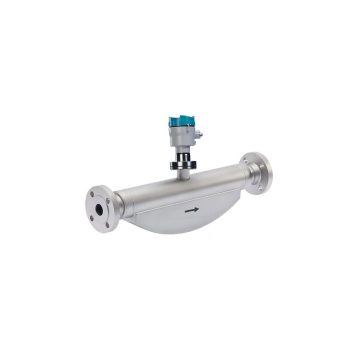
With the SITRANS FC310 digital Coriolis flowmeter, you can fit more meters into less space and reduce skid size without compromising performance. The FC310 features an all-in-one design for streamlined installation, easy integration into your control system and optimal cost efficiency since you only pay for what you really need. The complete system can be ordered for standard or hygienic use. The FC310 flowmeter consists of a SITRANS FCS300 sensor and a SITRANS FCT010 transmitter.

 Datenblatt Datenblatt
|
|
Bedienungsanleitung
|