


-
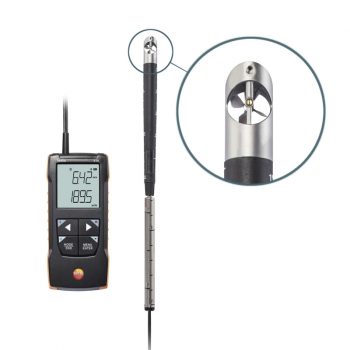
Precise Airflow Measurement – Accurately determines flow velocity and volume flow in ventilation ducts for efficient system analysis.
-
Extendable Telescopic Probe – Cable-connected 16 mm vane probe extends up to 850 mm, ideal for overhead work or deep ducts.
-
Smart App Connectivity – Connects to the testo Smart App for easy configuration, second-screen display, data logging and report generation.
-
Averaging Functions Built-In – Automatically calculates time-based and multi-point mean values for thorough airflow assessment.
 Datasheet Datasheet |
| User Manual |
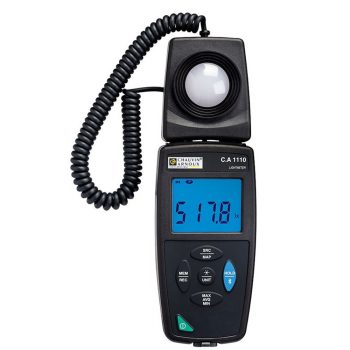
- Measurement range: 0.1 lx to 200,000 lx (lux)
- Intrinsic uncertainty (without compensation): ± 3% of the reading for incandescent sources (default) ± 6% of the reading for LEDs (3,000 K to 6,000 K) ± 9% of the reading for fluorescent sources
- Functions: Min, Max, Average, MAP and Hold; lx or fc / Backlighting
- Recording capacity: up to 1 million measurement points
- Interfaces: USB or Bluetooth
- Protection rating: IP50
- Dimensions: Casing: 150 × 72 × 32 mm Sensor: 67 × 64 × 35 mm
- Weight: 345 g (including batteries)
- Compatible with Multifix accessory
- Shockproof protective sheath available as an accessory
| Datasheet |
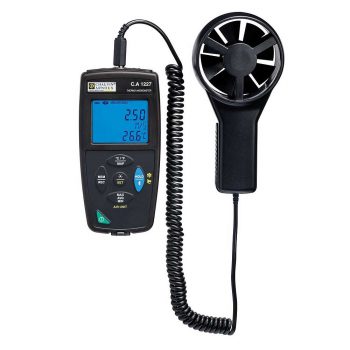
- Flow rate measurement range: 0.50 m/s to 27.0 m/s Intrinsic uncertainty: ± 3 % of reading ± 4 counts
- Flow rate measurement with the cones kit available as an accessory Square cross-section: 346 x 346 mm / Circular cross-section: Ø210 mm
- Temperature measurement range: - 20.0 to + 50.0 °C Intrinsic uncertainty: 0 to 50 °C : ± 0.8 °C / -20 to 0 °C : ± 1.6 °C
- Min, Max, Average, MAP and Hold functions / Backlighting
- Air speed units: m/s, km/h, fpm, mph
- Flow rate units: m3/s, m3/h, l/s, cfm
- Recording up to 1 million points
- USB or Bluetooth interfaces
- Vane diameter: Ø8 mm
- Casing dimensions: 150 x 72 x 32 mm / Sensor: 160 x 80 x 38 mm
- Weight: 400 g with batteries
- Compatible with the Multifix accessory
- Shockproof protective sheath available as an accessory
| Datasheet |

Professional measuring technology in a small format: the compact testo 410i vane anemometer with smartphone operation measures the volume flow, air velocity and temperature at air outlets quickly and reliably. The testo Smart App enables readings to be viewed conveniently and offers intelligent additional functions.
- Measurement of air velocity, volume flow and temperature
- Display of the volume flow of multiple outlets in order to adjust systems
- Easy parametrization of the outlet (dimension and geometry)
- Convenient viewing of readings on a smartphone/tablet with the testo Smart App
| Datasheet |

The testo 410-1 vane anemometer measures air velocity and air temperature. Use it to carry out quick spot measurements at ventilation grilles (air outlets). The anemometer is also ideal for use outdoors. It displays the units m/s, km/h, fpm, mph and kts, and also calculates wind chill and the Beaufort wind force.
- Vane anemometer with permanently installed 30 mm vane
- Measurement of air velocity and air temperature
- Calculates wind chill and the Beaufort wind force
- Practical: with single-point averaging, max/min and Hold function
|
Datasheet
|
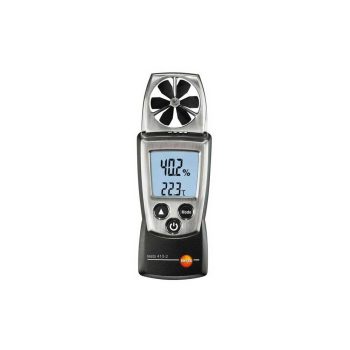
Ideal for rapid measurement at ventilation grilles (air outlets) and for inspecting air conditions – also outdoors: use the testo 410-2 vane anemometer to measure humidity, as well as air velocity and air temperature. Dew point and wet bulb temperature, wind chill or Beaufort wind force: the anemometer can accomplish the calculation of all these parameters at the touch of a button.
- Permanently installed vane with a diameter of 30 mm
- Measurement of air velocity, air temperature and humidity
- Calculates dew point and wet bulb temperature, wind chill and Beaufort wind force
- Includes single-point averaging, max/min and Hold function
|
Datasheet
|

Vane anemometer with telescopic sensor – ideal for carrying out airflow measurements in air ducts.
- Permanently connected telescopic sensor – maximum length 890 mm, diameter 16 mm
- Airflow measurements, selective and time mean values for calculating air volume
- Hold function; min/max display; auto power off
- Calibration certificate and batteries included
 Datasheet Datasheet
|
|
User Manual
|
-
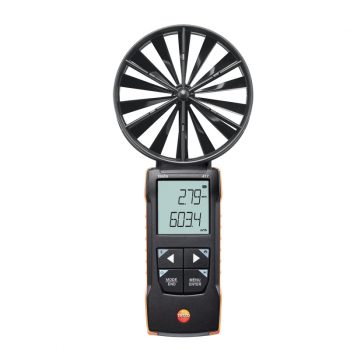
Fast, Accurate Measurements – Measures flow velocity, volume flow and air temperature with precision at both air inlets and outlets.
-
Integrated 100 mm Vane – Ensures quick, stable readings, ideal for residential and commercial ventilation systems.
-
Smart App Connectivity – Connects to the testo Smart App for easy configuration, second-screen display, data logging and report generation.
-
Efficient Ventilation Adjustment – Automatically calculates time and multi-point averages for balanced residential ventilation setup.
|
Datenblatt
|
|
Bedienungsanleitung
|

-
Accurate Flow & Temperature Measurement – Precisely measures air velocity, air temperature and volume flow in ventilation ducts.
-
Telescopic Probe Design – Cable-connected hot wire probe extends up to 820 mm for easy access to large or overhead ductwork.
-
Smart App Connectivity – Connects to the testo Smart App for easy configuration, second-screen display, data logging and report generation.
-
Automatic Calculations – Computes volume flow, timed averages, and multi-point mean values directly on the device.
| Datasheet |
| User Manual |
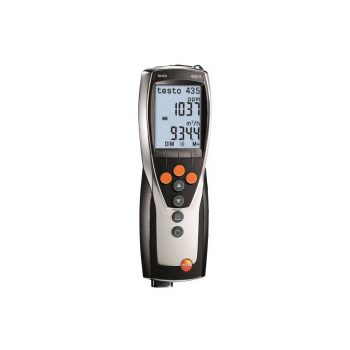
testo 435 is a series of multi-function climate measuring instruments made by Testo. The testo 435-1 version is the entry-level measuring instrument in this series. You can use this to carry out measurements which you need to adjust ventilation and air conditioning systems and assess air quality. For this we offer you a comprehensive range of optional probes and sensors to choose from.
- You have the option of connecting thermal anemometers and vane anemometers for measuring air velocity and volumetric flow in ventilation ducts
- Air quality: measurement of CO2, air humidity, air temperature and absolute pressure with the optional IAQ probe
- Display of dew point distance, min., max. and mean values
- Illuminated display
|
Datasheet
|
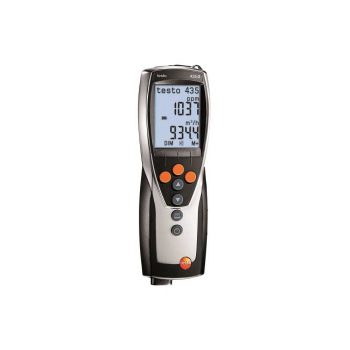
The testo 435-2 indoor air quality meter allows you to carry out all the measurements that are necessary to check and adjust ventilation and air conditioning systems and assess the quality of the indoor air. Select from a wide range of probes and sensors. Because it’s you know best what your meter needs to be able to do!
- Comprehensive range of measuring functions using optionally available accessories – e.g. anemometers, moisture sensors, lux and degree of turbulence sensors
- Super-size memory for up to 10 000 readings
- Displays dew point difference, min, max and mean values
- PC software for analyzing and logging measuring data
|
Datasheet
|
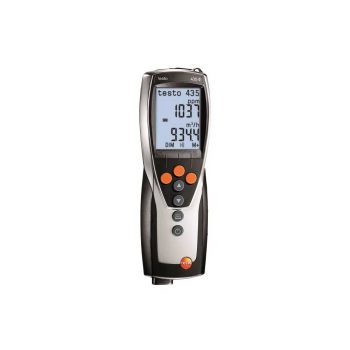
testo 435-3 – multi-function climate measuring instrument with integrated differential pressure measurement. You can use this to carry out measurements which you need to adjust ventilation and air conditioning systems and assess room air quality. For this we offer a comprehensive range of optional probes and sensors to choose from.
- Includes differential pressure measurement for filter monitoring or for measurement with a Pitot tube
- Further optional probes can be attached: thermal and vane anemometers, along with probes for air humidity, CO2, absolute pressure and temperature
- Display of dew point distance, min., max. and mean values
- Illuminated display
|
Datasheet
|
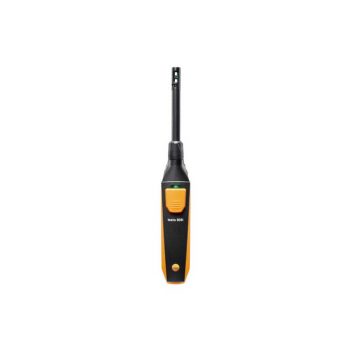
The compact testo 605i temperature and humidity measuring instrument with bendable probe head features professional measuring technology in an intelligent format: it can be used in conjunction with a smartphone/tablet and the testo Smart App to reliably measure air temperature and humidity in rooms and ducts.
- Measurement of air humidity and temperature in rooms and ducts
- Automatic calculation of the dew point and wet bulb temperature via testo Smart App
- Measurement data analysed and sent via testo Smart Probes App
- Problem-free application at measuring points that are a long distance apart thanks to Bluetooth® range up to 100 m
|
Datasheet
|

With the testo 405i hot wire anemometer, you can measure air velocities, temperatures and volume flows. Via Bluetooth, the readings are transmitted wirelessly straight to the testo Smart App on your smartphone or tablet. You can view the values conveniently and use numerous intelligent features:
- For measuring volume flow, air velocity and temperature
- Simple configuration of the dimension and geometry of the duct cross-section for determining the volume flow
- Convenient for working in ventilation ducts thanks to its telescopic tube, which can be extended up to 400 mm
- Really convenient to operate thanks to the testo Smart App (e.g. easy viewing of readings, measurement data trend, log function)
| Datasheet |

The Testo 435-4 multifunction indoor air quality meter allows you to carry out all the measurements you need to inspect and adjust ventilation and air conditioning systems and to check the quality of the indoor air. There is also an integrated pressure difference sensor for pitot static tube measurements and filter monitoring and a wide range of optionally available sensors and probes to choose from.
|
Datenblatt
|

Airflow Instruments – Vane Anemometers for air & technical gases
Vane anemometers measure air velocity and volume flow robustly and intuitively—ideal for HVAC/R, fume hoods, cleanrooms, industrial exhaust and commissioning. Available as handhelds with interchangeable probes, fixed-mount sensors with analog/digital outputs, or flow hoods (balometers) for direct volume-flow determination.
Benefits: direct m/s readout without conversion, strong repeatability in the mid-speed range, optional temperature/humidity compensation, data logging and interfaces (4–20 mA, 0–10 V, Modbus/BACnet, IO-Link). Accessories include telescopic probes, cones/hoods, tripods and calibration certificates.
ICS Schneider Messtechnik assists with probe selection, installation position, traverses, calibration and integration into BMS/SCADA/IIoT.
FAQ on Vane Anemometers
Answers on selection, accuracy, cones/hoods, traversing, installation, compensation, calibration and best practices.
When are vane anemometers the best choice?
When you need direct velocity measurement across roughly 0.2…20 m/s at outlets, ducts, hoods or filters. They’re rugged, less EMC-sensitive and easy to read.
How do small vs. large vanes differ?
| Vane Ø | Strengths | Notes |
|---|---|---|
| Ø 16–25 mm | Good point resolution, tight spaces | More sensitive to alignment; best < 10 m/s |
| Ø 60–100 mm | Better area averaging | Needs space; limited at very low m/s |
What accuracy is realistic?
Typically ±(1…3 % of reading + 0.02…0.1 m/s) within the calibrated range. Alignment to flow and profile quality dominate the uncertainty.
How do I measure volume flow at outlets?
Use a flow hood/cone (direct m³/h readout) or traverse the outlet area and compute Q = vavg · A.
What does a traverse add?
It captures non-uniform flow profiles (behind grilles/swirl diffusers). Multi-point grids significantly improve accuracy vs. single-point readings.
Do I need temperature/pressure compensation?
For standard volume flow you should account for ρ, T, p. Many instruments measure T; pressure can be assumed or measured externally.
What are the rules for fixed sensors?
- Straight runs: typically ≥10·D upstream / ≥5·D downstream (model-dependent).
- Align the sensing axis parallel to the flow; ensure airtight mounting.
- For very low v, consider a flow straightener.
How do I align the probe correctly?
The vane must face the flow square-on. Even ±5–10° tilt can cause measurable error; many probes feature arrow markers.
Can I measure turbulent flows?
Yes, but uncertainty increases. Use a longer averaging time, more points and optionally cones/hoods to average fluctuations.
What are cones/hoods good for?
For supply/exhaust outlets where a defined cross-section and direct m³/h display are desired—less operator-dependent.
Which interfaces are available?
Handhelds: USB/Bluetooth for apps/software and logging. Fixed sensors: 4–20 mA, 0–10 V, pulse/relay, Modbus/BACnet, IO-Link.
How do I clean and maintain the vane?
Remove dust with a soft brush/air; avoid solvents on bearings/blades. For heavy wear/resin, follow manufacturer guidance or service.
How often should I calibrate?
Guideline: annually; shorten for QA-critical use, high utilization or dusty environments. Calibrate in a wind tunnel or using a traceable transfer standard.
Which factors increase uncertainty?
Misalignment, profile inhomogeneity, edge vortices, vibration, temperature swings and contamination of the vane.
How to handle very low velocities?
Use small vane diameters, longer averaging, denser grids, and minimize disturbances (people/thermal plumes). Alternatively consider thermal anemometers.
Any standards/guidelines?
For HVAC acceptance/testing see EN 12599; for field traverses agree on grid layout and uncertainty reporting beforehand.
How do I document professionally?
Provide the grid, averages, stability window, ambient data (T/p/RH), traceability and expanded uncertainty (k=2); export CSV/PDF.
Do you support selection & commissioning?
Yes—we recommend the probe/diameter, define the grid, supply calibration certificates and integrate fixed sensors with BMS/SCADA/IIoT.