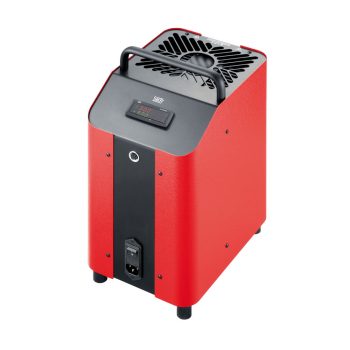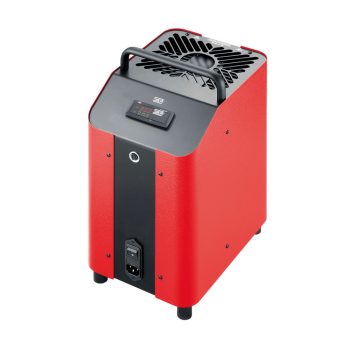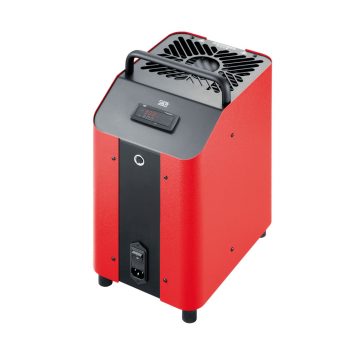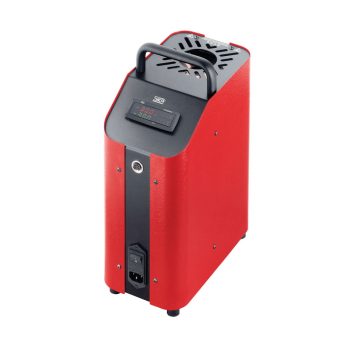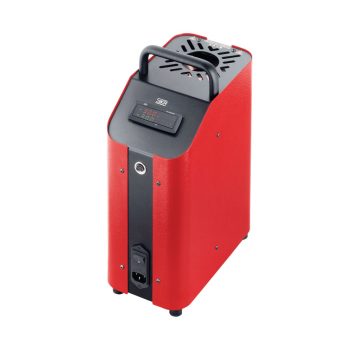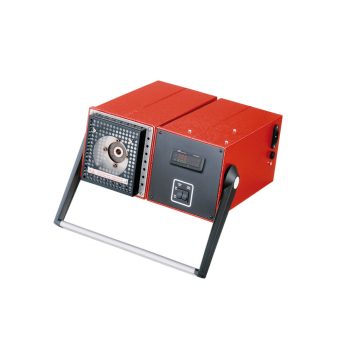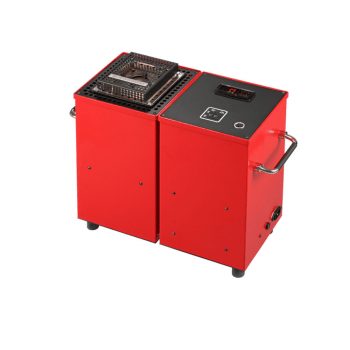
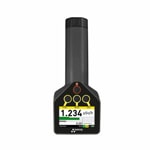


























- Temperature range: RT…650 °C
- Dimension of the calibration insert: Ø13.5 x 110 mm
- Accuracy: ±1.2 °C
- DNV
Datasheet |
User Manual |
- Temperature range -35...165 °C
- Calibration insert dimensions: Ø28 x 150 mm
- Accuracy ±0.4 or 1 °C
Datasheet |
Datasheet |
Datasheet |
User Manual |
- Temperature range -35...165 °C
- Calibration insert dimensions: Ø60 x 150 mm
- Accuracy ±0.4 °C
Datasheet |
Datasheet |
User Manual |
- Temperature range -55...200 °C
- Calibration insert dimensions: Ø28 x 150 mm
- Accuracy ±0.4 °C
- Fastest calibrator with widest temperature range
Datasheet |
Datasheet |
User Manual |
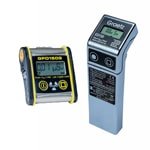
- Temperature range RT...450 °C
- Calibration insert dimensions: Ø60 x 150 mm
- Accuracy ±0.6 °C
- Highest heating power
Datasheet |
Datasheet |
User Manual |
- Temperature range RT...650 °C
- Calibration insert dimensions: Ø28 x 150 mm
- Accuracy ±0.8
Datasheet |
Datasheet |
Datasheet |
User Manual |
- Temperature range RT…200°C
- Accuracy ±1 °C
- DUT holder Ø 18 mm / depth 100 mm
Datasheet |
Datasheet |
User Manual |
- Temperature range RT…850°C
- Accuracy ±1 °C
- DUT holder Ø 18 mm / depth 100 mm
Datasheet |
Datasheet |
User Manual |
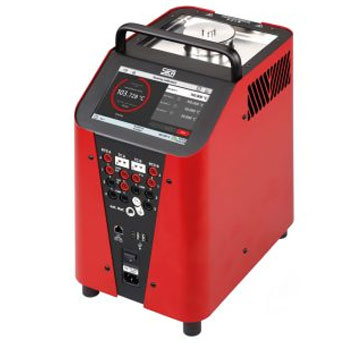
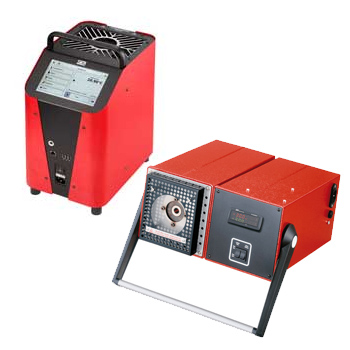
SIKA TP Basic – compact dry-well calibrators for everyday use & service
The SIKA TP Basic series offers handy dry-well calibrators for quick, practical testing and adjustment of temperature probes, indicators, and switches. Ideal for maintenance, production, QA, and field work.
Depending on the model you get interchangeable block inserts, clear set/actual display, configurable ramp rates, and stability assessment functions. The instruments combine short heat-up/cool-down times with high repeatability—at low weight.
ICS Schneider Messtechnik supports selection, test concepts, calibration certificates (ISO/DAkkS), sequences, and documentation of your calibrations.
FAQ on the SIKA TP Basic Series
Answers on use cases, accuracy, inserts, immersion depth, stability, ramps, documentation, and accessories.
Who is TP Basic designed for?
For service/maintenance, production, and QA where mobile, fast, and clean calibrations are needed in daily operations.
Which sensor types can I test?
RTD/Pt100/Pt1000, thermocouples (via indicator/transmitter), thermal switches/thermostats, and temperature indicators.
What temperature ranges are covered?
Depending on the model from sub-zero to high operating temperatures. See the respective product page—we’ll help you choose.
How accurate is calibration with TP Basic?
Practical accuracy depends on stability, gradient, reference sensor, and thermal coupling. For low uncertainties use an external reference probe close to the DUT.
What do stability and homogeneity mean in the block?
Stability = temporal constancy at the setpoint; homogeneity = spatial uniformity (axial/radial). Both affect measurement uncertainty.
Which block inserts are available?
Interchangeable inserts with various bore sizes (single-/multi-hole). Choose a bore 0.2–0.5 mm larger than the probe diameter.
How deep should I immerse the probe?
Rule of thumb: 15–20× the probe diameter or until the sensing point sits fully in the homogeneous zone. Keep distance to the bore bottom.
What should I consider when loading the block?
Many/large probes increase gradients and prolong stabilization time. Reduce count or select larger bores/inserts if needed.
Does TP Basic support ramps and dwell times?
Yes—model-dependent ramp and stability criteria can be configured. Record readings only after stability is achieved.
How do I choose calibration points?
Process-driven: low/mid/high operating range; optionally 0 °C (ice point) and a point near the upper limit.
Can I test thermostats/switches?
Yes. Capture the switching point on heating and cooling, document hysteresis, and record limits.
How is documentation handled?
Log readings with timestamp, set/actual, reference, and ambient data; export CSV/PDF via connected indicator/software.
Which references do you recommend?
Precision Pt100 with a current calibration certificate matched to the temperature span. Position as close to the DUT as possible.
Are interfaces/software available?
Depending on model, PC interfaces are available for reporting. We provide report templates and integrate with existing QA workflows.
How fast does TP Basic heat/cool?
Designed for short ramps in daily use. Exact times are model-dependent and influenced by setpoint and load.
What safety notes apply?
Mark hot surfaces, wear heat-protection gloves, ensure stable setup and ventilation. Do not leave devices unattended at high temperatures.
Which accessories are useful?
Transport case, block inserts (various bores), reference probes, tongs/tweezers, and a surface plate (model-dependent).
ISO or DAkkS calibration available?
Yes. We supply factory or DAkkS certificates for reference probes and indicators—aligned with your audit requirements (e.g., ISO 9001, GMP).
Limits of TP Basic vs. high-end series?
TP Basic focuses on mobile everyday utility. For highest accuracies, advanced automation, or special ranges, we offer alternatives within SIKA’s portfolio.
Do you support selection & commissioning?
Yes. We define sequences, recommend inserts/references, integrate with QA/software, and train your team—including uncertainty analysis.


Datasheet
Datasheet