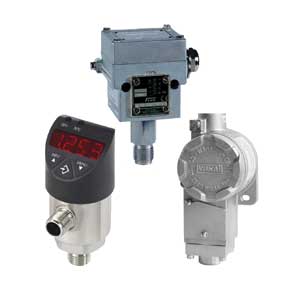
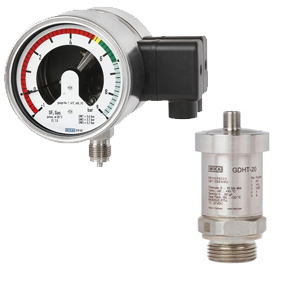
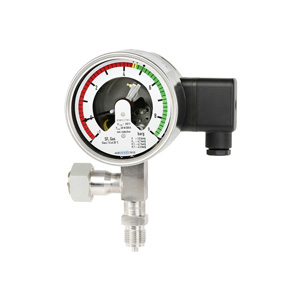
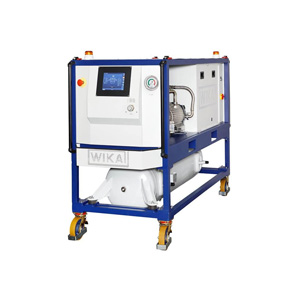
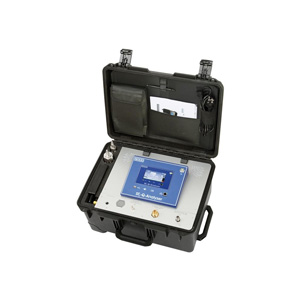






















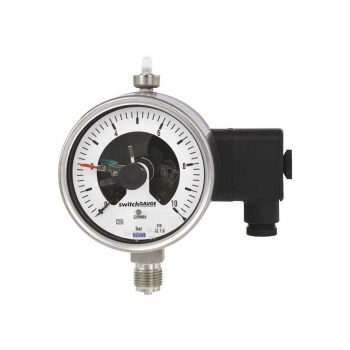
- High reliability and long service life
- Up to 4 switch contacts per instrument
- Instruments with electronic contacts for PLC applications
- Contact gauges comply with DIN 16085
Datasheet |
User Manual |
User Manual Ex |
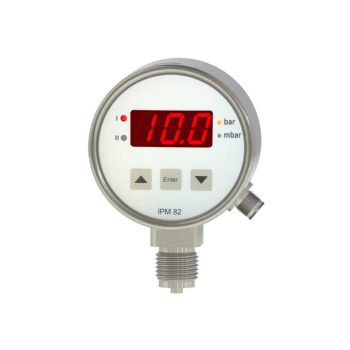
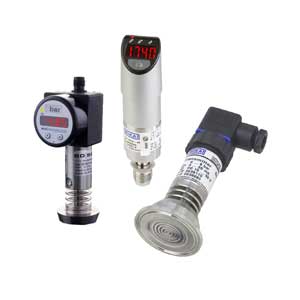
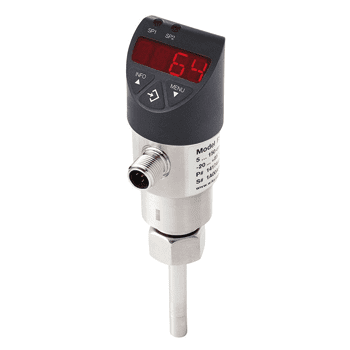
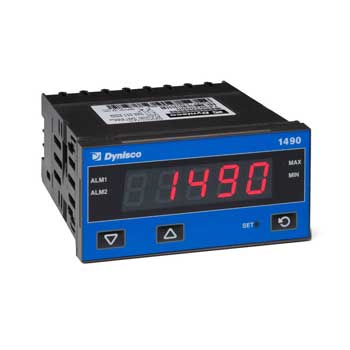
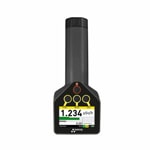
- 3-digit 14 mm LED digital contact gauge
- 80 mm stainless steel case turnable 330°
- Min./max. memory
- Ranges from 25 mbar to 40 bar
- Dry ceramic sensor
- Analog output: 0(4)...20 mA, 0...10 V
- 2 DC PNP contact setpoints, max. 200 mA
- Available with all standard process connections
Datasheet
|
Datasheet |
User Manual |
- Up to 4 switch contacts per instrument
- Also available with case filling for high dynamic pressure loads or vibrations
- Instruments with inductive contacts for use in hazardous areas
- Instruments with contacts for PLC applications
- Instruments optionally available in safety version S3 per EN 837
Datasheet |
User Manual |
User Manual |
- High reliability and long service life
- Wide choice of special materials
- Up to 4 switch contacts per instrument
- Also available with liquid filling for high dynamic pressure loads or vibrations
- Instruments with inductive contacts for use in hazardous areas
- Instruments with contacts for PLC applications
Datasheet |
User Manual |
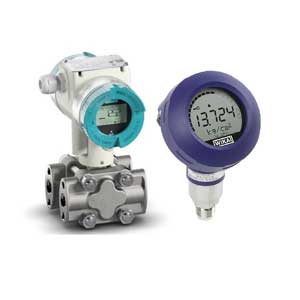
- Differential pressure measuring ranges from 0 … 60 mbar
- High working pressure (static pressure) and high overload safety, selectable up to 40, 100, 250 or 400 bar
- Measuring cell liquid dampening against rapid pressure changes
- Instruments with inductive contacts for use in hazardous areas
- Instruments with switch contact for PLC applications
Datasheet |
ndustry version , with or without filling, Nominal size 100 and 160 according to DIN EN 837-3.
Datasheet
|
Stainless steel, with or without filling Nominal size 100 , 160, Accuracy class 1,6 and 2,5 according to DIN EN 837-3
Datasheet
|
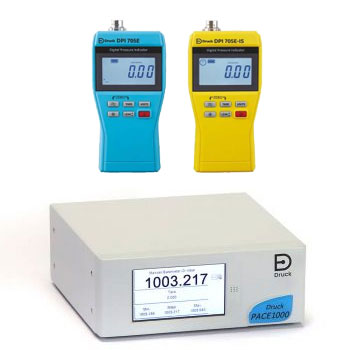
- No configuration necessary due to “plug-and-play”
- Signal transmission per NAMUR
- Differential pressure measuring ranges from 0 … 16 mbar
- Easy-to-read analogue display with nominal sizes 100 and 160
- Individual, non-linear characteristic curves (e. g. x2 or √x for flow measurement)
Datasheet |
User Manual |
- Differential pressure measuring ranges from 0 … 60 mbar
- High working pressure (static pressure) and high overload safety, selectable up to 40, 100, 250 or 400 bar
- Measuring cell liquid dampening against rapid pressure changes
- Instruments with inductive contacts for use in hazardous areas
- Instruments with switch contact for PLC applications
Datasheet |
User Manual |
User Manual |
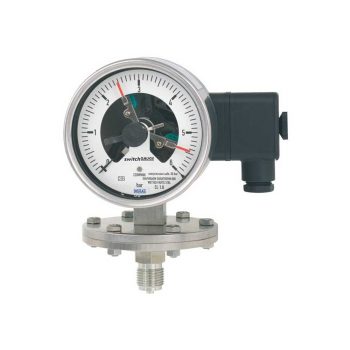
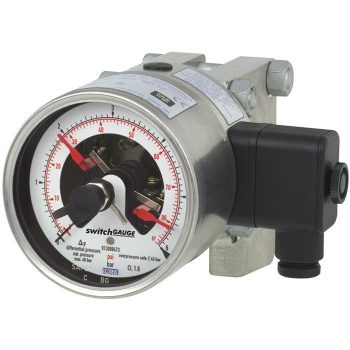
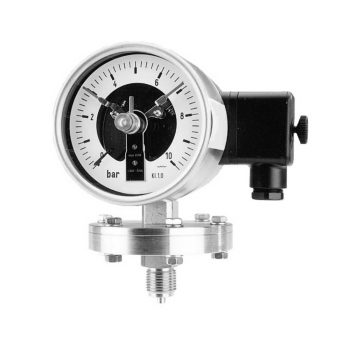
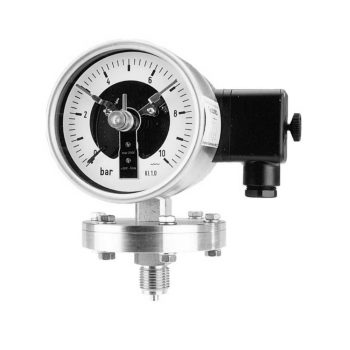
Contact Pressure Gauges – local indication with integrated switching
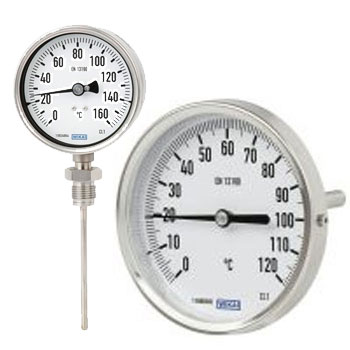
Contact pressure gauges combine an easy-to-read pointer dial with electrical switching contacts for limit monitoring. Depending on the model you can choose magnetically or inductively actuated contacts, micro-switches or reed contacts — as single, dual (Hi/Lo) or multiple contacts. This allows direct control of pumps, valves, alarm horn/beacon or a PLC.
ICS Schneider Messtechnik supplies contact gauges in all-stainless-steel designs (e.g., for process industries), with glycerin filling for vibrating installations, optionally in hygienic versions with diaphragm seal, and with ATEX/IECEx approvals. On request we provide calibration certificates (ISO/DAkkS) and assist with safe electrical integration.
FAQ on Contact Pressure Gauges
Answers on contact types, switching capacity, wiring, damping, accuracy, hazardous areas, and electronic-output alternatives.
Which contact types exist and what are they good for?
| Contact type | Principle | Advantages | Typical application |
|---|---|---|---|
| Magnetic (MSR) | Magnetic follower, mechanical switch | Robust, simple wiring | General limits, AC/DC loads |
| Reed | Hermetic glass reed, magnet actuated | Long life, low arcing | Low currents, signal inputs |
| Inductive (NAMUR) | Non-contact, flag on pointer | Wear-free, suitable for Ex i | Hazardous areas, PLC NAMUR inputs |
| Micro-switch | Mechanical change-over | High switching power | Direct switching of small loads |
How many setpoints can I configure?
Depending on the model 1 to 4 contacts. Common: Hi and Lo (dual contact) for window monitoring. Setpoint markers are accessible on the front and can be secured against accidental adjustment.
What switching capacities are typical?
| Contact | Typical switching capacity | Notes |
|---|---|---|
| Magnetic/Micro-switch | e.g., 250 V AC / up to 1–3 A | Observe datasheet ratings, limit switching frequency |
| Reed | e.g., 30 V DC / 0.2–0.5 A | Use flyback diode with inductive loads; keep contact load low |
| Inductive (NAMUR) | mA-range signal | Requires isolator/barrier (Ex i) |
How is a contact gauge wired?
Via a terminal box or cable gland. Follow the wiring diagram. In hazardous areas use only approved barriers/isolators (e.g., for NAMUR circuits).
How do I set the switch points?
Position the setpoint markers at the desired values, then function-test with a pressure source. Hysteresis depends on the contact principle; if needed, increase effective hysteresis by adding a restrictor/snubber on the process side.
How can I improve switching accuracy with pulsation/vibration?
- Glycerin filling (pointer damping)
- Restrictor/snubber against pressure spikes
- Rigid mounting and short process line
What accuracy classes are common?
For the dial indication typically class 1.6–1.0 per EN 837. Note: switch repeatability depends on the contact type and may differ. For tight tolerances consider an electronic pressure switch or a digital gauge with switch output.
Which process connections and materials are available?
| Connection | Material | Use |
|---|---|---|
| G 1/4, G 1/2 / ¼"–½" NPT | Brass, 316L | General applications |
| Tri-Clamp/Varivent® (with diaphragm seal) | 316L, PTFE/PFA | Hygienic food/pharma |
| Flange EN/ASME | 316L, special alloys | High pressure/corrosive media |
Are versions for hazardous areas available?
Yes. Inductive (NAMUR) contacts are well-suited for Ex i loops. Select approvals and associated apparatus according to the protection concept.
When is a diaphragm seal recommended?
With hot, viscous or aggressive media and in hygienic applications. The seal protects the gauge but slightly reduces dynamics; consider a larger dial size for better readability.
Contact gauge or electronic pressure switch?
| Criterion | Contact gauge | Electronic pressure switch |
|---|---|---|
| Indication | Pointer & scale | Digital/display |
| Setpoints | Mechanical/inductive | Electronically configurable |
| Accuracy/repeatability | Good | Very good |
| EMC/diagnostics | Basic | Extended (model-dependent) |
Which dial sizes are offered?
Typically DN 100 and DN 160. Larger dials make precise setting/reading of setpoints easier.
How often should I calibrate/check?
Annually as a rule of thumb; in safety-related applications semi-annually/quarterly. After overload/events, check immediately. Archive calibration certificates securely.
What ingress protection (IP) ratings are available?
Depending on model IP54–IP65. Consider front sealing and window (safety glass). Choose splash-proof variants for washdown areas.
What should I consider for electrical safety?
- Do not exceed contact load and switching capacity.
- Protect inductive loads with flyback diodes/suppressors.
- EMC-compliant cable routing; observe PE/earthing and equipotential bonding.
How do I prevent nuisance alarms caused by pressure spikes?
Add a snubber/restrictor on the process side, optionally a capillary or remote mount. Provide mechanical damping and suitable hysteresis.
Are combinations with analog output available?
Yes — alternatively use pressure gauges with output signal (4–20 mA/0–10 V) or a digital gauge with switch output if you need both indication and a measurement signal.
Do you support selection & commissioning?
Yes. We size range/dial, select contact type/switching power, advise on damping/EMC/Ex, and supply calibration certificates plus suitable connection components.


Datasheet
Datasheet