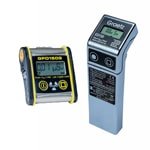





















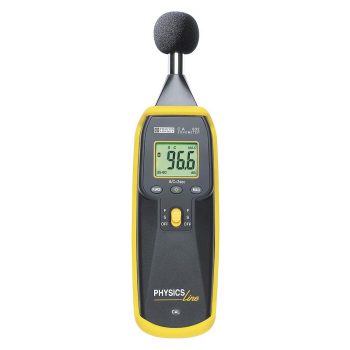
- Dynamic range: 37 to 130 dB
- Accuracy: ± 1.5 dB
- Resolution: 0.1 dB
- Time weighting: Fast, Slow
- Frequency weighting: dB(A) et dB(C)
- Storage of maximum value
- Analogue output: 10 mV/dB and 1 VRMS - 600 Ohms
- Tripod insert
- Shockproof protective sheath
- Dimensions: 237 x 60.5 x 38 mm
- Weight: 230 g
Datasheet |
- Frequency evaluation according to characteristic curves A and C
- Easy to adjust (adjustment screwdriver included in the scope of delivery)
- Min./max. memory
- Integrated tripod knuckle screw (1/4 inch)
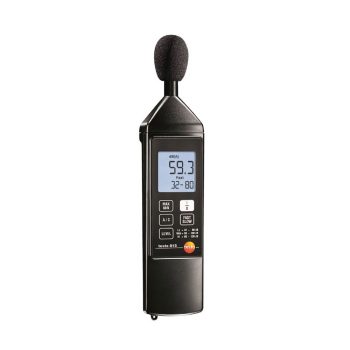
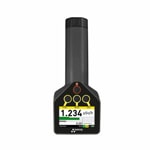
Determine the noise level quickly, easily and reliably in your day-to-day work: with the testo 815 sound level meter.
Datasheet
|
- Precise noise level measurements according to IEC 61672-1 Class 2 and ANSI S1.4 Type 2
- Ideal for health and safety inspections and immission control
- Integrated memory for up to 31 000 readings: long-term measuring possible
- PC software for data analysis and USB cable for data transfer
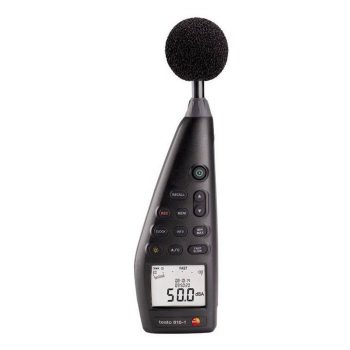
The testo 816-1 sound level meter is the professional model in the Testo sound level meter series. It is designed specifically for measuring noise levels in the workplace, in public places and in industry and production. Includes data storage and analysis.
Datasheet
|
- Measurement of the equivalent continuous sound level (Leq)
- Recording of up to 64,000 measurement points
- Wide backlit screen with digital display and bargraph
- Microphone for remote use (extension accessory)
Datasheet |
User Manual |
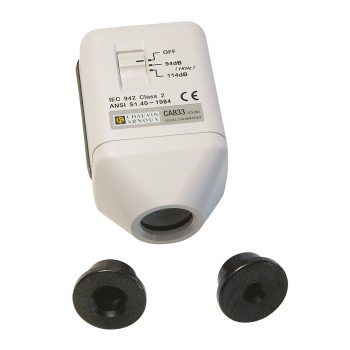
The C.A 833 Calibrator is a standard source (1kHz) used for calibrating sound level meters.
- Compliant with the IEC 942 type 2 standard
- Calibration level: 94 and 114 dB
- Usable microphone diameter: 2.5 cm / 1.3 cm / 0.64 cm
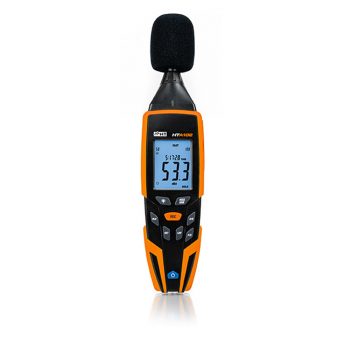
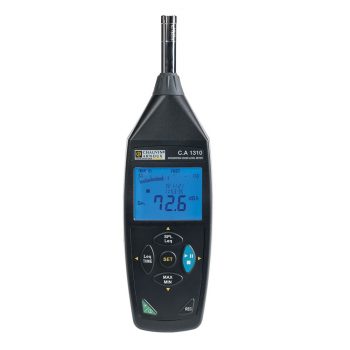
| Noise measurement resolution | 0,1 dB |
| Noise measuring range | from 30 dB to 130 dB |
| Measurement of sound pressure level (SPL) | Auto 30/130 |
| Measurement of sound pressure level (SPL) | Hi 80/130 |
| Measurement of sound pressure level (SPL) | Med 50/100 |
| Internal memory for data saving | 32.700 recordings |
| Backlit LCD display | 4 digit |
| Bargraph | |
| Device category (Class) | IEC61672-1 Class 2 |
| Mini-USB interface for PC connection | |
| Auto Power OFF | |
| -10°C / 60°C - <75%RH | |
| Power supply | 1x9V alkaline battery type IEC 6F22 |
| Size (L x W x H) | 260x65x50 mm |
| Weight | 280 gr |
Datasheet
|
User Manual
|
Sound Level Meters / Noise and Sound Pressure Measuring Instruments
Sound level meters (SLM) are used to measure sound pressure level (SPL) in the environment, expressed in decibels (dB). They capture ambient noise — for example from machines, workplaces, environmental or neighbourhood noise — and help assess acoustic conditions. Modern devices offer A- and C-weighting, peak and Leq measurement, data logging, frequency analysis, and often interfaces for documentation and acoustic quality control.
What exactly does a sound level meter measure?
A sound level meter measures the sound pressure level in dB, which represents the ratio of the current sound pressure to a reference pressure. In addition, the instrument can record time-weighted averages (Leq), maximum levels (Lmax/Lpeak), minimum levels (Lmin) and impulse levels. Some meters also offer frequency analysis to identify specific noise sources.
What do A- and C-weighting mean?
A-weighting approximates the frequency-dependent sensitivity of the human ear and is used for general noise measurements in everyday and workplace environments. C-weighting covers a broad frequency range — including low frequencies — and is used for specialized measurements, e.g. industrial, machine or environmental noise. Choosing the correct weighting adjusts the measurement result to the situation.
What is Leq and why is it important?
Leq (equivalent continuous sound level) indicates the constant sound pressure level over the measurement period that has the same total acoustic energy as the measured varying noise. This value is important for valid assessment of average noise exposure, e.g. at workplaces or in residential environments over extended times, and serves as a basis for legal regulations and guidelines.
Which measurement ranges do sound level meters cover?
Typical sound level meters cover sound levels from approx. 30 dB up to 130 dB. This allows measuring from quiet environments (whispering, quiet rooms) up to loud settings (machines, traffic, construction sites). Some devices offer extended ranges or special sensitivity for low-frequency ambient noise.
Why are frequency analysis and spectrum useful in sound measurements?
Frequency analysis allows separating sound components into different frequency bands, making it possible to draw conclusions about noise sources — e.g. motors, fans, machine vibrations or traffic noise. Spectrum data supports root-cause analysis, sound insulation measures and adherence to specific standards or requirements concerning noise characteristics.
Where are sound level meters typically used?
Typical applications include workplace noise measurement, environmental noise assessment, machinery and equipment testing, construction site monitoring, traffic noise, acoustic inspections, consultancy, room acoustics measurements, as well as emission control for devices or installations.
What should be considered when positioning the microphone sensor?
The microphone head should be placed freely and representatively in the room — ideally away from reflective surfaces, walls or obstacles that could distort the result. Orientation and height should correspond to typical listening position or the source of noise. For outdoor measurements, windscreen and distance to noise sources must be taken into account.
Why is calibration important for sound level meters?
Microphone and sensitive electronics may lose sensitivity over time. Regular calibration using a reference sound generator ensures that measurements remain accurate and traceable — particularly important for norm-based measurements, reports or after prolonged use.
Which additional functions are useful in sound level meters?
Important features are data logging, time-weighted average, peak level memory, frequency / spectrum analysis, A- and C-weighting, impulse detection, configurable measurement durations, hold / freeze function, interfaces (e.g. USB/RS-232) and — if used outdoors — windscreen to ensure reliable, flexible and standards-compliant measurements.
Are there differences between basic and professional sound level meters?
Yes — basic devices are often sufficient for rough checks or leisure and ambient noise assessments, providing simple A-weighting and level display. Professional sound level meters offer extended functions like Leq, Lmax, spectrum analysis, data logging, high accuracy, directional microphones, windscreen and calibratability — required for industrial, legal or standard-compliant applications.


Datasheet