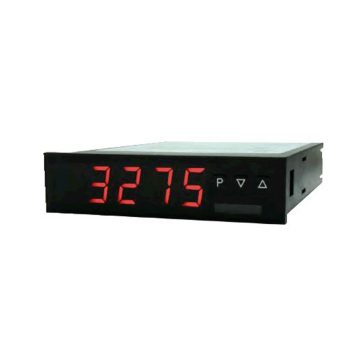
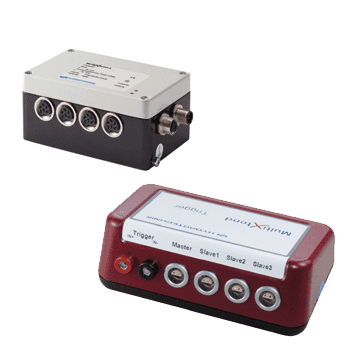
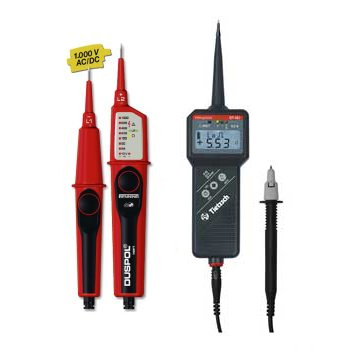
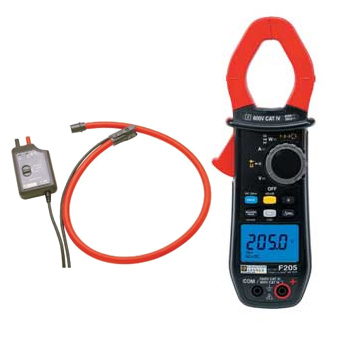
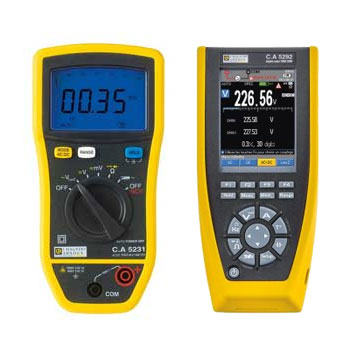
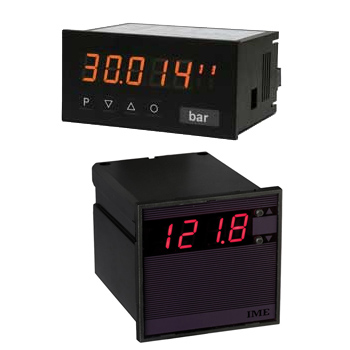
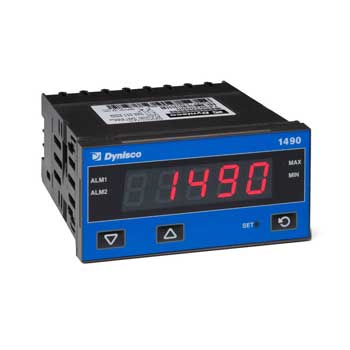
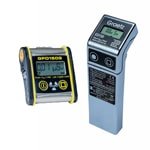
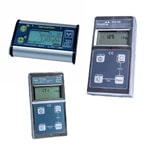
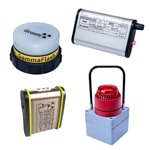
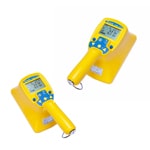























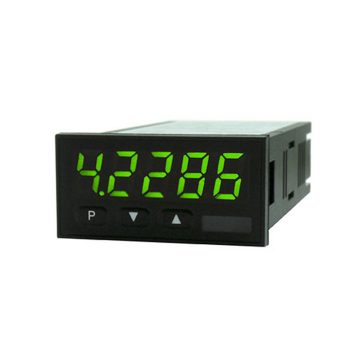
Housing 48 x 24 mm
Display 5-digit 10 mm digit height Colour: red, green, orange or blue display
Range displayed 0 to 99999
Operation front panel keyboard protection class IP65
Input Frequency 0.01 to 999.99 kHz 3-wire PNP/NPN, Namur, incremental encoder, TTL signals Digital input: <2.4V OFF, >10V ON, max. 30 VDC
Analogue Output 0/4-20 mA / 0-10 VDC / 16 Bit Alternatively sensor supply
Switch point 2 PhotoMos outputs (NOC) 30 VDC/AC, 0.4 A
Interface
Power supply 24 VDC galvanic isolated 100-240 VAC 50/60 Hz / DC +/- 10%
Sensor supply 10 VDC / 20 mA, incl. digital input 24 VDC / 50 mA, incl. digital input & impulse output, max. 10kHz Alternatively analog output
Software properties
  • min/max-memory with adjustable permanent display
  • 30 additional adjustable supporting points
  • display flashing at threshold value exceedance/undercut
  • Schmitt-Trigger-input
  • digital frequency filter for contact bounce suppression and interference suppresion
  • frequency filter with varying pulse-duty factor
  • navigation keys for triggering of Hold, Tara, display change, setpoint setting, alarm actuator
  • flexible alarm system with adjustable delay times
  • volume metering (Totalisator) pulse precisely for frequencies up to 1kHz
  • mathematical functions like reciprocal value, square root, squaring and rounding
  • constant setting/setpoint setting
  • sliding averaging
  • brightness control via parameter or front keys
  • programming interlock via access code
Datasheet
User Manual

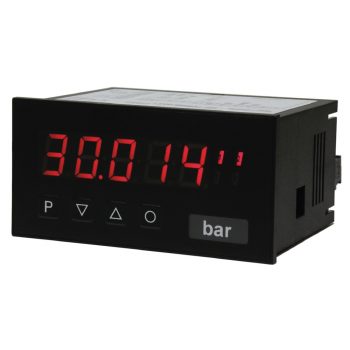
Housing 96 x 24 mm
Display 5-digit
14 mm digit height
Colour: red, green, orange or blue display
Range displayed 0 to 99999
Operation front panel keyboard protection class IP65
Input Frequency
0.01 to 999.99 kHz
3-wire PNP/NPN, Namur, incremental encoder, TTL signals
Digital input: <2.4V OFF, >10V ON, max. 30 VDC
Analogue Output 0/4-20 mA / 0-10 VDC / 16 Bit
Alternatively interface RS232/RS485
Switch point 1 or 2 change-over relays
250 VAC / 2 AAC ; 30 VDC / 2 ADC
Interface RS232 or RS485 galvanic isolated
Alternatively analog output
Power supply 10-40 VDC / 18-30 VAC 50/60Hz
100-240 VAC 50/60 Hz / DC +/- 10%
Sensor supply 10 VDC / 50 mA, incl. digital input
24 VDC / 50 mA, incl. digital input
Software properties
  • min/max-memory with adjustable permanent display
  • 30 additional adjustable supporting points
  • display flashing at threshold value exceedance/undercut
  • Schmitt-Trigger-input
  • digital frequency filter for contact bounce suppression and interference suppresion
  • frequency filter with varying pulse-duty factor
  • navigation keys for triggering of Hold, Tara, display change, setpoint setting, alarm actuator
  • flexible alarm system with adjustable delay times
  • volume metering (Totalisator) pulse precisely for frequencies up to 1kHz
  • mathematical functions like reciprocal value, square root, squaring and rounding
  • constant setting/setpoint setting
  • sliding averaging
  • brightness control via parameter or front keys
  • programming interlock via access code
Datasheet
User Manual

Housing 96 x 48 mm
Display 5-digit 14 mm digit height Colour: red, green, orange or blue display
Range displayed 0 to 99999
Operation front panel keyboard protection class IP65
Input Frequency 0,01 Hz to 999,99 kHz 3-wire PNP/NPN, Namur, incremental encoder, TTL signals Digital input: <2.4V OFF, >10V ON, max. 30 VDC
Analogue Output 0/4-20 mA / 0-10 VDC / 16 Bit Alternatively sensor supply and digital input
Switch point 2 relays (change-over contact) 250 V / 5 AAC, 30 V / 5 ADC
Interface
Power supply 230 VAC 10-30 VDC galvanic isolated Other voltage supplies on demand!
Sensor supply 10 VDC / 20 mA, incl. digital input 24 VDC / 50 mA, incl. digital input 24 VDC / 50 mA, incl. digital input & impulse output, max. 10kHz Alternatively analog output
Software properties
  • min/max-memory with adjustable permanent display
  • 30 additional adjustable supporting points
  • display flashing at threshold value exceedance/undercut
  • Schmitt-Trigger-input
  • digital frequency filter for contact bounce suppression and interference suppresion
  • frequency filter with varying pulse-duty factor
  • zero-key for triggering of Hold, Tara, display change, setpoint setting, alarm actuator
  • flexible alarm system with adjustable delay times
  • volume metering (Totalisator) pulse precisely for frequencies up to 1kHz
  • mathematical functions like reciprocal value, square root, squaring and rounding
  • constant setting/setpoint setting
  • sliding averaging
  • brightness control via parameter or front keys
  • programming interlock via access code
Datasheet
User Manual

Housing 96 x 48 mm
Display 5-digit 14 mm digit height Colour: red, green, orange or blue display
Range displayed 0 to 99999
Operation front panel keyboard protection class IP65
Input Frequency 0,01 Hz to 999,99 kHz 3-wire PNP/NPN, Namur, incremental encoder, TTL signals Digital input: <2.4V OFF, >10V ON, max. 30 VDC
Analogue Output 2 analog outputs 0/4-20 mA / 0-10 VDC / 16 Bit
Switch point 2 or 4 relays (change-over contacts) 250 V / 5 AAC, 30 V / 5 ADC or 8 PhotoMos outputs (NOC) 30 V / 0.4 A AC/DC
Interface RS232 or RS485 galvanic isolated Alternatively to analog output 2
Power supply 100-240 VAC 50/60 Hz / DC +/- 10% 10-40 VDC / 18-30 VAC 50/60Hz
Sensor supply 10 VDC / 20 mA, incl. digital input 24 VDC / 50 mA, incl. digital input 24 VDC / 50 mA, incl. digital input & impulse output, max. 10kHz
Software properties
  • min/max-memory with adjustable permanent display
  • 30 additional adjustable supporting points
  • display flashing at threshold value exceedance/undercut
  • Schmitt-Trigger-input
  • digital frequency filter for contact bounce suppression and interference suppresion
  • frequency filter with varying pulse-duty factor
  • zero-key for triggering of Hold, Tara, display change, setpoint setting, alarm actuator
  • flexible alarm system with adjustable delay times
  • volume metering (Totalisator) pulse precisely for frequencies up to 1kHz
  • mathematical functions like reciprocal value, square root, squaring and rounding
  • constant setting/setpoint setting
  • sliding averaging
  • brightness control via parameter or front keys
  • programming interlock via access code
Datasheet
User Manual


Digital Frequency Panel Meters (ICS)

Digital frequency panel meters in the “Frequency (ICS)” category measure electrical frequency or pulse rates and display the values digitally on LED or LCD screens. These instruments typically accept a wide variety of signal types — such as pulses from sensors, encoders or digital inputs (e.g. TTL, PNP/NPN, Namur) — and cover large frequency ranges from very low frequencies up to several hundred kilohertz. They are used for rotational speed monitoring, pulse counting, process control and automation systems. Many models include additional features such as analog outputs, relay contacts, min/max memory and communication interfaces.

F&A

What is a digital frequency panel meter?

A digital frequency panel meter measures the frequency or pulse rate of an input signal and displays the result numerically. It is designed for installation in control cabinets and automation systems and is suitable for processing signals from sensors, encoders and digital pulse sources.

Which input signals and ranges are supported?

The devices typically support wide frequency ranges, for example from 0.01 Hz up to several hundred kHz. Supported input signal types include incremental encoder signals, PNP/NPN inputs, Namur sensors, TTL logic levels and other digital pulse sources.

How does frequency measurement work?

The panel meter counts cycles or pulses within a defined time window and calculates the frequency based on the count. Internal electronics filter and condition the input signal so that stable and reliable readings are produced, even with noisy or irregular signals.

Which display and output options are available?

Typical devices offer 5-digit LED or LCD displays. Depending on the model, additional features may include analog outputs (such as 4–20 mA or 0–10 V), relay outputs, MOSFET or photoMOS switches, serial communication (e.g. RS-232 or RS-485), min/max memory, alarm thresholds or pulse outputs for further counting or control tasks.

Where are digital frequency panel meters used?

Common applications include rotational speed monitoring (motors, pumps, conveyors), frequency and pulse measurement in process control, automation systems, counting tasks in production, flow or speed calculation via sensors and general industrial signal monitoring.

What are the advantages of digital frequency meters?

They provide accurate numeric readings, offer filtering and signal conditioning, avoid reading errors, support additional functions (alarms, storage, outputs) and integrate easily into automated systems. Compared to analog devices, they are usually more flexible, precise and stable.

What should be considered when selecting a device?

Important factors include the required frequency range, compatibility with the input signal type (encoder, TTL, PNP/NPN etc.), needed output features (relay, analog, communication), display size, supply voltage and installation dimensions. Signal quality and noise immunity should also be considered.

Are there limitations?

Digital frequency meters require a stable power supply and clean signal conditions. Very noisy or unstable input signals may require filtering or signal conditioning. At extremely high frequencies, the device’s maximum counting capability must be considered.

Diese Website benutzt Cookies. Wenn du die Website weiter nutzt, gehen wir von deinem Einverständnis aus.