


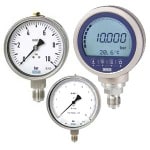
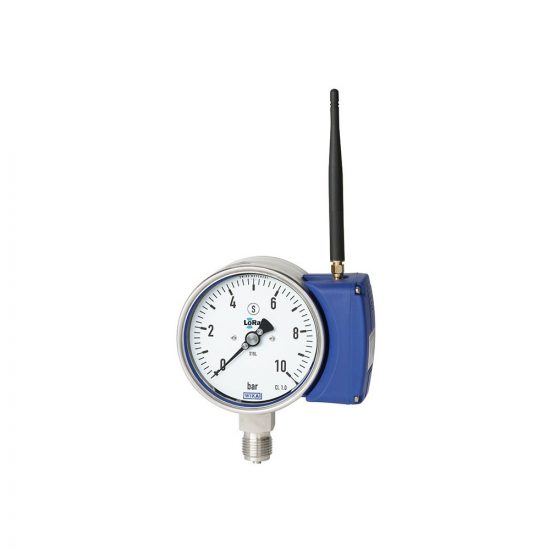

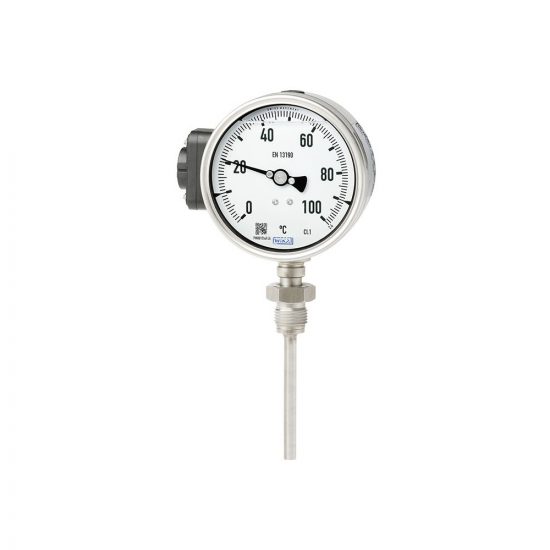

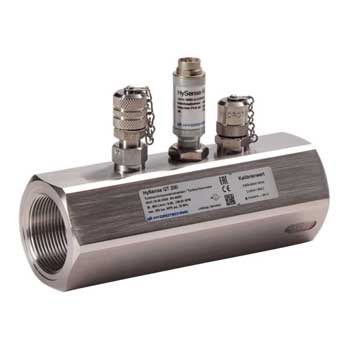
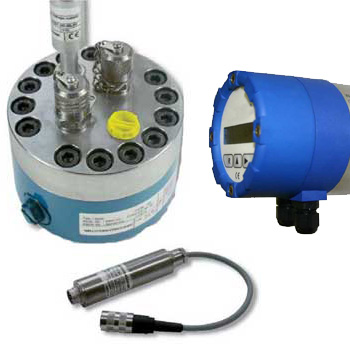
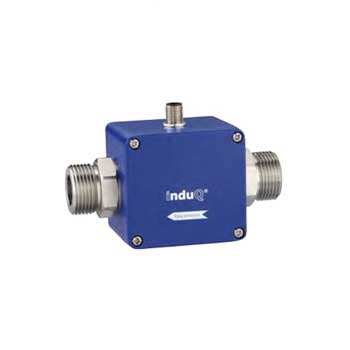
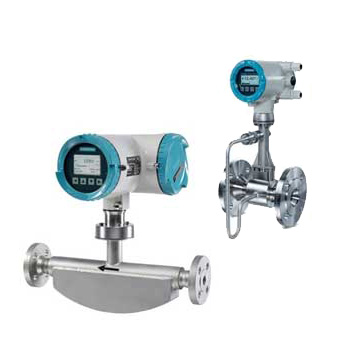
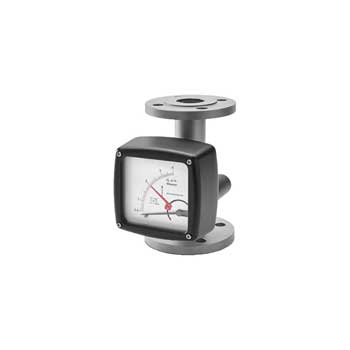
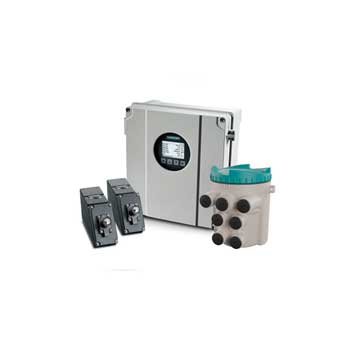
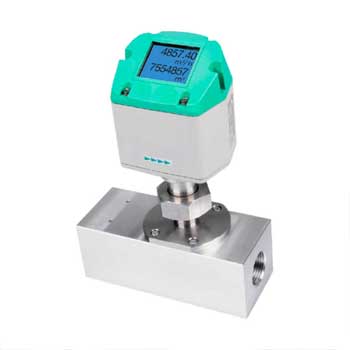
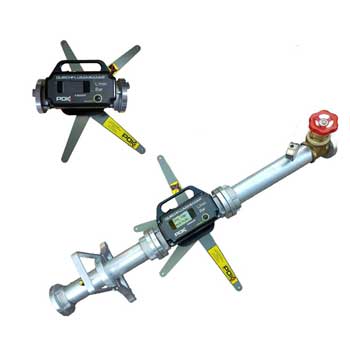
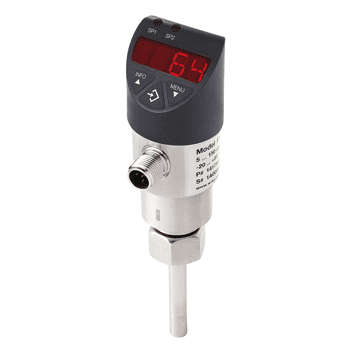
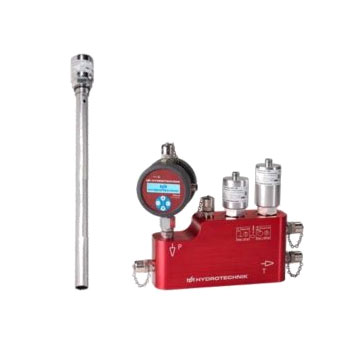
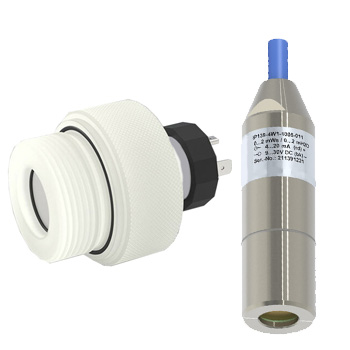



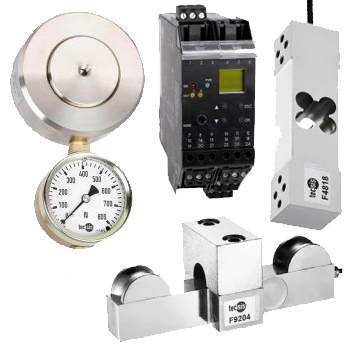



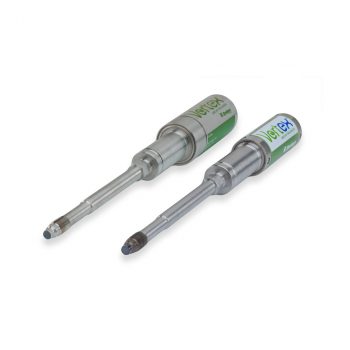
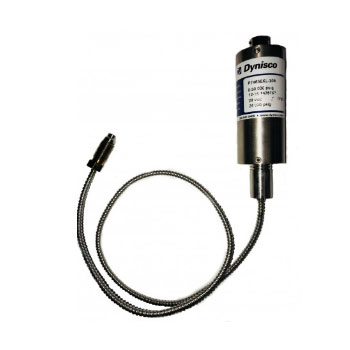
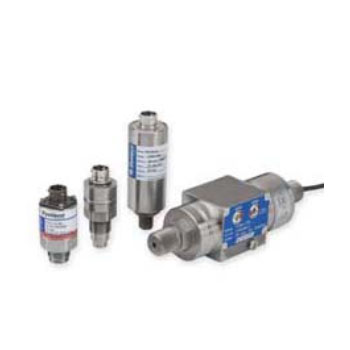
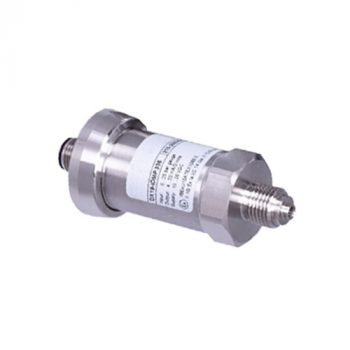
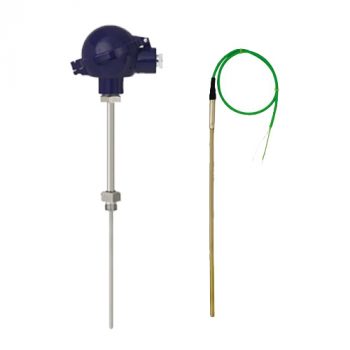
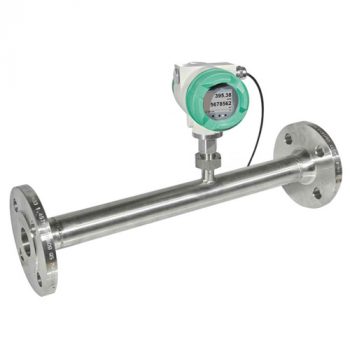
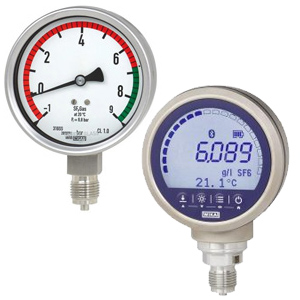
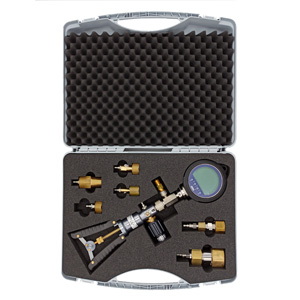
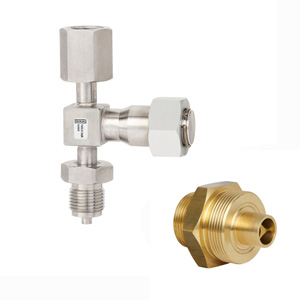
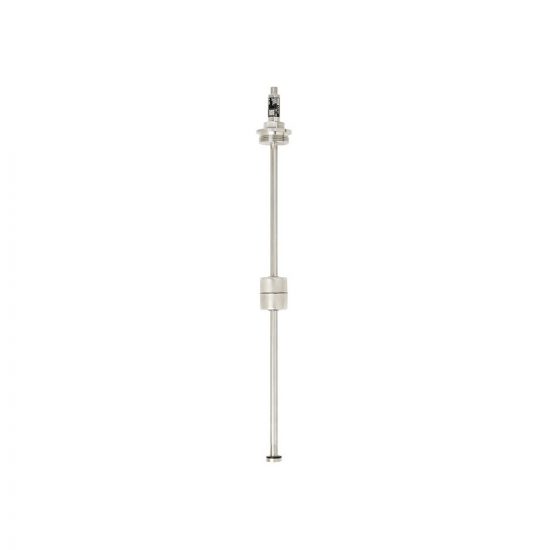
























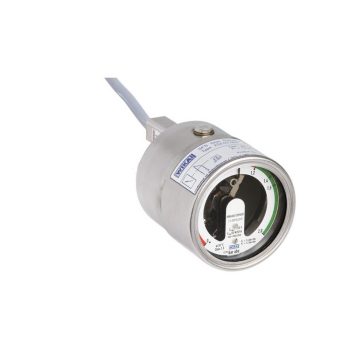
- Temperature-compensated pressure gauge with Bourdon tube
- Suitable for outdoor use
- Wetted parts from stainless steel
- Local readout with alarm contacts
- Hermetically leak-tight, therefore no negative impact by atmospheric pressure fluctuations and differences in altitude
 Datasheet Datasheet
|
|
User Manual
|
|
User Manual
|
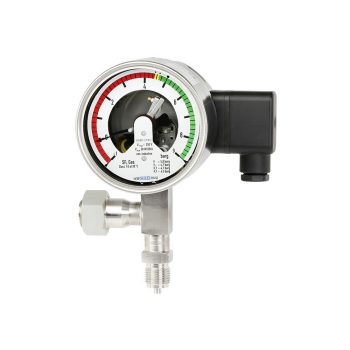
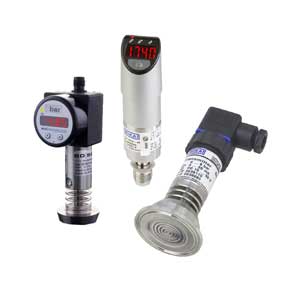
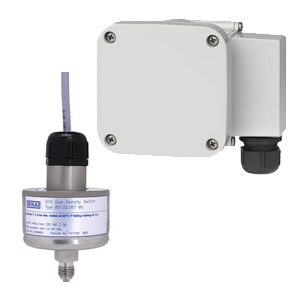
- On-site display with switch contact
- Temperature-compensated and hermetically sealed, therefore no influence of temperature fluctuations, differences in level and atmospheric pressure fluctuations
- Compensation possible for gas mixtures
- Functional check or recalibration possible without dismounting, in accordance with EU regulation no. 517/2014 on fluorinated greenhouse gases
- Test connection is welded to prevent leakage
| Datasheet |
| User Manual |
| User Manual |
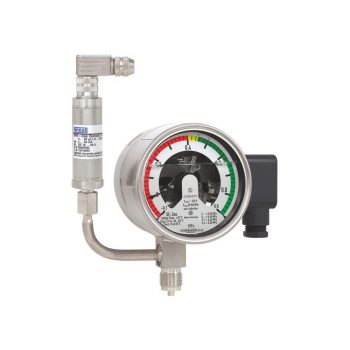
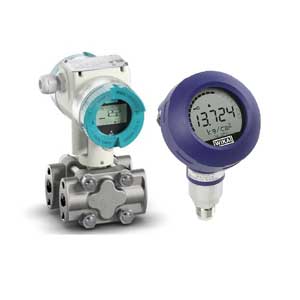
- On-site display with switch contact
- Remote readout (output 4 … 20 mA, 2-wire), measuring ranges from 0 ... 10 g/litre to 0 ... 80 g/litre
- High electromagnetic compatibility (EMC)
- Hermetically sealed, therefore no influence from atmospheric pressure fluctuation and differences in mounting heights
| Datasheet |
| User Manual |

- Measuring ranges from 0 ... 10 to 0 ... 80 g/litre
- Output signal 4 ... 20 mA, 2-wire
- Wetted parts and case made of stainless steel, fully welded
- Ingress protection IP 54 up to 68, depending on the electrical wiring
- Excellent long-term stability, high EMI performance
| Datasheet |
| User Manual |
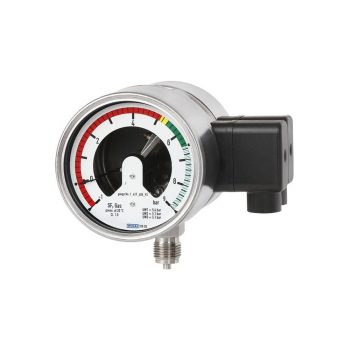
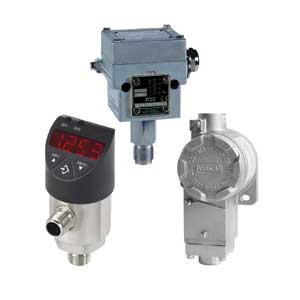
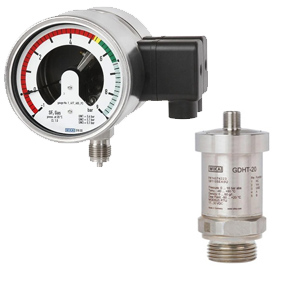
- Ideally suited for Smart Grid or modernisation projects
- On-site display with switch contacts and Modbus® output
- Modbus® delivers measured values for pressure, temperature and gas density
- Compact design with only one process connection
- Precision sensors enable high-accuracy gas density determination
|
Datasheet
|
|
User Manual
|
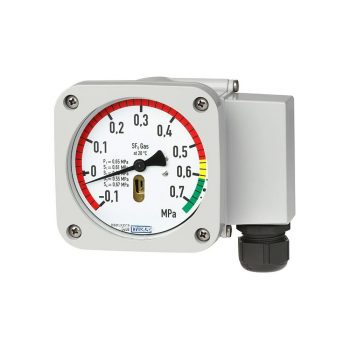
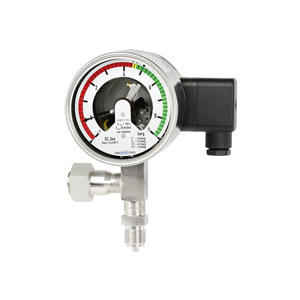
- Accurate isochore, temperature-compensated switching and display over the entire temperature range
- Complete local display of the density and vacuum range on a 100-mm dial
- Increased plant safety through self-diagnostics
- Prepared for any alternative gases
- Very high long-term stability through welded reference gas volume
| Datasheet |
| User Manual |
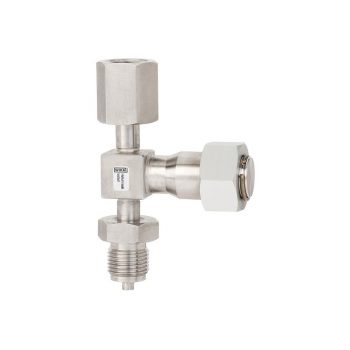
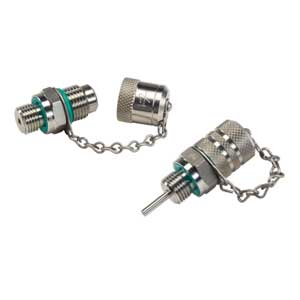
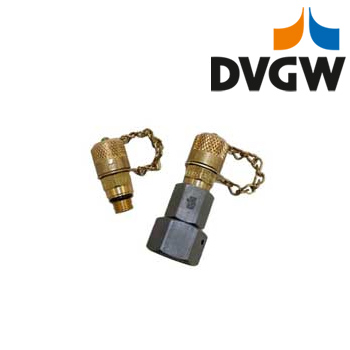
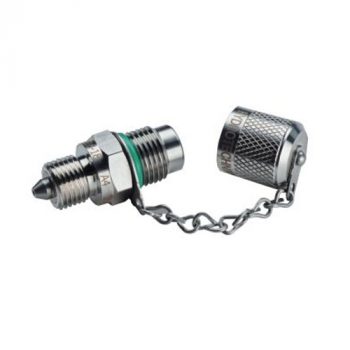
- Retrofitting for leakage detection systems
- Functional check or recalibration possible without dismounting, in accordance with EU regulation No. 517/2014 on fluorinated greenhouse gases
- Test connection from stainless steel
| Datasheet |

SF6 Gas Density Monitors for Gas-Insulated Switchgear
Gas density monitors continuously supervise the SF6 gas density in sealed pressure vessels and gas-insulated switchgear. Using temperature-compensated measuring systems, they detect the density-related pressure and switch at defined thresholds, providing early leak detection and ensuring the operational safety of high-voltage equipment.
Questions & Answers on Gas Density Monitors
What is an SF6 gas density monitor?
An SF6 gas density monitor is a mechanical or mechatronic device that monitors the density of SF6 gas and actuates warning and alarm contacts when preset thresholds are undershot. It is used for early detection of gas losses in SF6-insulated equipment.
Where are gas density monitors used in SF6 installations?
Gas density monitors are used in gas-insulated switchgear, circuit breakers, cable terminations and other SF6 pressure vessels. They protect the equipment against inadmissible insulation degradation, arc fault risk and mechanical overload caused by loss of gas.
What measuring principle do gas density monitors use?
Most gas density monitors use a pressure-based measuring system with integrated temperature compensation. A bellows or diaphragm system senses the SF6 pressure, mechanically amplifies it and transmits the movement to switching mechanisms. The scale or internal characteristic is designed so that the indicated value is proportional to the gas density.
What is the difference between a gas density monitor and a gas density switch?
A gas density monitor typically combines a local indication with several switching contacts for warning and alarm levels in one device. A gas density switch is usually a purely switching device without an analogue indication. Both, however, are based on monitoring the SF6 gas density.
What kind of switching contacts are typically available?
Gas density monitors usually provide at least two potential-free change-over contacts that can be set to different density or pressure levels. Common settings include stages for pre-warning, alarm and, in some cases, an additional stage for forced shutdown of the equipment.
Which measuring and switching ranges are common?
Measuring and switching ranges are matched to the nominal filling pressure and operating temperature of the respective installation. They typically cover the SF6 filling pressure at 20 °C, with switching points at defined relative density losses, for example at 10 % or 20 % loss of gas density.
How is temperature compensation implemented?
Temperature compensation is usually realised by a second bellows or capillary system that mechanically compensates for temperature changes and converts the pressure-dependent signal into a quasi constant gas density indication. This keeps indication and switching points largely independent of ambient temperature within the specified range.
Which process connections are common for gas density monitors?
Common process connections are threaded connections such as G ½, G ¾ or ¼ NPT, depending on the design of the installation. The gas density monitor is mounted directly on the SF6 pressure vessel, on a measuring coupling or on a dedicated connection that links the internal gas space to the measuring system.
Which standards and requirements apply to gas density monitors?
Gas density monitors must meet the pressure equipment, insulation and long-term stability requirements for use in high-voltage installations. They are designed in accordance with the relevant standards for gas-insulated switchgear, including specifications for tightness, mechanical strength, switching accuracy and lifetime performance.
How is a gas density monitor installed?
Installation is usually carried out on a dedicated connection on the SF6 pressure vessel. It is important to ensure stress-free mechanical mounting, observance of the permissible tightening torque and proper orientation of the dial for good readability. The electrical contacts are wired to the protection and monitoring system via terminals or plug connectors.
How often should gas density monitors be tested or recalibrated?
Test intervals depend on the internal maintenance strategy and operator requirements. Typical practice is to check switching points, indication and tightness of the device at multi-year intervals. In critical applications, shorter inspection intervals may be specified.
What options exist for remote monitoring with modern gas density monitors?
Modern gas density monitors may offer, in addition to mechanical switching contacts, electronic outputs such as analogue signals proportional to gas density or digital output signals. This allows easy integration into supervisory control systems and enables continuous remote condition monitoring of the SF6 filling level from the control room.