
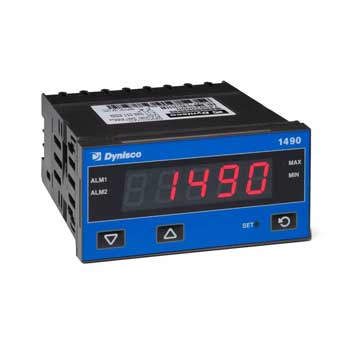
























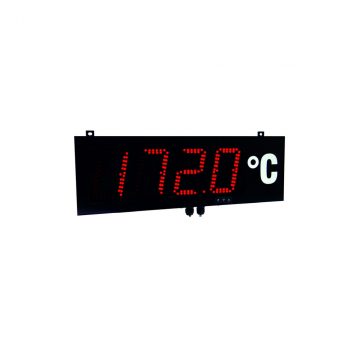
- Digital large-format display with RS232/RS485 interface
- Large 4- to 8-digit 7-segment display with 57 mm digit height
- Suitable as wall-mounted or panel-mount housing
- Display colour red, optionally available in green
- Configurable ASCII protocol for serial communication
- Galvanically isolated RS232 or RS485 interface available
- Front-panel operation via keypad with IP65 protection rating
- Configurable baud rate from 300 to 57 kbit/s
- Software functions such as protocol configuration, start/stop characters, number formatting and programming lock
Datasheet
|
User Manual
|
- Digital large-format display with RS232/RS485 interface
- Large 4- to 8-digit 7-segment display with 100 mm digit height
- Suitable as wall-mounted or panel-mount housing
- Display colour red, optionally available in green
- Configurable ASCII protocol for serial communication
- Galvanically isolated RS232 or RS485 interface available
- Front-panel operation via keypad with IP65 protection rating
- Configurable baud rate from 300 to 57 kbit/s
- Software functions such as protocol configuration, start/stop characters, number formatting and programming lock
Datasheet
|
User Manual
|
- Digital large-format display with RS232/RS485 interface
- Large 4- to 8-digit 7-segment display with 200 mm digit height
- Suitable as wall-mounted housing, panel-mount housing available on request
- Display colour red, optionally available in green
- Configurable ASCII protocol for serial communication
- Galvanically isolated RS232 or RS485 interface available
- Operation via Schurter buttons on the underside of the housing
- Configurable baud rate from 200 to 57 kbit/s
- Software functions such as protocol configuration, start/stop characters, number formatting and programming lock
Datasheet
|
User Manual
|
Large-Digit Displays with RS232/RS485 Interface
Large-digit displays with RS232 or RS485 interface combine a highly visible LED readout with serial digital communication. They show measurement values in a clear, large format while simultaneously transmitting data to higher-level controllers, PCs or control systems. This makes them suitable for control rooms, distribution cabinets or production halls where values need to be visible and at the same time processed in automation systems.
Questions & Answers
What are large displays with serial interface used for?
They are used to both display measured values clearly and transmit them for further processing — for example in production lines, test stations, distribution cabinets or manufacturing plants.
Which communication interfaces are supported?
Typical interfaces are RS232 and RS485. These allow data transmission either via simple point-to-point connection or via differential bus lines suitable for multiple devices and longer distances.
What are the benefits of RS232/RS485 connection?
Serial communication offers digital, interference-resistant data transfer. RS485 in particular supports long cable runs and multiple devices on the same bus. Several displays or instruments can be connected and read out centrally.
How large are the display digits typically?
Digit heights are usually several centimeters, ensuring good readability from a distance — well suited for halls, distribution boxes or control stations.
Which process values can be shown?
Depending on the connected sensor or input signal, a variety of process values can be displayed — for example voltage, current, temperature, pressure, flow, level, etc., provided the input and scaling are configured correctly.
Is scaling and unit selection possible?
Yes — unit, decimal point and scaling are configurable so that the input signal is converted to the desired physical unit for display.
How is data transmitted to external systems?
Measurement values are sent via the serial interface (RS232 or RS485) in digital form. This allows PLCs, PCs, data loggers or other systems to read, log or further process the data.
Where are these large-digit serial displays especially useful?
They are particularly useful in production halls, control rooms, test benches, distribution systems or anywhere where values need to be visible to personnel and simultaneously integrated into automation or monitoring systems.
How is device configuration handled?
Configuration is typically done via a front keypad or via serial commands. Parameters include scaling, units, decimal point, communication settings and display format.
How robust are large serial displays for industrial use?
They are built for industrial environments, usually with dust- and shock-resistant enclosures, and feature large LED digits that remain readable even under harsh lighting or from a distance.

Datasheet