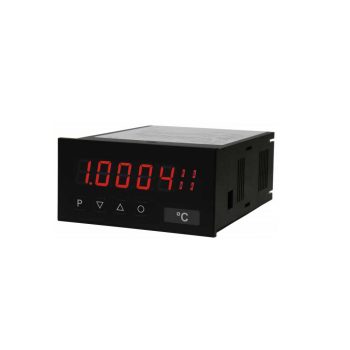
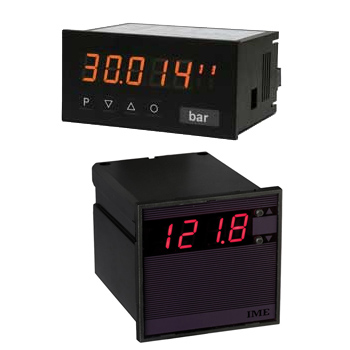
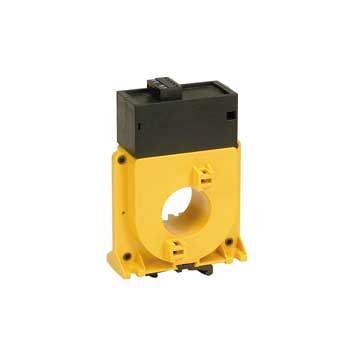
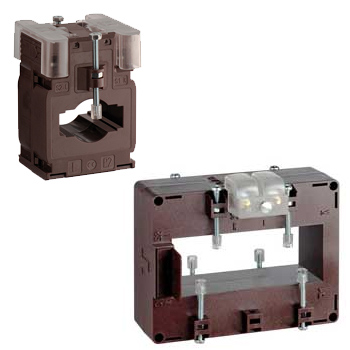
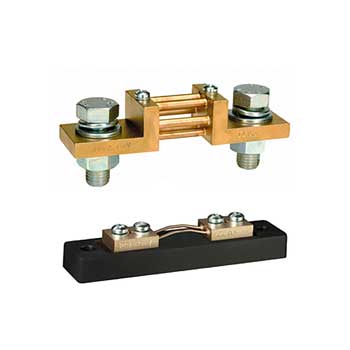
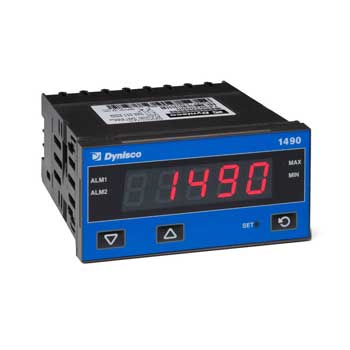
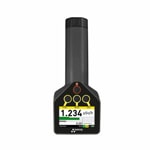
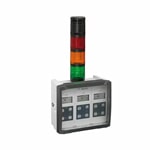
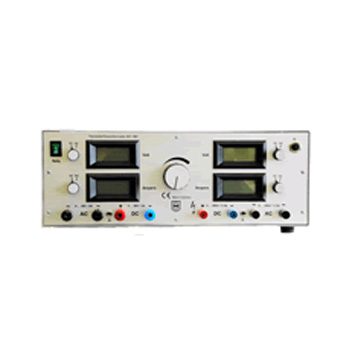























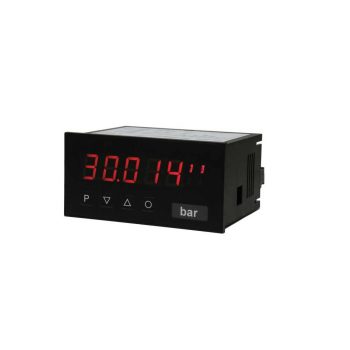
Housing 96 x 48 mm
Display 5-digit
14 mm digit height
Colour: red, green, orange or blue display
Range displayed -19999 to 99999
Operation front panel keyboard protection class IP65
Input DMS / Melt pressure: 1 mV/V, 2 mV/V, 3.3 mV/V free up to 4 mV/V
with 80% calibration
Digital input: <2.4V OFF, >10V ON, max. 30 VDC
Analogue Output
Switch point 2 relays (change-over contact)
250 V / 5 AAC, 30 V / 5 ADC
Interface
Power supply 230 VAC
10-30 VDC galvanic isolated
Other voltage supplies on demand!
Sensor supply Feeding 10 VDC / 20-40 mA / 250-500 Ohm
Software properties
  • min/max-memory with adjustable permanent display
  • 30 additional adjustable supporting points
  • display flashing at threshold value exceedance/undercut
  • zero-key for triggering of Hold, Tara or setpoint setting
  • standard digital input for triggering of Hold, Tara or setpoint setting
  • flexible alarm system with adjustable delay times
  • mathematical functions like reciprocal value, square root, squaring and rounding
  • sliding averaging
  • brightness control via parameter or front keys
  • programming interlock via access code
Datasheet
User Manual

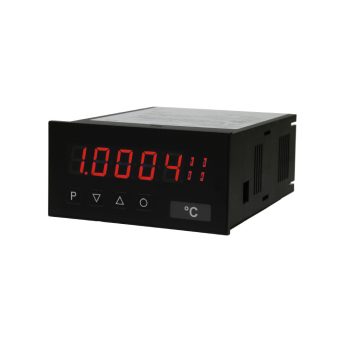
Housing 96 x 48 mm
Display 5-digit
14 mm digit height
Colour: red, green, orange or blue display
Range displayed -19999 to 99999
Operation front panel keyboard protection class IP65
Input DMS / Melt pressure: 1 mV/V, 2 mV/V, 3.3 mV/V free up to 4 mV/V
with 80% calibration
Digital input: <2.4V OFF, >10V ON, max. 30 VDC
Analogue Output 2 analog outputs
0/4-20 mA / 0-10 VDC / 16 Bit
Switch point 2 or 4 relays (change-over contacts)
250 V / 5 AAC, 30 V / 5 ADC
or 8 PhotoMos outputs (NOC) 30 V / 0.4 A AC/DC
Interface RS232 or RS485 galvanic isolated
Alternatively to analog output 2
Power supply 100-240 VAC 50/60 Hz / DC +/- 10%
10-40 VDC / 18-30 VAC 50/60Hz
Sensor supply Feeding 10 VDC / 20-40 mA / 250-500 Ohm
Software properties
  • min/max-memory with adjustable permanent display
  • 30 additional adjustable supporting points
  • display flashing at threshold value exceedance/undercut
  • zero-key for triggering of Hold, Tara or setpoint setting
  • standard digital input for triggering of Hold, Tara or setpoint setting
  • flexible alarm system with adjustable delay times
  • mathematical functions like reciprocal value, square root, squaring and rounding
  • sliding averaging
  • brightness control via parameter or front keys
  • programming interlock via access code
Datasheet
User Manual

Housing 96 x 48 mm
Display 5-digit 14 mm digit height Colour: red
Range displayed -9999…99999
Operation front panel keyboard protection class IP65
Input Strain gauge / Melt pressure: 1 mV/V, 2 mV/V, 3.3 mV/V frei bis 6 mV/V with 80% calibration Digital input: <2.4V OFF, >10V ON, max. 30 VDC
Analogue Output 0-20 mA Burden ≤500Ohm 12Bit 4-20 mA Burden ≤500Ohm 12Bit 0-10 VDC Burden ≥100kOhm 12Bit
Switch point 2 or 4 relays (change-over contacts) 250 V / 5 AAC, 30 V / 5 ADC
Interface RS232 or RS485 galvanic isolated
Power supply 100-240 VAC 50/60 Hz / DC +/- 10% 10-40 VDC / 18-30 VAC 50/60Hz
Sensor supply Bridge supply 10 VDC / 20-50 mA / 200-500 Ohm
Software properties
  • integrated factory calibration for preset weighing cells
  • auto sensor recognition for 1mV/V-, 2mV/V- or 3.3mV/V-sensors
  • free selectable scaling and decimal point adjustment
  • alignment of a sensor with up to 30 additional supporting points
  • taring function for manual and automated triggering
  • fully automated or semi-automatic functions
  • min/max-memory with adjustable permanent display
  • display flashing at threshold value exceedance/undercut
  • flexible alarm system with adjustable delay time
  • programming interlock via access code
Datasheet
User Manual


Digital Panel Meters for Strain Gauge / Load Cell / Mass-Pressure Signals

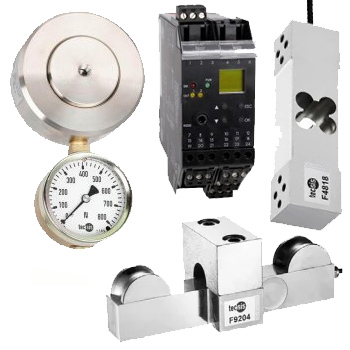
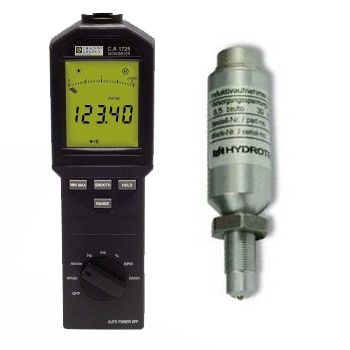
Digital panel meters designed for strain-gauge (DMS) or load-cell/pressure inputs are used to evaluate the very small bridge signals generated by strain-gauge sensors. These sensors are commonly used in applications such as weighing, force measurement and pressure monitoring. The panel meter amplifies, digitizes and processes the bridge signal and displays the corresponding physical value — such as weight, force or pressure — on an LED or LCD display. Many models offer additional functions including zeroing, scaling, min/max storage, alarms or communication interfaces.

F&A

What does “strain gauge / mass-pressure” input mean?

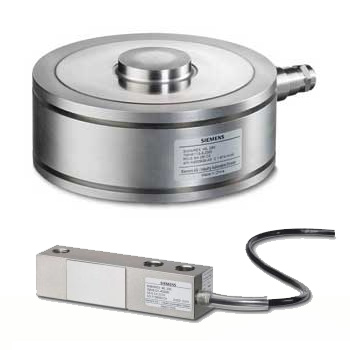
Strain-gauge sensors (load cells, force sensors, pressure transducers) produce a very small voltage change when they experience mechanical deformation. A digital panel meter with DMS/load-cell input is designed to process this bridge signal and display a scaled physical measurement such as mass, force or pressure.

How does a strain-gauge sensor generate a signal?

A strain gauge is a thin metal element whose electrical resistance changes when stretched or compressed. In a Wheatstone bridge configuration, this resistance change produces a proportional voltage signal. When a force, load or pressure is applied, the bridge output changes and the panel meter amplifies, digitizes and evaluates the signal.

Which physical quantities can be displayed?

Depending on the connected sensor and scaling, the meter can display force, weight, mass, load or pressure. This makes these devices suitable for weighing systems, material testing, process monitoring and mechanical measurement tasks.

Which input and display features do these devices provide?

They typically support full-bridge strain-gauge inputs and include a precision amplifier and ADC. The result is shown on an LED or LCD display. Many devices offer zero adjustment, tare, scaling, selectable units, min/max storage, relay outputs and communication options.

Why use a digital strain-gauge panel meter?

It enables direct, accurate display of measurements derived from strain-gauge sensors, without external amplifiers or manual interpretation. Digital processing improves stability, readability and integration into automated systems.

Where are such meters commonly used?

Typical applications include industrial weighing systems, test stands, force measurement, pressure vessel monitoring, conveyor weighing, quality inspection and any installation where mechanical quantities are measured using strain-gauge technology.

What should be considered during selection and installation?

Important factors include compatibility with the connected load cell/strain gauge, excitation voltage, required measurement range and units, calibration procedures, shielding and grounding of cables, and environmental protection — as strain-gauge signals are extremely sensitive.

Are there limitations?

Yes — strain-gauge signals are very small and prone to electrical noise, mechanical vibration or temperature drift. Accuracy depends heavily on proper wiring, sensor quality and calibration. Very fast load changes can exceed the response time of some meters.

Diese Website benutzt Cookies. Wenn du die Website weiter nutzt, gehen wir von deinem Einverständnis aus.