


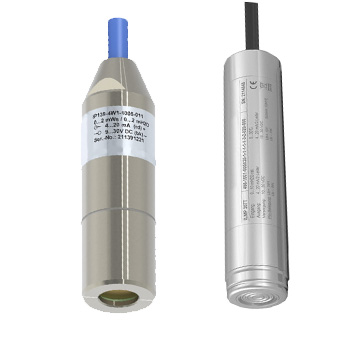
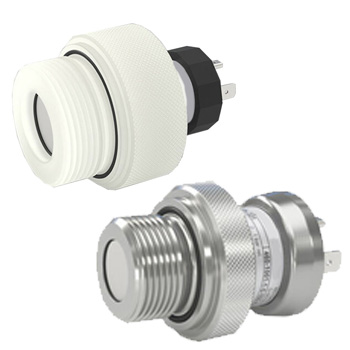

Level Sensors – Hydrostatic & Differential-Pressure Solutions for Tanks, Silos & Pits
Level sensors based on hydrostatic measurement (submersible probes, pressure sensor + stilling tube) and differential pressure (Δp between bottom and gas space) capture level height, percent and volume in open and closed vessels. Variants cover water/wastewater, chemicals & food, and energy applications with outputs 4–20 mA, 0–10 V, or digital via IO-Link, RS-485/Modbus RTU, or HART. Optional: ATEX/IECEx, hygienic design, long-term stability and corrosion-resistant materials.
ICS Schneider Messtechnik supports selection & sizing (range/density), process connections, installation accessories (probe weights, vent filters, manifolds), calibration and—on request— IIoT integration into SCADA/cloud via edge gateways (MQTT/HTTPS).
FAQ on Level Sensors (Hydrostatic & Δp)
Answers on measurement principle, density/temperature compensation, installation, accuracy, strapping tables, hygiene/Ex and digital integration.
How does hydrostatic level measurement work?
The sensor measures the local pressure; level height is derived as h ≈ p / (ρ·g). A known/compensated medium density ρ is required.
When should I use differential pressure (Δp)?
For closed tanks or when gas-space pressure varies. Δp between bottom and headspace yields level height (with density compensation).
How does medium temperature affect the result?
Temperature changes density and thus the p→h conversion. Remedy: add a temperature sensor or store density-vs-temperature profiles in the transmitter/edge.
What accuracy is realistic?
Typically ±0.1…0.5% FS (device dependent). Consider the Total Error Band (temperature, long-term drift, venting/bleeding).
How do I convert level height to volume/percent?
Use a strapping table (height→volume) or geometry formulas. For non-linear tanks, calculate percent from volume rather than height.
Example strapping table
| Level height (mm) | Volume (L) |
|---|---|
| 0 | 0 |
| 250 | 1,200 |
| 500 | 2,550 |
| 750 | 4,000 |
| 1,000 | 5,500 |
Which outputs/interfaces are available?
| Interface | Benefit | Use Case |
|---|---|---|
| 4–20 mA | Robust, 2-wire, long runs | Process/retrofit |
| 0–10 V | High local resolution | Panel/short distances |
| IO-Link | Parameterization/diagnostics | Machinery/OEM |
| RS-485/Modbus | Multi-drop, long cables | Distributed/IIoT |
| HART | Analog with digital access | Installed base |
How do I install submersible probes correctly?
- Select a calm zone; use a probe weight/suspension cable.
- Keep the vented reference tube dry (use a vent filter).
- Provide strain relief and EMC-compliant cable routing.
What should I consider when mounting Δp transmitters?
- 3/5-valve manifold for zeroing and service.
- Impulse lines short, symmetric, properly routed (condensate/gas traps).
- Provide overpressure protection against mishandling.
What materials/seals are common?
Wetted parts stainless steel 316L, optional Hastelloy/Monel/Tantalum; seals FKM/EPDM/PTFE/FFKM per medium/temperature.
Are hygienic or Ex requirements possible?
Yes—EHEDG/IP69K-capable versions and ATEX/IECEx are available, including suitable process connections (Tri-Clamp, Varivent®, diaphragm seals).
How should I define alarms?
Hi/HiHi/Lo/LoLo with hysteresis/deadband, rate-of-change (leak/overflow), minimum fill time after start; trigger alarms locally in transmitter/edge.
What polling/publish intervals make sense?
| Use Case | Interval | Note |
|---|---|---|
| Storage tank | 10–60 s | On-change (Δ≥0.5%) saves traffic |
| Process tank | 2–10 s | Hysteresis/filtering against noise |
| Shaft/overflow | 1–5 s | Fast alarming |
How do I document measuring points?
Device ID, medium/density, range, accuracy, installation location/depth, connection/materials, cable routing, calibration history; for digital connections record address/topics/registers.
Calibration & traceability—what is sensible?
Recommendation: annually; QA/safety loops more frequently or event-based. ISO/DAkkS certificates available; version changes to density/strapping.
IIoT integration—possible?
Yes. Via PLC or edge gateway (Modbus/HART/IO-Link → MQTT/HTTPS) for dashboards, historian, alarms. Security: TLS/VPN, certificates, roles/scopes, audit logs.
Typical error causes & remedies
- Drift/offset: wet/dirty vent → replace filter, keep dry.
- Fluctuating values: turbulence → stilling/averaging filter.
- Wrong percent: missing/wrong strapping → verify table.
- Overflow damage: range too small → increase range/protect mechanics.
Do you support selection & commissioning?
Yes—from media/material check, sizing (range/density), mounting accessories and calibration to commissioning with documentation/test reports.