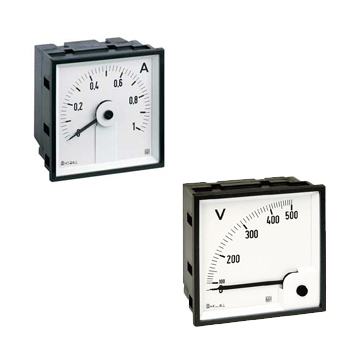
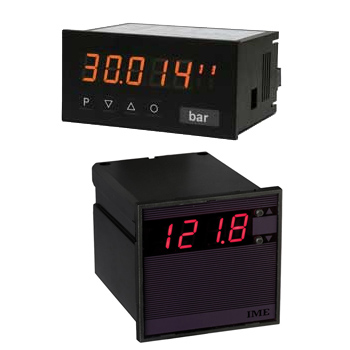
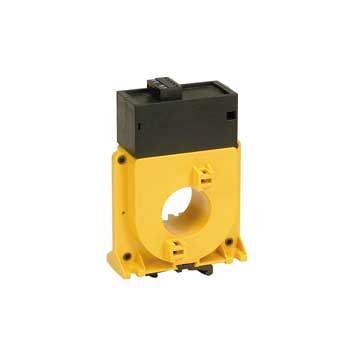
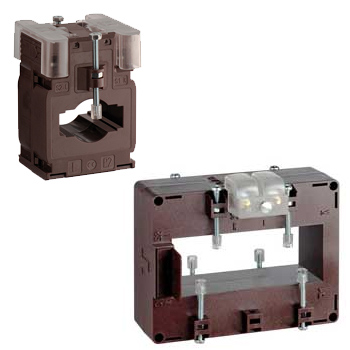



























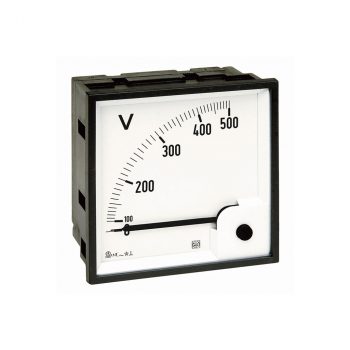
| INSERTION | direct |
|---|---|
| FORMAT | 48x48 mm |
| CURRENT | 5 A |
| TYPE | A.C. ammeter (moving iron) |
| SCALE | 0…In |
| OPTIONS | tropicalized-antivibration |
Datasheet
|
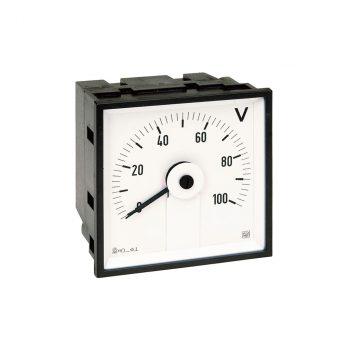
- Direct indication of input voltage or primary
- voltage of external VT
- Moving iron equipment
- Direct connection 10...600V
- Input by external VT /100V - /110V
- Scale lenght 240°
- Accuracy class 1,5
Datasheet
|
| INSERTION | direct |
|---|---|
| FORMAT | 96x96 mm |
| CURRENT | 2,5 A |
| TYPE | A.C. ammeter (moving iron) |
| SCALE | overscale 5In |
| OPTIONS | tropicalized-antivibration |
Datasheet
|
- Direct indication of input voltage or primary
- voltage of external VT
- Moving coil equipment
- with rectifier accessory
- Direct connection 10...600V
- Input by external VT /100V - /110V
- Scale lenght 240°
- Accuracy class 1,5
Datasheet
|
- Direct indication of input voltage or primary
- voltage of external VT
- Moving coil equipment
- with rectifier accessory
- Direct connection 10...600V
- Input by external VT /100V - /110V
- Scale lenght 240°
- Accuracy class 1,5
Datasheet
|
- Direct indication of input voltage or primary
- voltage of external VT
- Moving coil equipment
- with rectifier accessory
- Direct connection 10...600V
- Input by external VT /100V - /110V
- Scale lenght 240°
- Accuracy class 1,5
Datasheet
|
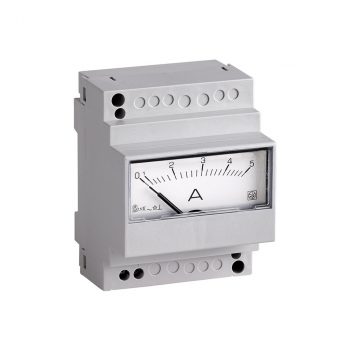
| INSERTION | on CT |
|---|---|
| FORMAT | 4 DIN modules |
| CURRENT | 800/1 A |
| TYPE | A.C. ammeter (moving iron) |
| SCALE | overscale 2In |
Datasheet
|
Analog AC Voltage Panel Meters / Wechselspannungs-Einbaumessgeräte
Analog AC voltage panel meters are devices intended for permanent installation in switchgear cabinets, distribution boards or control panels, providing a direct analog display of alternating voltage levels. Using a dial with a pointer instead of digital electronics, they provide continuous real-time monitoring of the network voltage — without additional power supply and with high reliability and simplicity.
What is an analog AC voltage panel meter?
An analog AC voltage panel meter is a built-in instrument that displays the RMS voltage of an AC supply (e.g., 230 V, 400 V) using a pointer and a scale. It does not rely on digital conversion or external power, allowing for constant display of voltage directly in control cabinets or distribution systems.
Which voltage ranges are typically supported?
Common supported ranges correspond to standard network voltages such as 230 V or 400 V AC. Some meters offer multiple scales or configurable measurement ranges depending on the supply network and intended application.
How does the measuring movement work for AC voltage meters?
AC voltage meters usually employ a magnetic movement (e.g., moving-iron or similar) that reacts to the instantaneous RMS voltage. The magnetic field generated by the voltage causes the pointer to deflect proportionally — providing a direct visual indication of the supply voltage level.
What are the advantages of analog AC voltage meters?
They offer immediate visual representation, are sturdy and immune to many interferences, require no auxiliary power supply, and are maintenance-free. Their simplicity ensures high reliability, and they remain functional even if auxiliary electronics fail. This makes them ideal for basic voltage monitoring in industrial and infrastructure applications.
Where are they typically used?
Analog AC voltage panel meters are commonly found in switchgear cupboards, distribution cabinets, energy distribution systems, machine control panels and building electrical installations — wherever continuous monitoring of supply voltage is needed, especially in industrial contexts, building automation or control panels.
Which mounting sizes and form factors are common?
Standard panel cut-outs include front sizes like 48×48 mm, 72×72 mm, 96×96 mm or larger (e.g., 144×144 mm). Narrow versions (e.g., 48×24 mm, 72×24 mm, 96×24 mm) are available for compact installations. Meters can be mounted directly on front panels, DIN rails or inside enclosures depending on installation requirements.
What are the limitations and disadvantages of analog AC voltage meters?
They are less precise compared to digital instruments, may suffer from reading errors (e.g., parallax), lack automatic range switching, data logging or communication interfaces. Overload or incorrect wiring can damage the internal movement. For detailed logging or precise measurement tasks they are therefore not suitable.
For which applications are analog AC voltage meters best suited?
They are well-suited for continuous, simple monitoring of AC voltages — especially where quick visual inspection and robustness matter more than high precision. They are particularly advantageous in environments with fluctuating loads or where auxiliary power for digital displays is not available.
How do they respond to voltage fluctuations or supply disturbances?
The pointer immediately follows changes in voltage, showing fluctuations, dips or voltage spikes as they occur. This allows direct detection of transient events, under- or overvoltage conditions — an advantage compared to digital displays that may show averaged or delayed values.
What should be considered when selecting and installing analog AC meters?
Ensure that the meter’s voltage range matches the network, that the movement type is appropriate for AC measurement, and that mounting dimensions fit the control cabinet or panel. Environmental conditions (dust, humidity, vibrations), proper wiring, and compliance with relevant standards and safety classes must be ensured to guarantee safe and reliable operation.


Datasheet