
























- Professional software with Excel export function for programming the logger and data analysis
- Records up to 5 measurements at the same time
- Temperature measuring range from -20 °C to +70 °C
- Easy-to-change battery
- Automatic measuring data backup when the battery runs out or is changed
- Displays violations of limit values
When ambient conditions, for example in a laboratory, need to be documented securely and highly accurately, the testo 176 P1 is the right data logger. It has an integrated absolute pressure sensor and connection possibilities for two external temperature/humidity probes (optional).
Datasheet |
User Manual |
- Measurement data memory for up to 16,000 readings
- Temperature measuring range from -20 °C to +70 °C
- Automatic measuring data backup when the battery runs out or is changed
- Convenient Excel export functions
- Data analysis: three different software versions available, basic software free to download
- Displays violations of limit values
Datasheet
|
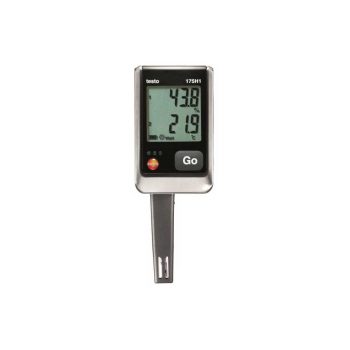
Saving energy, archiving, storing goods, creating a comfortable indoor climate – if you can’t analyze the temperature and humidity, you won’t get optimal results. The testo 175 H1 is designed to carry out reliable long-term measurements and log these crucial values for you.
- Transfer of measuring data via SD card
- Round-the-clock monitoring and logging of temperature, relative humidity and dew point
- Temperature measuring range from -20 °C to +70 °C
- Automatic measuring data backup when the battery runs out or is changed
- Professional software for programming the logger and data analysis
- Convenient Excel export functions
Datasheet |
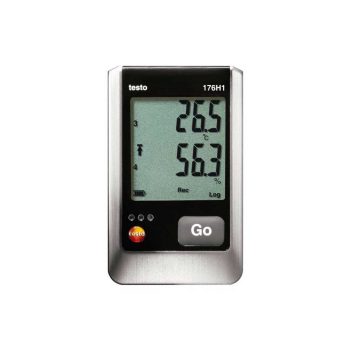
The data logger testo 176 H1 allows the monitoring of temperature and humidity in warehouses and buildings. With the testo 176 H1, you can examine whether mould in a house or apartment has been caused by insufficient ventilation or by building damage.
- Record up to two humidity and temperature values simultaneously with optionally connectable probes
- Temperature measuring range from -20 °C to +70 °C
- Easy-to-change battery
- Automatic measuring data backup when the battery runs out or is changed
- Convenient Excel export functions
- Three software versions available for data management on the PC, basic software available as a free download
Datasheet |
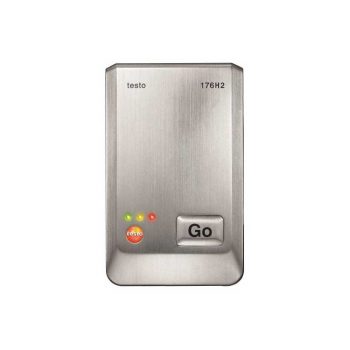
- Measure humidity and temperature on two channels thanks to its two connections for external sensors
- Temperature measuring range from -20 °C to +70 °C
- Robust metal housing and protection against dust and water jets in compliance with protection class IP 65
- Automatic measuring data backup when the battery runs out or is changed
- Convenient Excel export functions
- Three software versions available for data management on the PC, basic software available as a free download
Datasheet |
- Easy programming and reporting without additional software (plug and play)
- Measurement data memory for up to 65,000 readings
- Easy-to-change battery
- Battery life up to 120 days
- Professional software for programming the logger and data analysis
- Convenient Excel export functions
Datasheet |
- Precise dew point measurement down to -80°Ctd
- Robust case for field use
- Integrated pressure measurement up to 16 bar
- Integrated measuring chamber with integrated dry container protects the dew point sensor during transport and grants a quick adaptation time
- Long-time stable humidity sensor: precise, insensitive against dewing, quick adaptation time
- Optionally available: 2 further sensor inputs for external sensors
- Optionally available: Integrated data logger
Datasheet |
- Easy programming and reporting without additional software (plug and play)
- Measurement data memory for up to 64,000 readings
- Easy-to-change battery
- Battery life up to 500 days
- Professional software for programming the logger and data analysis
- Convenient Excel export functions
Datenblatt |
Humidity Data Loggers – reliable RH/T recording for QA, labs & buildings
Humidity data loggers record relative humidity (RH), temperature and—depending on model—dew point, heat-stress indices or CO₂/VOC. Typical applications include quality management, transport/cold chain, museums/archives, cleanrooms, HVAC and process monitoring.
Form factors: stand-alone units with display/keys, mini loggers for long-term campaigns, multi-channel loggers with external probes, network-enabled loggers (LAN/Wi-Fi) and cloud/IoT loggers with alerting.
Features (model-dependent): configurable sample rate, large memory (10⁴…10⁶ points), calibration offsets, event markers, PDF/CSV export, secure audit trail, alerts (email/SMS/relay) and interfaces such as USB, BLE, Modbus or MQTT.
ICS Schneider Messtechnik supports logger selection, probe choice, validation, factory/DAkkS calibration and data integration with BMS/SCADA/cloud.
FAQ on Humidity Data Loggers
Answers on selection, accuracy, memory, power, alarms, software, calibration and best practices.
Where do humidity data loggers add the most value?
For long-term monitoring, compliance evidence (GxP, ISO 14644, museum standards), cold-chain transport and limit alarms on excursions.
Which sensing technologies are used?
Mainly capacitive RH sensors combined with precision temperature sensors; for very dry gases use dew-point/trace-humidity probes; optional CO₂/VOC modules.
What accuracy is typical?
Commonly ±1…2 %RH and ±0.2…0.3 °C in standard ranges. Higher accuracy is possible with reference-calibrated probes and narrower spans.
How much memory do I need?
| Memory | Sample rate (example) | Duration (2 channels) |
|---|---|---|
| 100,000 points | 1 min | ~34 days |
| 1,000,000 points | 5 min | ~6.9 years |
What power options are available?
Long-life batteries (lithium) for autonomous logging, mains/PoE for 24/7 online systems, sometimes USB charging. Runtime depends on interval, display use and wireless activity.
How do I retrieve the data?
Via USB, Bluetooth (app), Wi-Fi/LAN or memory card. Cloud loggers transmit via MQTT/HTTPS to dashboards; export PDF/CSV.
What alarm options exist?
Buzzer/LED on the device, email/SMS/push via network/cloud, and relay outputs for beacons/sirens. Configure hysteresis and delays to avoid chatter.
How should I choose the sample rate?
Fast processes: 1–30 s; building climate: 1–5 min; long-term trends: 10–60 min. Faster sampling increases data volume and power draw.
What is roll-over/circular buffer logging?
When storage is full, the oldest records are overwritten—ideal for continuous monitoring without manual deletion.
How are loggers calibrated/recalibrated?
Using a humidity generator/chamber or saturated salt solutions with a traceable reference. Typical interval: annually, or semi-annually for QA-critical tasks.
Can one logger support multiple probes?
Multi-channel units accept external RH/T probes, sometimes dew-point, CO₂ or contact inputs (door events/acknowledgement).
How do I protect data integrity?
Use software with a secure audit trail, user roles, signatures and checksums; export read-only PDF for audits.
What matters for museums/archives?
Stable RH/T (e.g., 45–55 %RH, 18–22 °C per guideline), moderate sampling for battery life, gentle mounting and loan reports for shipments.
Which enclosure ratings/materials should I look for?
IP54–IP67 depending on environment; probes with PTFE sinter/metal mesh for dust/splash; smooth, cleanable surfaces for cleanrooms.
How do I place loggers correctly?
Avoid windows/heaters and direct drafts; choose representative height; for ducts prefer an inserted probe rather than housing-mounted sensors.
How do I handle condensation or chemicals?
Use heated caps, chemically resistant filters, and condensate management; shorten calibration intervals under harsh exposure.
Which software features are useful?
Reports (as-found/as-left), limit analysis, time zones/UTC, event markers, batch export, and an API for ERP/CAQ integration.
How do I ensure GxP compliance?
Prepare IQ/OQ docs, perform mapping before go-live, enable the audit trail, assign roles/permissions, use e-signatures and maintain backups.
What determines real battery life?
Primarily the sample rate, temperature, radio use and display backlight. Spec sheets often assume optimized profiles.
Do you help with selection & commissioning?
Yes—we define limits/intervals, select loggers/probes, set up software/alerts and provide factory/DAkkS certificates.


Datasheet
Datasheet
Datasheet