
























Showing all 5 results

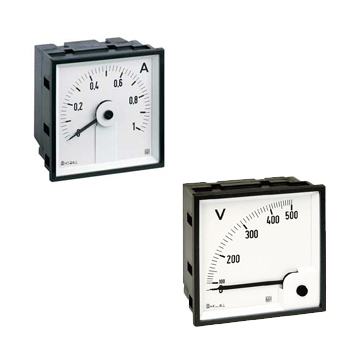
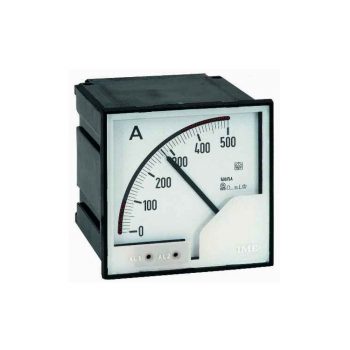
  • AUX: 230 V AC
  • APPLICATION: via current transformer
  • THRESHOLDS: 1 min + 1 max
  • FORMAT: 96 × 96 mm
  • CURRENT: 5/5 A
  • TYPE: AC ammeter with alarms
  • SCALE: standard scale In
Datasheet

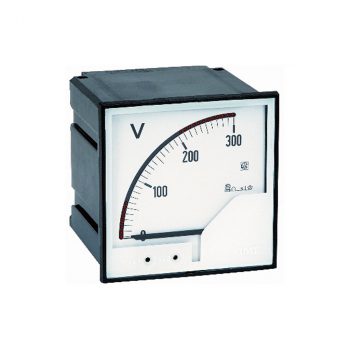
  • AC voltmeter with limit contacts
  • Dimensions: 96 x 96 mm
  • Limit contact types: 2 max or 2 min or 1 min + 1 max
  • Primary input: 300 V or 500 V direct or via VT / 100 V
  • Auxiliary voltage: 115 Vac or 230 Vac or 240 Vac
  • Scale: 0...Un (direct) or according to specification (VT)
Datasheet

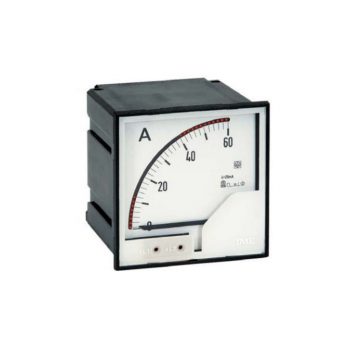
  • DC ammeter with limit contacts
  • Dimensions: 96 x 96 mm
  • Limit contact types: 2 max or 2 min or 1 min + 1 max
  • Primary input: 0–1 mA or 0–5 mA or 0–10 mA or 0–20 mA or 4–20 mA
  • Auxiliary voltage: 115 Vac or 230 Vac or 240 Vac
  • Scale: according to specification
Datasheet

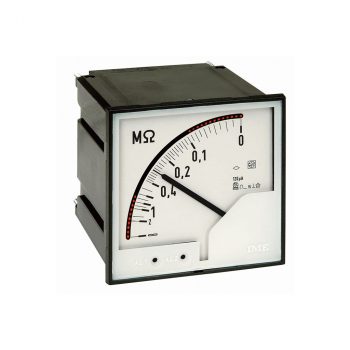
  • Continuous control insulation towards ground
  • Connection on ac network up to 690/100V
  • Measuring range 2MΩ or 5MΩ
  • 2 programmables alarms
  • Alarms type: MIN+MAX or MIN1+MIN2
  • Scale lenght 90°
  • Accuracy cl.1,5
Datasheet

  • Continuous control insulation towards ground
  • Connection on dc network up to 220V
  • Measuring range 200kΩ or 2MΩ
  • 2 programmables alarms
  • Alarms type: MIN+MAX or MIN1+MIN2
  • Scale lenght 90°
  • Accuracy cl.1,5
Datasheet


Analog Limit-Contact Panel Meters / Grenzkontaktanzeiger

Analog limit-contact panel meters display electrical or process values with a pointer and scale and additionally provide switching contacts that activate when preset thresholds are crossed. They are designed for installation in control cabinets and switchgear systems, enabling simple alarm, protection and control functions without digital electronics.

F&Q

What is a limit-contact panel meter?

A limit-contact panel meter combines an analog display with one or more switching contacts that activate when a measured value reaches or exceeds a defined threshold.

Which quantities can be monitored?

Typical quantities include AC or DC current, voltage or other compatible input signals used in industrial monitoring.

How does the switching mechanism work?

The switching point is mechanically linked to the pointer position. When the pointer crosses the set threshold, the internal contact changes state and triggers an external circuit.

What types of limit contacts exist?

Common variants include minimum contacts, maximum contacts, combinations of both and versions with two independent switching points.

Where are these devices used?

They are used in switchgear, distribution boards, process monitoring, overload or underload detection and simple automation tasks.

What advantages do limit-contact meters offer?

They provide visual measurement and threshold switching in one device, are robust, require no auxiliary electronics and are easy to integrate into control systems.

Which installation formats are common?

Typical panel sizes include 96×96 mm, suited for front-panel mounting in industry-standard switchgear systems.

Do they require external power?

Most versions operate without auxiliary supply; the measurement energy is derived from the input signal itself.

What limitations do they have?

They offer limited accuracy compared to digital devices and do not support logging, remote control or communication interfaces.

Can they replace electronic controllers?

They are suitable for simple threshold-based control tasks, but not for complex logic or multi-parameter automation found in electronic or PLC systems.

Diese Website benutzt Cookies. Wenn du die Website weiter nutzt, gehen wir von deinem Einverständnis aus.