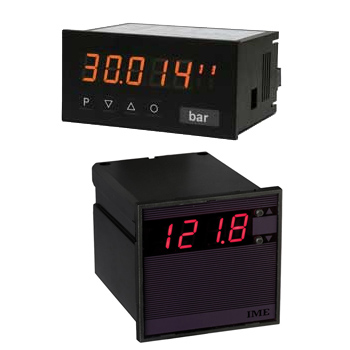
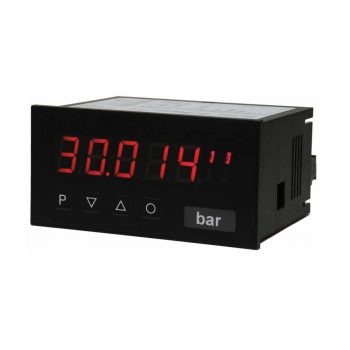
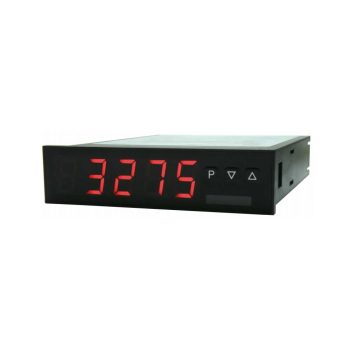
| Housing | 96 x 24 mm |
| Display | 5-digit 14 mm digit height Colour: red, green, orange or blue display |
| Range displayed | -19999 to 99999 |
| Operation | front panel keyboard protection class IP65 |
| Input | High voltages 0…1 ADC / span -1…1 ADC 0…300 VDC / Measuring span -300…300 VDC |
| Analogue Output | 0/4-20 mA / 0-10 VDC / 16 Bit |
| Switch point | 1 or 2 change-over relays 250 VAC / 2 AAC ; 30 VDC / 2 ADC |
| Interface | – |
| Power supply | 100-240 VAC 50/60 Hz / DC +/- 10% |
| Sensor supply | – |
| Software properties |
|
Datasheet
|
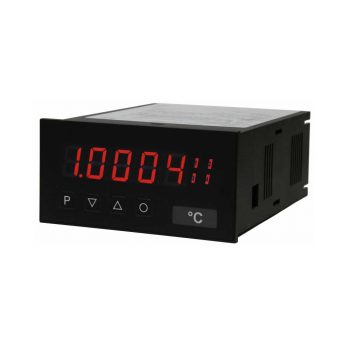
| Housing | 96 x 48 mm |
| Display | 5-digit 14 mm digit height Colour: red, green, orange or blue display |
| Range displayed | -19999 to 99999 |
| Operation | front panel keyboard protection class IP65 |
| Input | High voltages 0…1 ADC / span -1…1 ADC 0…50 VDC / span -50…50 VDC 0…300 VDC / span -300…300 VDC 0…600 VDC / span -600…600 VDC Digital input: <2.4V OFF, >10V ON, max. 30 VDC |
| Analogue Output | 0/4-20 mA / 0-10 VDC / 16 Bit Alternatively digital input |
| Switch point | 2 relays (change-over contact) 250 V / 5 AAC, 30 V / 5 ADC |
| Interface | – |
| Power supply | 230 VAC |
| Sensor supply | – |
| Software properties |
|
Datasheet
|
| Housing | 96 x 48 mm |
| Display | 5-digit 14 mm digit height Colour: red, green, orange or blue display |
| Range displayed | -19999 to 99999 |
| Operation | front panel keyboard protection class IP65 |
| Input | High voltages 0…1 ADC / span -1…1 ADC 0…50 VDC / span -50…50 VDC 0…300 VDC / span -300…300 VDC 0…600 VDC / span -600…600 VDC Digital input: <2.4V OFF, >10V ON, max. 30 VDC |
| Analogue Output | 2 analog outputs 0/4-20 mA / 0-10 VDC / 16 Bit |
| Switch point | 2 or 4 relays (change-over contacts) 250 V / 5 AAC, 30 V / 5 ADC or 8 PhotoMos outputs (NOC) 30 V / 0.4 A AC/DC |
| Interface | RS232 or RS485 galvanic isolated Alternatively to analog output 2 |
| Power supply | 100-240 VAC 50/60 Hz / DC +/- 10% |
| Sensor supply | – |
| Software properties |
|
Datasheet
|
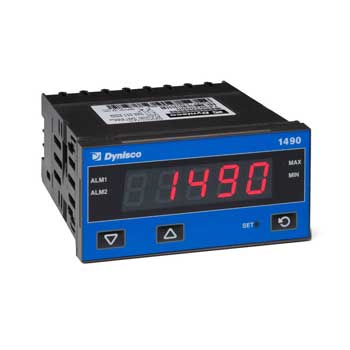
Digital Panel Meters for High DC Voltage and Current
Digital panel meters for high DC voltage and current capture DC signals up to several hundred volts and display them with high resolution on a 5-digit LED display. They are designed for panel mounting in control cabinets and offer front protection up to IP65. Typical input types include standardized ADC signals (e.g. 0…1 ADC, ±1 ADC) as well as direct DC voltage inputs such as 0…50 VDC, 0…300 VDC or 0…600 VDC. With freely scalable indication, programmable limits with relay outputs and optional analog outputs (e.g. 0/4–20 mA, 0–10 VDC, 16 bit), the measured values can be flexibly adapted to process and automation systems.
Questions & Answers
What are typical applications for high DC voltage panel meters?
High DC voltage panel meters are used to monitor DC power distribution, DC links of converters, battery systems, test benches, electroplating systems and power supplies where high DC voltages must be indicated and supervised safely.
Which input voltage ranges are commonly supported?
Typical input voltage ranges include direct DC inputs such as 0…50 VDC, 0…300 VDC and 0…600 VDC, as well as standardized ADC signals in the range 0…1 ADC or ±1 ADC to measure high voltages via suitable transducers.
What display range does the instrument provide?
The display range is usually between -19999 and 99999 counts. This allows both very small and large values to be indicated precisely with a freely selectable unit and scaling.
How is the scaling of the measured value configured?
Scaling is performed by a configurable linearization inside the instrument. Via the front keypad, the measuring range limits and corresponding display limits can be set so that the indicated digits directly represent the desired physical value.
What kind of analog outputs are available?
Many high DC panel meters provide freely scalable analog outputs, typically 0/4–20 mA or 0–10 VDC with 16-bit resolution. These outputs represent the measured value proportionally and can be used as input signals for PLCs, controllers or data loggers.
Are limit relays integrated for alarm functions?
Yes, one or two potential-free changeover relays are often integrated. These relays can be parameterized as MIN, MAX or window limits to trigger warnings or shutdowns in case of underload, overload or out-of-range conditions.
Which auxiliary supply voltages are required?
The instruments typically use a wide-range power supply, for example 100–240 VAC at 50/60 Hz or the corresponding DC supply with ±10 % tolerance. This enables flexible integration into various control cabinet environments.
How are configuration and operation performed?
Configuration is done via a front keypad. Menu-guided parameter setting allows the user to define input type, measuring range, decimal point, scaling, filter constants, setpoints, relay logic and analog output without opening the switchboard door.
What protection class and mechanical dimensions are typical?
The front side usually complies with protection class IP65, providing protection against dust and water jets. Typical panel cut-out sizes are 96 × 24 mm or 96 × 48 mm, fitting standardized panel mounting dimensions.
How is measurement safety ensured at high DC voltages?
Measurement safety is ensured by appropriate input circuitry with overvoltage protection, sufficient clearance and creepage distances, isolated input stages and compliance with relevant standards. Additionally, external resistors or measuring transducers must be designed correctly for the application.
Can both unidirectional and bidirectional signals be measured?
Depending on the instrument type, either unidirectional signals (e.g. 0…300 VDC) or bidirectional signals (±300 VDC) can be measured. Bidirectional meters can display positive and negative polarities and make them available for process evaluation.
How can these instruments be integrated into automation or supervisory systems?
Integration is mainly achieved via analog current or voltage outputs and via limit relays. In many applications, the analog outputs are connected directly to PLC analog input modules, controllers or data acquisition systems, while the relays provide contacts for alarms and switching functions.
Which options exist regarding display color and brightness?
The 5-digit LED display is often available in different colors such as red, green, orange or blue. Brightness can typically be adjusted in several steps to ensure good readability under various ambient light conditions.
What should be considered when installing the meter in a control cabinet?
During installation, sufficient ventilation, adherence to the specified installation depth, proper grounding and separation of signal and power cables must be ensured. For high DC voltages, appropriately rated wiring, insulation distances and protective measures are essential.

























Datasheet