




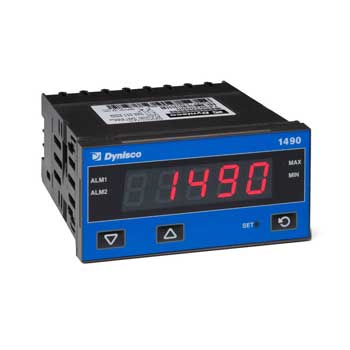
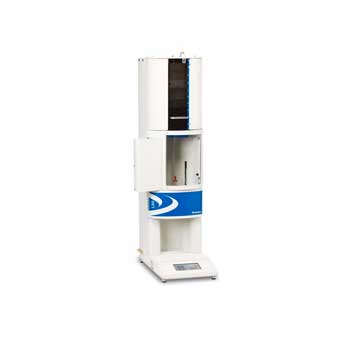
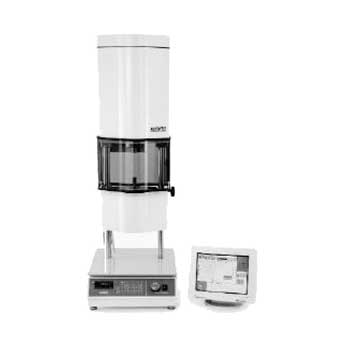
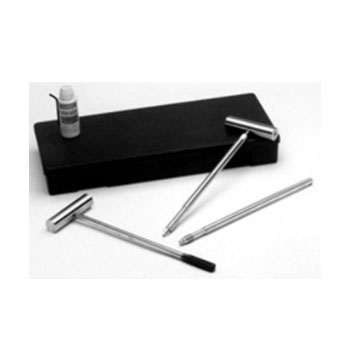































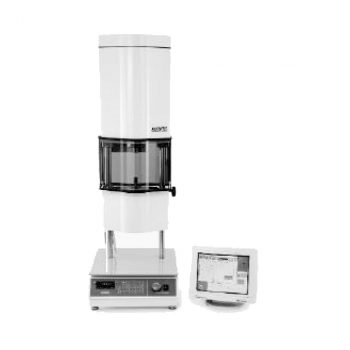
- Laboratory capillary rheometer for sophisticated material characterization
- Dynisco LCR7000/7001/7002 Series for precise rheological testing
- Suitable for melt viscosity, shear rate, shear stress and material stability analysis
- High accuracy, repeatability and sensitivity for laboratory and production environments
- Up to 45 shear stress or shear rate data points per test possible
- Precision servo-drive system for tight control of shear rates and test modes
- Multiple barrel heating zones with adaptive PID temperature control up to 430 °C
- LAB KARS software for analysis, evaluation and reporting
- LCR7000, LCR7001 and LCR7002 models for different testing requirements
- Options such as laser micrometer, tungsten carbide dies and corrosion-resistant barrels available
Datasheet
|
Capillary Rheometer – Dynisco
A capillary rheometer is a laboratory instrument used to characterize the flow behavior of polymer melts or viscous materials under realistic processing conditions. The material is melted and then forced through a narrow capillary (die) under defined pressure or piston force. By measuring the applied pressure and flow rate, shear viscosity, shear-rate dependence, viscosity function and other rheological properties can be determined. Capillary rheometers thus support process optimization, material development and quality control — especially for extrusion, injection molding or other high-shear processes.
Questions & Answers about Capillary Rheometers
What is a capillary rheometer?
An instrument that forces molten polymer through a defined capillary die and measures its flow behavior (viscosity as a function of shear rate).
Why use a capillary rheometer instead of a simple melt-flow index tester?
Because it can measure a full viscosity curve over a range of shear rates and temperatures — not just a single flow value — providing far more detailed insight into processing behavior and material characteristics.
What properties can be measured?
Shear viscosity, dependence of viscosity on shear rate and temperature, possible visco-elastic behavior, flow behavior under high shear rates and other rheological parameters.
For which materials is it suited?
Thermoplastic polymers, melts, viscous or highly filled materials — basically materials used in extrusion, injection molding or other polymer processing.
How does a typical test proceed?
The material is melted in a heated barrel, then pushed by a piston or feed system through a die. Pressure and flow are recorded and used to calculate rheological data.
What are the advantages of this method?
It provides realistic, process-relevant data about melt behavior at industrial shear rates — useful for material selection, tool design and process optimization to ensure stable production and high quality.
For which applications is a capillary rheometer especially important?
Material development, raw material testing, process optimization in extrusion or injection molding, quality control, especially for new or modified polymer formulations.
Can the influence of temperature or composition changes be investigated?
Yes — by varying temperature, shear rate or material composition, one can analyze how these factors affect viscosity and flow behavior.
How do industrial-grade capillary rheometers differ from simple lab devices?
Industrial versions support higher pressures, variable shear rates, broader measurement ranges and are built rugged for frequent use — ideal for demanding industrial test requirements.

Datasheet