


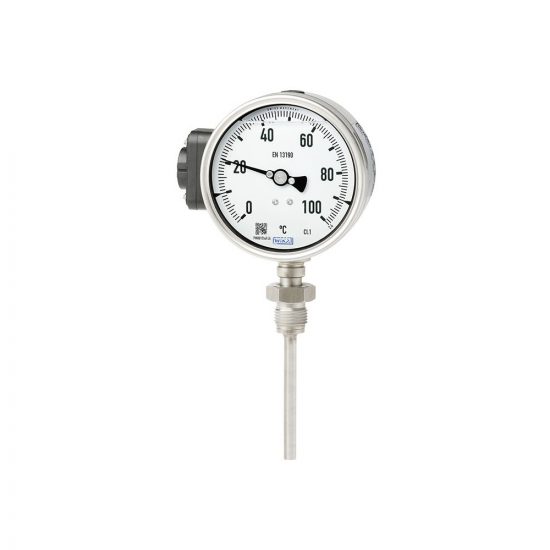









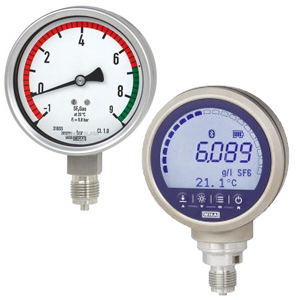
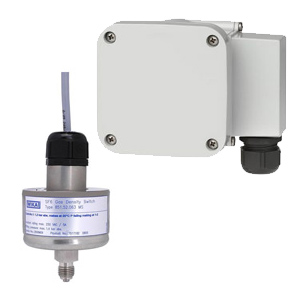
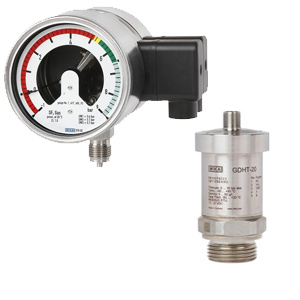
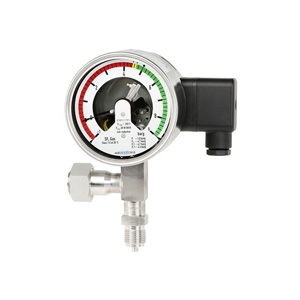



























- Accurate isochore, temperature-compensated switching over the entire temperature range
- Increased plant safety through self-diagnostics
- Prepared for any alternative gases
- Very high long-term stability through welded reference gas volume
 Datasheet Datasheet
|
|
User Manual
|

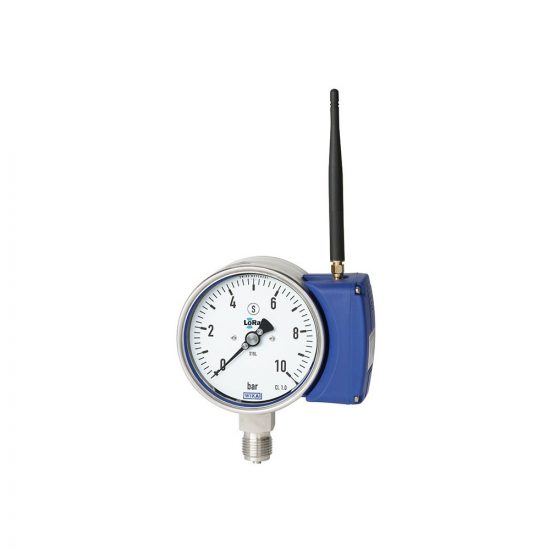
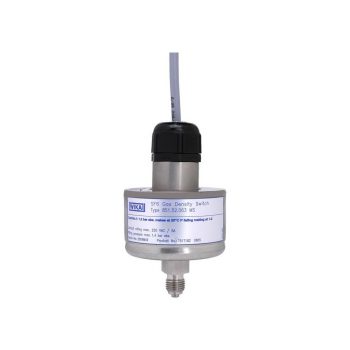
WIKA SF6 gas density switches for gas-insulated switchgear
SF6 gas density switches monitor the gas density in hermetically sealed SF6 pressure vessels of high- and medium-voltage switchgear. They determine a temperature-compensated gas density and operate defined switch contacts at specified thresholds in order to detect leaks at an early stage and to ensure the dielectric strength of the insulation over the entire service life.
Questions & answers on SF6 gas density switches
What is the basic operating principle of an SF6 gas density switch?
An SF6 gas density switch measures the internal gas pressure, compensates it to a reference temperature and compares the resulting density value with preset switching levels. When a switching level is reached or undershot, a mechanical or electronic mechanism actuates one or more electrical contacts.
How does a gas density switch differ from a gas density indicator?
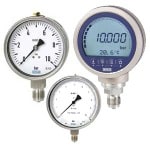
A gas density indicator provides local indication of the current SF6 gas density on a dial, whereas a gas density switch additionally includes electrical contacts. These contacts generate alarm, blocking or trip signals that can be integrated into protection and control systems.
Why is temperature compensation essential for SF6 gas density monitoring?
The pressure in a closed gas vessel strongly depends on temperature, while the dielectric strength of the insulation is linked to gas density. Integrated temperature compensation converts the measured pressure to a reference temperature so that switching points operate reproducibly, independent of ambient temperature variations.
What typical switching levels are used in SF6 gas density switches?
In many applications at least two switching levels are defined, for example a pre-alarm level to indicate a slow gas loss and a lockout level at which the equipment must not be operated for safety reasons. The switching thresholds are set relative to the nominal gas density of the equipment.
How are the switch contacts connected to the control system?
The micro-switches inside the gas density switch provide potential-free changeover or normally closed contacts. They are wired to terminals and connected to protection relays, PLCs or SCADA systems to generate alarms, interlocks or automatic switching sequences.
Which quantities are actually measured in a gas density switch?
Primarily the gas pressure is measured and then converted into a temperature-compensated density value by a mechanical or electronic system. Some designs additionally provide analogue or digital outputs that transmit pressure, density or temperature to higher-level systems.
What accuracy can be expected from SF6 gas density switches?
Mechanical gas density switches typically achieve accuracy classes in the range of 1.0 to 2.5 referred to the measuring span at reference temperature. Besides indication accuracy, the repeatability and long-term stability of the switching points over the specified temperature range and service life are crucial.
For which pressure and density ranges are SF6 gas density switches designed?
Versions for SF6 insulation generally cover a pressure range from near vacuum up to the upper single-digit bar range at room temperature. The corresponding density ranges are matched to the design of GIS, circuit breakers and ring main units and are specified by the equipment manufacturer.
Does the mounting position influence the performance of a gas density switch?
Most gas density switches are optimized for a defined mounting position, for example vertical mounting with the dial facing forward. Deviations from the specified mounting position can influence indication and switching behaviour and are only permissible if explicitly approved in the device documentation.
Which environmental conditions must be considered for SF6 gas density switches?
Gas density switches are designed for extended temperature ranges and must withstand humidity, vibration and shock loads. Enclosures with high ingress protection ratings shield the mechanism and contacts from dust, moisture and corrosion. The specified environmental limits must not be exceeded in service.
How is the tightness of a gas density switch ensured?
The measuring system is hermetically sealed, often using an all-welded stainless steel case and metallic sealing elements. Factory leak tests verify that leakage rates remain extremely low so that the reading is not affected by any internal leakage of the instrument itself.
What maintenance and test intervals are recommended for gas density switches?
Periodic visual checks, verification of contact operation and regular testing of switching points with suitable test equipment are common practice. The intervals are defined by operator guidelines, applicable standards and the criticality of the monitored equipment within the network.
How are switching points of gas density switches tested?
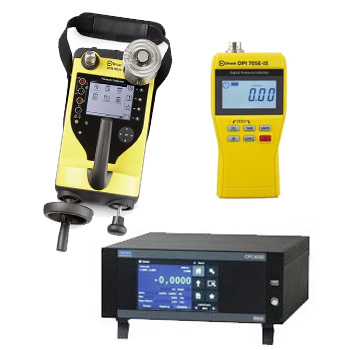
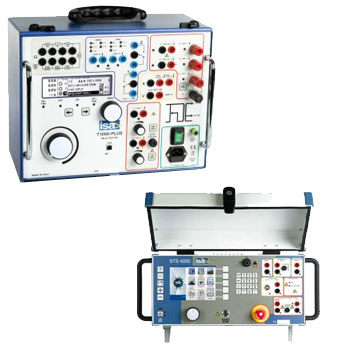
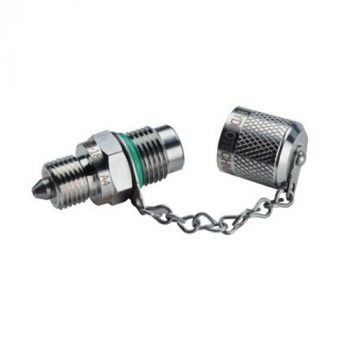
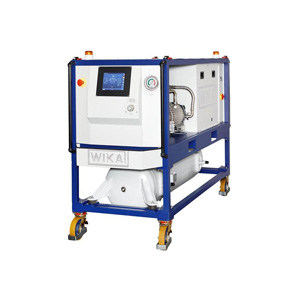
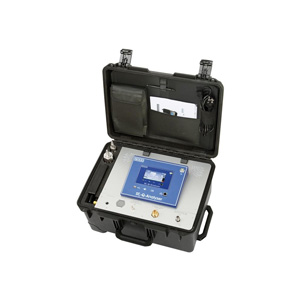
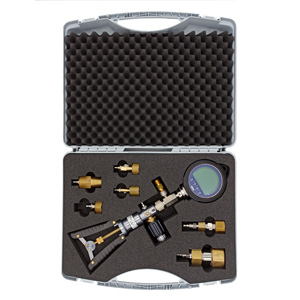
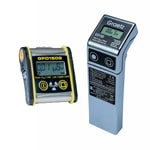
For testing, the connected gas compartment or a dedicated test chamber is pressurized in a controlled manner while the operation of the contacts at decreasing or increasing density is monitored. Dedicated test instruments can automatically approach defined test points and record the switching behaviour.
Which additional interfaces do modern gas density switches offer?
Modern designs combine mechanical switching contacts with integrated electronics and provide additional signals such as analogue current or voltage outputs and digital communication interfaces. This enables seamless integration of SF6 filling levels into condition monitoring systems and smart grid applications.
Which standards and regulations are relevant for SF6 gas density switches?
Gas density switches are typically designed in accordance with the relevant standards for gas-insulated switchgear and high-voltage equipment, as well as environmental requirements associated with SF6 handling. Operators additionally apply internal guidelines and national regulations regarding SF6 use and emission limits.
How do gas density switches support environmental protection in SF6 applications?
By detecting gas loss at an early stage, gas density switches enable timely maintenance and minimize uncontrolled SF6 emissions. This helps operators comply with internal targets and legal requirements for reducing the release of SF6 as a potent greenhouse gas.