


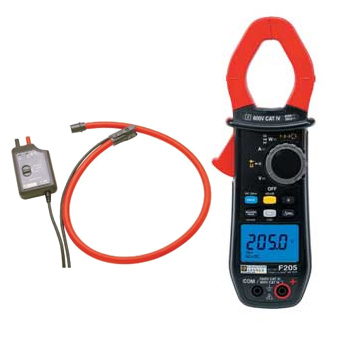
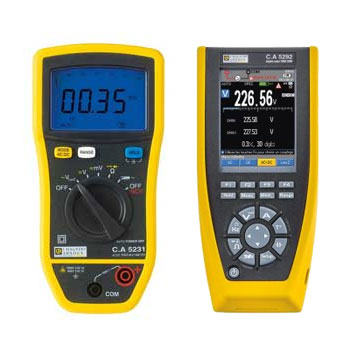
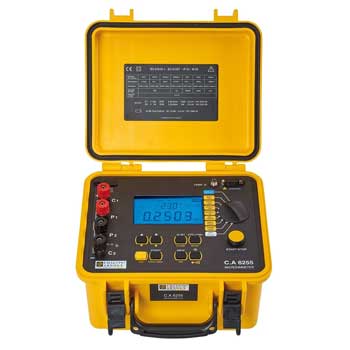
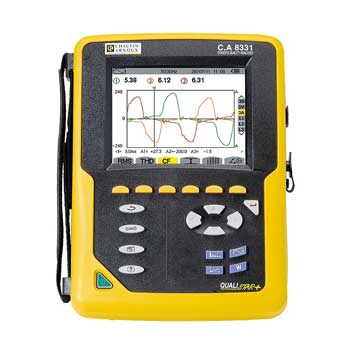
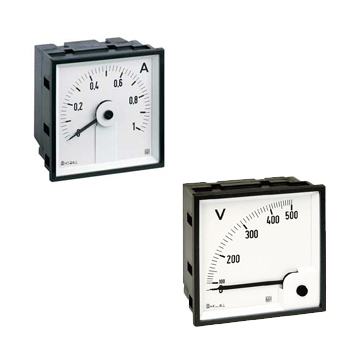
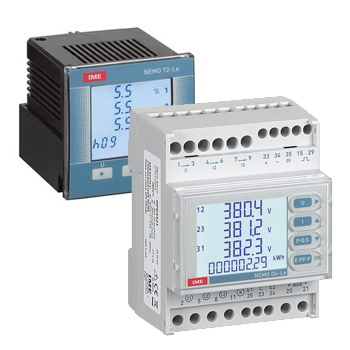
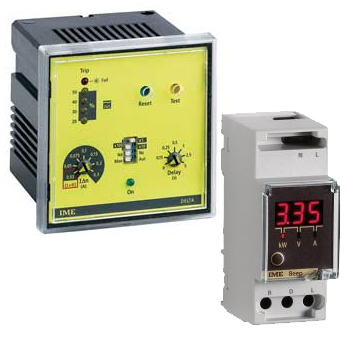
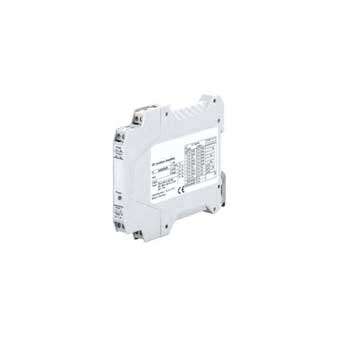
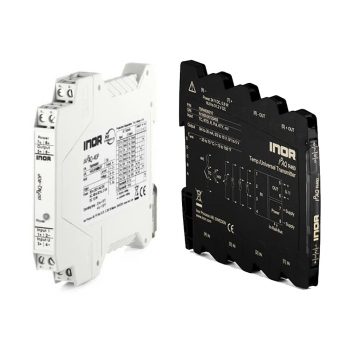
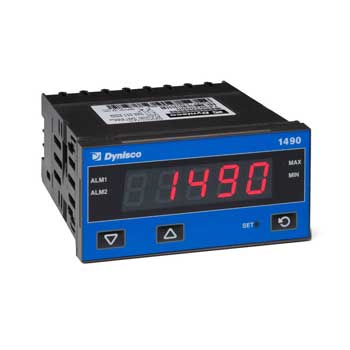























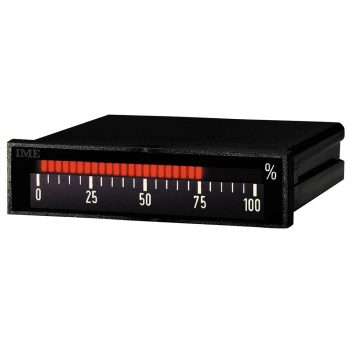
Bidirectional direct current measurements Display any proportional process variable Input for standard signal: 1 - 5 - 10 - 20mA - 4...20mA
 Datasheet Datasheet |
Bidirectional direct voltage measurements Display any proportional process variable Input for standard signal: 5 - 10V - 1...5 - 2...10V
|
Datasheet
|
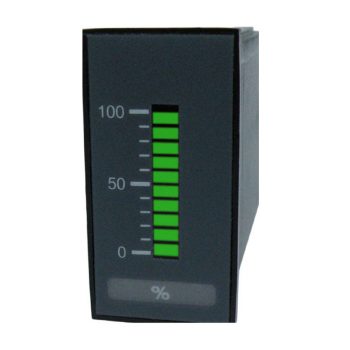
- 10 point bargraph display – NEW: colour: red or green, selectable via decode switch
- minimum installation depth: 30 mm without plug-in screw terminal
- adjustable via HEX switch and push-button
- pre-adjusted input for standard signals 0-10 V and 0/4-20 mA
- free adjustment on the input signal
- 8 different display types adjustable as bar, dot/point or curtain
- free choice of direction and display of centre (e.g. bars starting from the middle of display)
- control of bightness level in stages
- protection class IP65
- plug-in terminal
- optional: switchable colours green/orange, blue/red
| Datasheet |
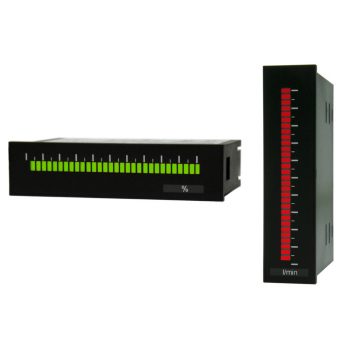
- 30-Punkte-Bargraph – NEU: Farbe Rot oder Grün über Codierschalter wählbar
- geringe Einbautiefe: 60 mm ohne steckbare Schraubklemme
- Parametrierung über HEX-Schalter und Taster
- ab Werk vorjustierter Eingang für Normsignal 0 bis 10 V und 0/4 bis 20 mA
- freie Justierung am Eingangssignal möglich
- 8 verschiedene Darstellungsarten als Balken, Dot/Punkt oder Vorhang parametrierbar
- freie Richtungswahl und Mittendarstellung (z.B. Balken aus der Mitte heraus)
- stufenweise Helligkeitsregulierung
- Schutzart IP65 frontseitig
- steckbare Schraubklemme
- optional: umschaltbare Farben Grün/Orange, Blau/Rot
|
Datenblatt
|
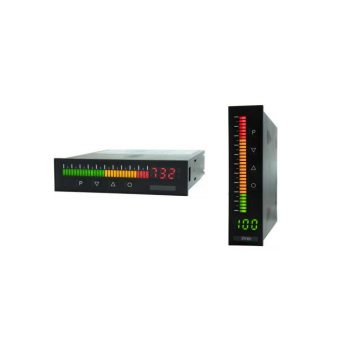
| Housing | 96 x 24 mm |
| Display | 3-digit 8 mm digit height Colour: red, optional green 30 dots bargraph display tricolour |
| Range displayed | -199…999 |
| Operation | front panel keyboard protection class IP65 |
| Input | High voltages 0…1 ADC / span -1…1 ADC 0…300 VDC / span -300…300 VDC |
| Analogue Output | 0/4-20 mA / 0-10 VDC / 16 Bit |
| Switch point | 2 relays (change-over contact) 250 VAC / 2 AAC ; 30 VDC / 2 ADC |
| Interface | – |
| Power supply | 100-240 VAC 50/60 Hz / DC +/- 10% |
| Sensor supply | – |
| Software properties |
|
 Datasheet Datasheet |
| User Manual |
| Housing | 96 x 24 mm |
| Display | 3-digit 8 mm digit height Colour: red, optional green 30 dots bargraph display tricolour |
| Range displayed | -199…999 |
| Operation | front panel keyboard protection class IP65 |
| Input | 0/4-20 mA / Span -22…24 mA 0-10 VDC / Span -12…12 VDC Digital input: <2.4V OFF, >10V ON, max. 30 VDC |
| Analogue Output | 0/4-20 mA / 0-10 VDC / 16 Bit Alternatively interface RS232/RS485 |
| Switch point | 1 or 2 change-over relays 250 VAC / 2 AAC ; 30 VDC / 2 ADC |
| Interface | RS232 or RS485 galvanic isolated Alternatively analog output |
| Power supply | 100-240 VAC 50/60 Hz / DC +/- 10% 10-40 VDC / 18-30 VAC 50/60Hz |
| Sensor supply | 10 VDC / 50 mA, incl. digital input 24 VDC / 50 mA, incl. digital input |
| Software properties |
|
|
Datasheet
|
|
User Manual
|
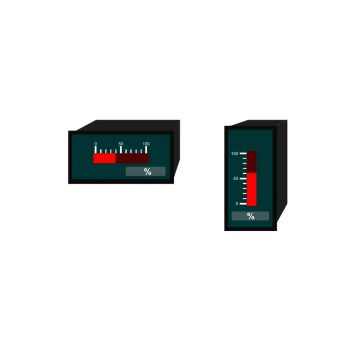
| Housing | 48 x 24 mm |
| Display | 10 segments |
| Range displayed | scale 0…100 |
| Operation | front panel poti,jumper |
| Input | 0/4…20 mA 0…50 V |
| Analogue Output | – |
| Switch point | – |
| Interface | – |
| Power supply | 24 VDC +/-10% galvanic isolated 1,5 VA |
| Sensor supply | – |
|
Datasheet
|
|
User Manual
|
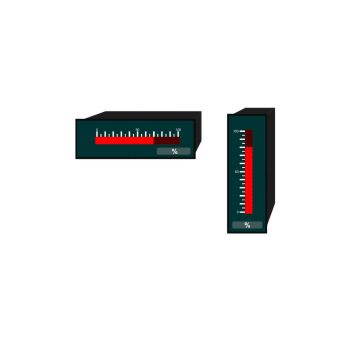
| Housing | 72 x 24 mm |
| Display | 20 segments |
| Range displayed | scale 0…100 |
| Operation | front panel poti,jumper |
| Input | 0/4…20 mA 0…50 V |
| Analogue Output | – |
| Switch point | – |
| Interface | – |
| Power supply | 24 VDC +/-10% galvanic isolated 1,5 VA |
| Sensor supply | – |
|
Datasheet
|
|
User Manual
|
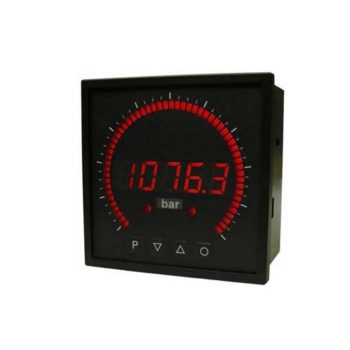
| Housing | 96 x 96 mm |
| Display | 5-digit 14 mm digit height Colour: red, green, orange or blue display 55 dots bargraph display |
| Range displayed | -19999 to 99999 |
| Operation | front panel keyboard protection class IP65 |
| Input | 0/4-20 mA / Span -22…24 mA 0-10 VDC / Span -12…12 VDC Digital input: <2.4V OFF, >10V ON, max. 30 VDC |
| Analogue Output | 0/4-20 mA / 0-10 VDC / 16 Bit |
| Switch point | 2 relays (change-over contact) 250 V / 5 AAC, 30 V / 5 ADC |
| Interface | RS232 or RS485 galvanic isolated |
| Power supply | 100-240 VAC 50/60 Hz / DC +/- 10% 10-40 VDC / 18-30 VAC 50/60Hz |
| Sensor supply | 24 VDC / 50 mA 10 VDC / 20 mA |
| Software properties |
|
|
Datasheet
|
|
User Manual
|
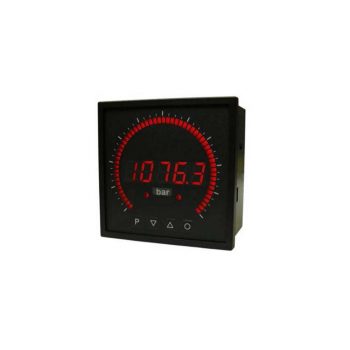
| Housing | 96 x 96 mm |
| Display | 5-digit 14 mm digit height Colour: red, green, orange or blue display 55 dots bargraph display |
| Range displayed | 0 to 99999 |
| Operation | front panel keyboard protection class IP65 |
| Input | Frequency 0,01 Hz to 999,99 kHz 3-wire PNP/NPN, Namur, incremental encoder, TTL signals Digital input: <2.4V OFF, >10V ON, max. 30 VDC |
| Analogue Output | 0/4-20 mA / 0-10 VDC / 16 Bit |
| Switch point | 2 relays (change-over contact) 250 V / 5 AAC, 30 V / 5 ADC |
| Interface | RS232 or RS485 galvanic isolated |
| Power supply | 100-240 VAC 50/60 Hz / DC +/- 10% 10-40 VDC / 18-30 VAC 50/60Hz |
| Sensor supply | 24 VDC / 50 mA, incl. digital input 12 VDC / 50 mA. incl. digital input |
| Software properties |
|
|
Datasheet
|
|
User Manual
|
