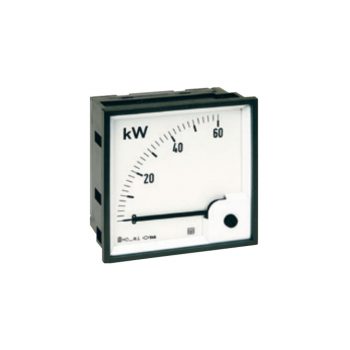
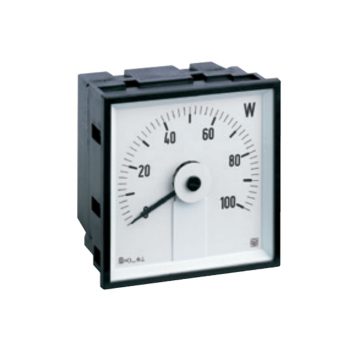
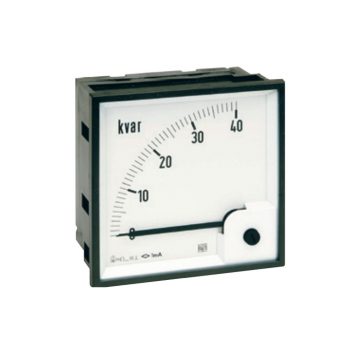
Analog Power Panel Meters / Leistungsanzeiger
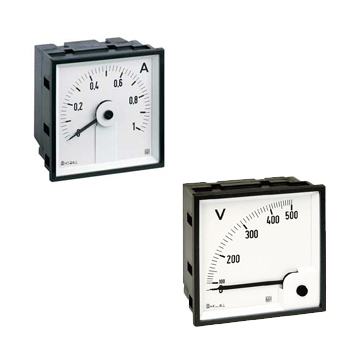
Analog power panel meters are built-in instruments used to display electrical power parameters directly via a pointer and scale. Mounted in control cabinets, distribution panels or operator consoles, they provide continuous, real-time indication of electrical power such as active power, apparent power, reactive power or power factor. Their mechanical design makes them robust, maintenance-friendly and independent of digital electronics — ideal for industrial environments that require clear, instant load monitoring.
What is an analog power panel meter?
An analog power panel meter is a panel-mounted instrument that visually displays electrical power values, such as active (P), apparent (S) or reactive power (Q), using a pointer on a calibrated dial. It represents the current load condition of a system in real time without digital processing.
Which power parameters can be displayed?
Depending on the model, the meter can display active power, apparent power, reactive power or power factor. Some instruments measure single-phase power, while others are suitable for three-phase systems depending on wiring and measurement configuration.
How does the measuring mechanism work?
Analog power meters often use electrodynamic or magnetic measuring mechanisms that respond to a combination of voltage, current and phase angle. By combining these quantities, the instrument derives the instantaneous power and moves the pointer proportionally. This allows a direct, real-time visualization of the actual electrical power.
What are the advantages of analog power meters?
They provide immediate and continuous feedback on system load, are robust and resistant to interference, and require little maintenance. Their simple mechanical display makes overloads, underloads and fluctuations easy to detect — without depending on auxiliary power or complex electronics.
Where are analog power meters used?
They are used in switchgear cabinets, industrial distribution panels, machine control systems, energy distribution networks and monitoring consoles. Typical applications include load supervision, distribution control and fast visual inspection of power conditions.
Which sizes and mounting formats exist?
Common panel sizes include 48×48 mm, 72×72 mm, 96×96 mm and 144×144 mm. Depending on the installation, they can be mounted in front panels, on DIN rails or integrated into enclosures. Selection depends on available space and wiring layout.
What are the limitations of analog power meters?
They offer lower accuracy than digital instruments, can be subject to parallax reading errors and lack functions such as data logging or communication. The pointer may fluctuate under varying load conditions, and incorrect wiring or overload can damage the mechanism.
For which applications are analog power meters especially suitable?
They are ideal for simple, continuous performance monitoring in industrial systems, distribution networks or machine control panels — especially when quick visual inspection is more important than high-precision measurement or digital data recording.
How do analog power meters respond to load changes or voltage fluctuations?
The pointer reacts directly to instantaneous changes in load or power, making peaks, drops, unbalanced phases or network disturbances immediately visible. This fast indication is often superior to digital displays that may average or buffer readings.
What should be considered for selection and installation?
Important factors include correct voltage, current and power ranges, proper wiring (single-phase or three-phase), and suitability for the electrical network. Mounting dimensions, protection requirements and environmental influences such as vibration, dust or humidity must also be considered to ensure reliable operation.

































Datasheet