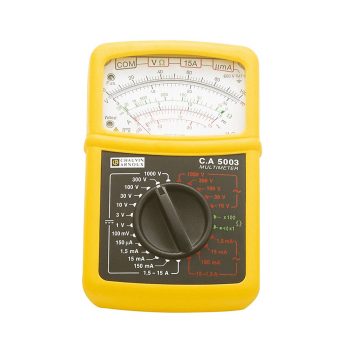
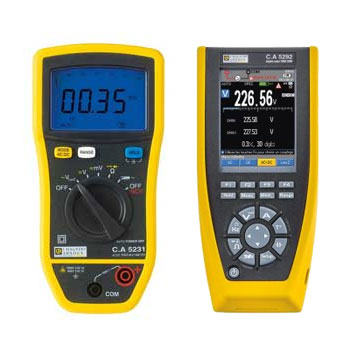
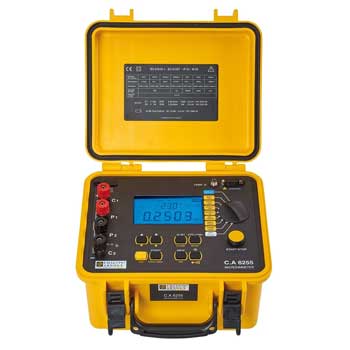
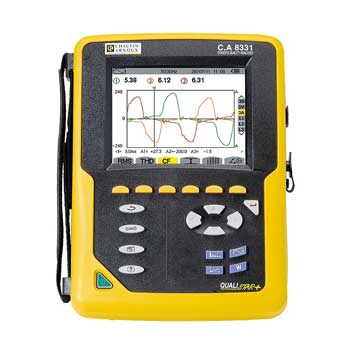
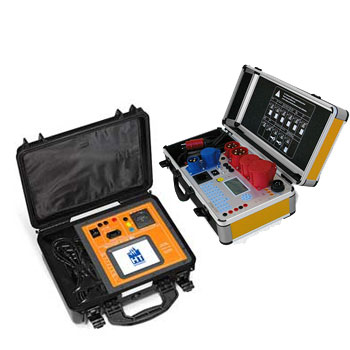
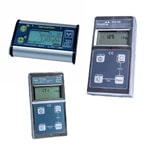


























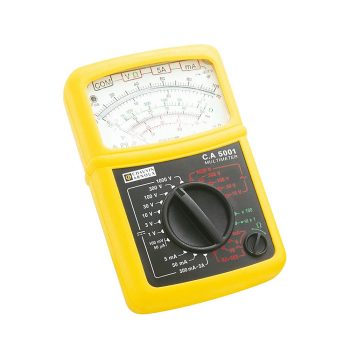
Specifications:

  • DC voltage: 100 mV to 600 V (8 ranges)
  • Accuracy: 1.5% except with 100 mV range (2.5%)
  • AC voltage: 10 V to 600 V (5 ranges) Bandwidth: [20Hz-100kHz] on 10 V range,  [20Hz-1kHz] on 300 V and 1,000 V ranges Accuracy: 2.5% except with 100 mV range (3%)
  • Impedance: 20 kΩ/V
  • DC current: 50 µA to 5 A (5 ranges)
  • AC current: 5 mA to 5 A (4 ranges) Bandwidth: [40 Hz-5 kHz] Accuracy: 2.5% except with 5 A range(5%)
  • Resistance: 10 kΩ and 1 MΩ
  • Audible continuity test: R < 50 Ω
  • dB scale (V AC).
  • Fuse status LED
  • Dimensions: 160 x 105 x 56 mm
  • Weight: 500 g
  • Use on any installation rated lower than or equal to CAT III 600 V asper IEC/EN 61010-1 Edition 2
Datasheet

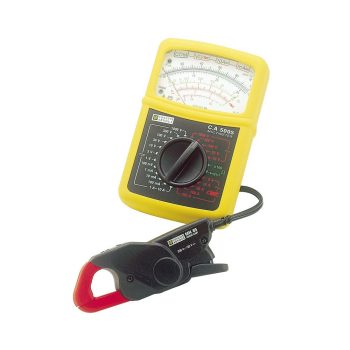
Specifications:

  • DC voltage: 100 mV to 600 V (8 ranges)
  • AC voltage: 10 V to 600 V (5 ranges)
  • DC current: 50 µA to 15 A (7 ranges)
  • AC current: 1.5 mA to 15 A (5 ranges)
  • Automatic calibration
  • “Voltest” LED if voltage present in ohmmeter mode
  • Typical accuracy: 1.5%
  • Impedance: 20 kΩ/V
  • Resistance: 10 kΩ and 1 MΩ
  • Audible continuity test: R < 50 Ω
  • dB scale (AC voltages)
  • Fuse status LED
  • Dimensions: 160 x 105 x 56 mm
  • Weight: 500 g
  • IP53
  • Use on any installation rated lower than or equal to CAT III 600 V asper IEC/EN 61010-1 Edition 2
Datasheet

Specifications:

  • DC voltage: 100 mV to 600 V (8 ranges)
  • AC voltage: 10 V to 600  V (5 ranges)
  • DC current: 50 µA to 10 A (6 ranges)
  • AC current: 3 A to 240 A (5 ranges) with MN89clamp supplied
  • Automatic calibration
  • “Voltest” LED if voltage present in ohmmeter mode
  • Typical accuracy: 1.5%
  • Impedance: 20 kΩ/V
  • Resistance: 10 kΩ and 1 MΩ
  • Audible continuity test: R < 50 Ω
  • dB scale (AC voltages)
  • Fuse status LED
  • Dimensions: 160 x 105 x 56 mm
  • Weight: 500 g
  • IP53
  • Use on any installation rated lower than or equal to CAT III 600 V as per IEC/EN 61010-1 Edition 2
Datasheet

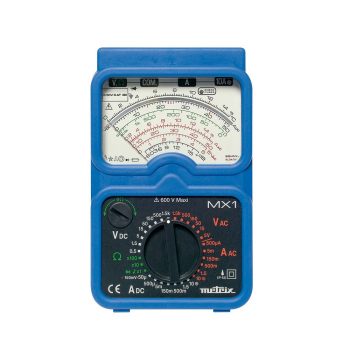
Specifications:

  • Automatic recognition of AC/DC
  • AC/DC voltage: 400 mV to 600 V (5 ranges)
  • Operating frequency: 20Hz to 10 kHz
  • Typical accuracy: 0.5% -Impedance: 10 MΩ
  • AC/DC current: 400 µA to 10 A (6 ranges)
  • Resistance: 400 Ω to 40M Ω(6 ranges)
  • Continuity test: (R<  400 Ω) and diode test
  • Frequency: 4 kHz to 400 kHz(3 ranges)
  • Reading of dB scale from -20 to16 dB
  • Fuse status LED
  • "Voltest"LED if a voltage is present in ohmmeter and continuity modes
  • Max and Hold functions
  • Can be used as a zero galvanometer
  • Backlighting
  • Dimensions: 160 x 105 x 56 mm
  • Weight: 500g
  • Use on any installation rated lower than or equal to CAT III 600 V as per IEC/EN 61010-1 Edition 2
Datasheet

Beep for continuity Protection on all calibres Ω safety alarms

Datasheet


Analogue Multimeters

Analogue multimeters are measuring instruments with a pointer-based display used to indicate electrical quantities such as voltage, current and resistance. Through the continuous needle movement, changes and trends are often easier to observe compared to digital displays. They are used in workshops, training environments, test benches and situations where visual feedback of measurement progress is important.

FAQ

What is an analogue multimeter?

An analogue multimeter uses a mechanical pointer movement to display measurement values on a scale. It typically relies on a moving-coil galvanometer mechanism. :contentReference[oaicite:12]{index=12}

Which parameters can analogue multimeters measure?

Common measurable parameters include DC voltage, DC current and resistance. Some models also measure AC voltage or current via rectification. :contentReference[oaicite:13]{index=13}

What advantages do analogue meters have versus digital ones?

Advantages include the ability to visually track fluctuations and trends, continuous representation of changes, simpler operation in certain use cases and sometimes lower power requirements. :contentReference[oaicite:14]{index=14}

What are their limitations?

Limitations include lower accuracy compared to high-quality digital meters, susceptibility to reading errors due to parallax, lower input impedance and often lack of true RMS capability for AC measurement. :contentReference[oaicite:15]{index=15}

How does the meter movement function work?

A current through the coil creates a magnetic force with a permanent magnet causing the coil to rotate. The pointer attached to the coil moves across the scale. A spring provides opposing force to control the movement. :contentReference[oaicite:16]{index=16}

What must be ensured when reading the scale?

Read the scale directly from the front to avoid parallax error, ensure the correct range is selected and observe the entire needle movement, particularly when the measured quantity fluctuates. :contentReference[oaicite:17]{index=17}

What safety category (CAT) applies?

The safety category (CAT I–IV) must fit the application environment. The rating must match the installation to avoid risk due to overvoltage or transient conditions.

How accurate are analogue meters?

Typically analogue meters deliver accuracies around ±1 % to ±3 % depending on model and measurement range. :contentReference[oaicite:18]{index=18}

What is input impedance characteristic?

Analogue meters often have a lower input impedance, which can load the measured circuit and affect accuracy, especially for high-impedance sources. :contentReference[oaicite:19]{index=19}

When are analogue meters especially useful?

They are especially useful for observing pointer deflections, slow changes, trends, training, repair work or in environments where battery independence is advantageous.

Which measurement ranges are common?

Examples: voltage ranges from ~100 mV to 1000 V, current from ~100 µA to 10 A, depending on the device. :contentReference[oaicite:20]{index=20}

What should be noted for AC voltage measurement?

Many analogue meters use rectifiers and do not provide true RMS reading for non-sinusoidal waves, which can result in significant error. :contentReference[oaicite:21]{index=21}

How is resistance measured?

An internal battery supplies current through the resistor under test, and the deflection indicates resistance. The zero-adjust must be set first. :contentReference[oaicite:22]{index=22}

What common error sources exist?

Typical error sources include incorrect range selection, multiple conductors in clamp, parallax reading, lack of zero adjust, mechanical wear or interference. :contentReference[oaicite:23]{index=23}

How often should calibration be done?

Calibration intervals depend on usage and documentation requirements. Annual calibration is typical for regulated environments; otherwise every 2–3 years may suffice.

What is “parallax error”?

Parallax error occurs when the observer’s eye does not align perpendicularly with the pointer and scale, causing misreading of the value. :contentReference[oaicite:24]{index=24}

What maintenance is needed?

Mechanical meter movement should be protected against shocks, inspect for damage or misalignment, battery (if present) replaced regularly and zero adjust checked.

Can an analogue multimeter fully replace a digital one?

For many general tasks – yes. Especially where visual feedback or trend detection is useful. For precision measurement, advanced features or non-sinusoidal signals, a digital meter is typically superior.

Diese Website benutzt Cookies. Wenn du die Website weiter nutzt, gehen wir von deinem Einverständnis aus.