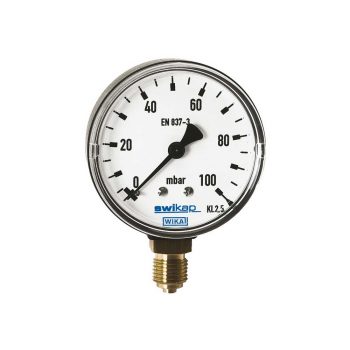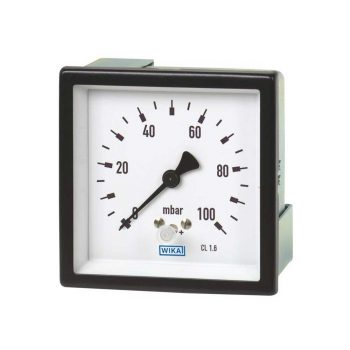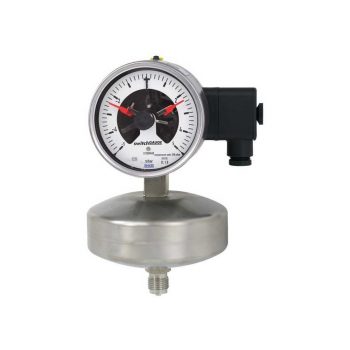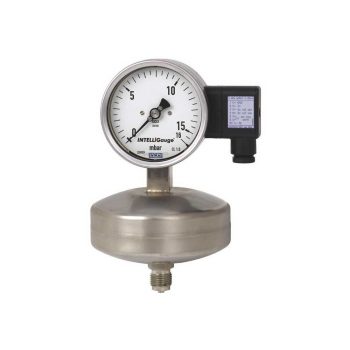
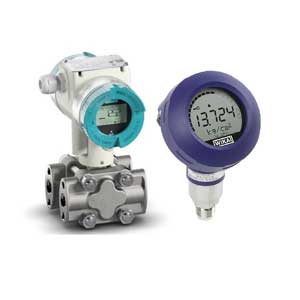
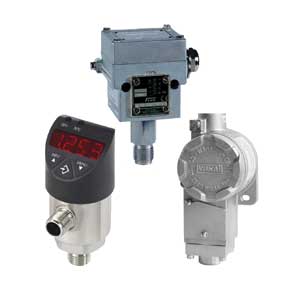
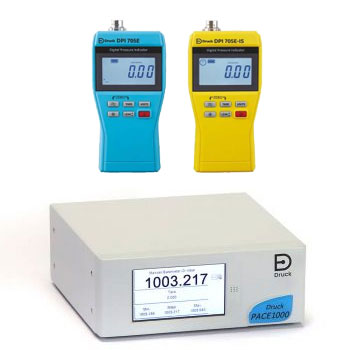
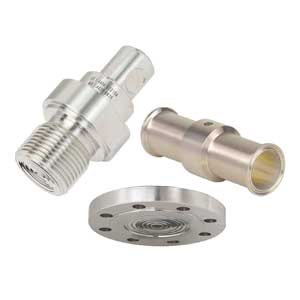
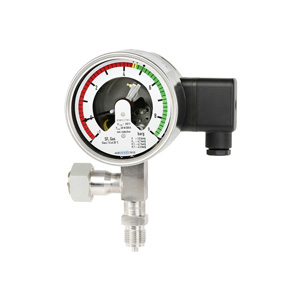



























• No configuration necessary due to "plug-and-play"
  • High overload safety up to 50 x full scale value
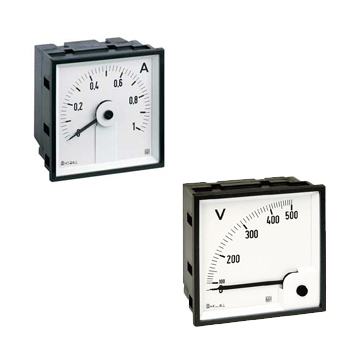
  • Easy-to-read analogue display with nominal sizes 100 and 160
  • Low measuring error and influence on function from medium pollution
  • Measuring chamber protected against unauthorised intervention
Datasheet
User Manual

  • Zero point correction in front
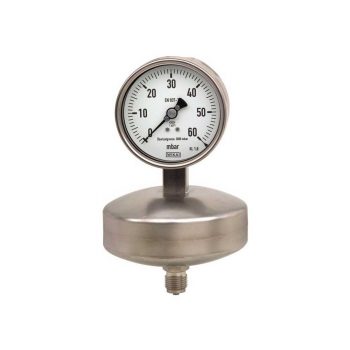
  • Completely from stainless steel
  • With liquid-filled case for applications with high dynamic pressure loads and vibrations (model 633.50)
  • Low scale ranges from 0 ... 2.5 mbar to 0 ... 600 mbar or 0 ... 1 inH2O to 0 ... 240 inH2O
Datasheet
User Manual

  • High overload safety up to 50 x full scale value
  • Scale ranges from 0 … 2.5 mbar
  • Measuring chamber protected against unauthorised intervention
  • Low measuring error and influence on function from medium pollution
Datasheet
User Manual

  • Zero point setting in front
  • Special connection location on request
  • Low scale ranges from 0 ... 25 mbar
Datasheet
User Manual

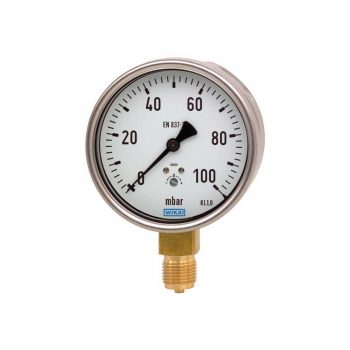
  • Zero point correction in front
  • Case from stainless steel
  • Robust design and ingress protection IP54
  • Low scale ranges from 0 ... 6 mbar to 0 ... 600 mbar or 0 ... 2.4 inH2O to 0 ... 240 inH2O
Datasheet
User Manual

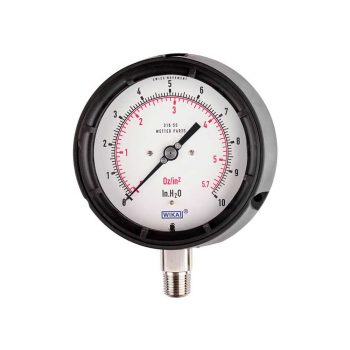
  • Safety version with solid baffle wall designed in compliance with the requirements and test conditions of ASME B 40.100
  • Low scale ranges from 0 ... 25 mbar to 0 ... 600 mbar
  • Nominal size 4 ½" (115 mm)
  • Robust, glass-fibre reinforced case from POCAN®
Datasheet
User Manual

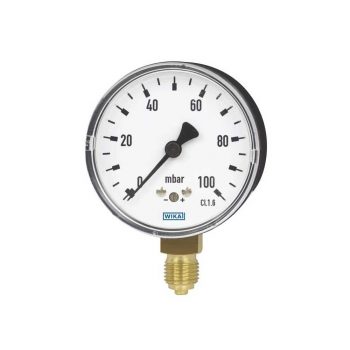
  • Compact design and ingress protection IP53
  • Case from plastic
  • Special connection location on request
  • Low scale ranges from 0 ... 60 mbar
  • Maximum scale range 0 ... 1,000 mbar
Datasheet
User Manual

  • High overload safety up to 50 x full scale value
  • High reliability and long service life
  • Up to 4 switch contacts per instrument
  • Instruments with inductive contacts for use in hazardous areas
  • Instruments with switch contact for PLC applications
Datasheet
User Manual

High reliability and long service life Overload protection ,up to x 10 Zero adjustment Copper alloy measuring system

Datasheet

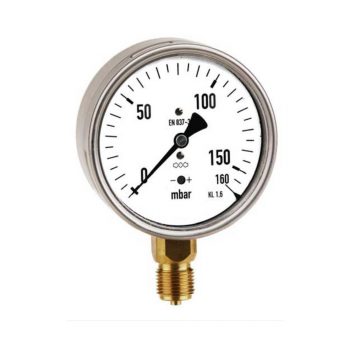
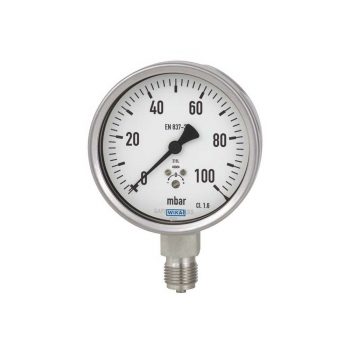
Nominal size NS 100 and 160, accuracy class 1.6, according to DIN EN 837-3
Datasheet

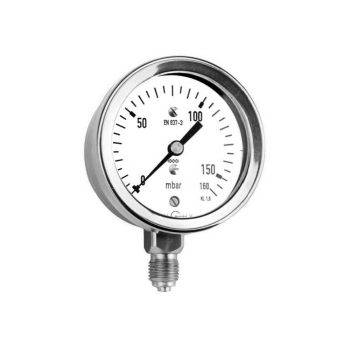
Nominal size NS 100 and 160, accuracy class 1.6, according to DIN EN 837-3
Datasheet


Capsule Pressure Gauges – ultra-sensitive for low & very low pressure

Capsule pressure gauges are the first choice for very low pressures in the mbar range: room and cleanroom monitoring, filter condition, leak tests, laboratory and test benches. The capsule design provides fine resolution, good long-term stability, and a clear, easy-to-read dial — from vacuum to slight overpressure.

ICS Schneider Messtechnik supports you with range selection, accuracy class, scales/units, materials, and process fittings (e.g., G 1/4, 1/4" NPT). Options include calibration certificates, versions with damping, and integration into measurement chains (e.g., a parallel-mounted transmitter for 4–20 mA/HART/RS-485).


FAQ on Capsule Pressure Gauges

Answers on use, selection, installation, accuracy, scales, media compatibility, and calibration.

What are capsule pressure gauges especially suited for?

For low and very low pressure in air/gases: HVAC/room pressure, cleanrooms, fume hoods, filter monitoring, differential pressure across flow resistances, and laboratory experiments.

What measuring ranges are typical?

RangeTypical applicationNote
±10 … 0 … 25 mbarRoom pressure cascadesFine resolution required
0 … 40/60/100 mbarFilter / flow monitoringΔp with stable signal
0 … 160/250/400 mbarLight pneumaticsLow pulsation only

What accuracy classes are common?

Typically Class 1.6–2.5 (EN 837-3), depending on dial size and range. For test tasks, consider larger dials or a Digitalmanometer.

Which standards apply?

EN 837-3 (capsule/bellows gauges) for construction, accuracy classes, and tests; enclosure protection per IP code.

How do I choose the correct measuring range?

Select span as working pressure × 1.3–2.0. If peaks are expected, choose more conservatively. For alternating vacuum/overpressure, use bipolar (±) scales.

Which process connections are available?

ConnectionStandardRemark
G 1/4 / G 1/2ISO 228Industry standard
¼" NPT / ½" NPTASMEUS/Oil & Gas
FlangeEN/ASMESpecial applications

What materials make sense?

For dry, clean gases, brass/bronze measuring systems are often sufficient; for more demanding environments use stainless steel 316L. Choose elastomers per medium (NBR/FKM/EPDM/PTFE).

Can I measure differential pressure?

Yes, there are Δp capsule designs for small pressure differences. For higher pressures/accuracy, DP transmitters with display are recommended.

How stable is the indication under vibration?

Capsule gauges are sensitive. Use damping (restrictor/snubber) and ensure low-vibration mounting. Glycerin filling is uncommon with capsule elements.

What should I consider during installation?

  • Install vertically with minimal vibration; keep the dial clearly visible.
  • Do not apply lever forces via the process connection.
  • With temperature swings, check zero periodically.

Which scales/units are available?

Scales in mbar, kPa, mmH₂O, or inH₂O; dual scales possible. Use one unit consistently across the project.

How does temperature affect the measurement?

Temperature changes can shift zero (thermal drift). Keep ambient as constant as possible or re-adjust/calibrate at intervals.

What protection classes are typical?

Usually IP54–IP65 depending on housing. For cleaning areas, consider front sealing and safety glass.

How often should I calibrate?

Rule of thumb: annually; in QA/safety loops semi-annually/quarterly or after events (shock/overload). Store certificates (DAkkS/ISO) securely.

Can capsule gauges be connected to SCADA/IIoT?

Indirectly via a dual measuring point: local gauge + transmitter (4–20 mA/HART/RS-485) for SCADA/cloud. An edge gateway publishes via MQTT/HTTPS.

Which dial sizes are available?

Dial sizeUseBenefit
DN 63Compact devices/panelsSaves space
DN 100General indicationGood readability
DN 160Long viewing distanceVery good readability

What are typical fault causes?

  • Pointer flutter: vibration/pulsation → add damping, check mounting.
  • Zero drift: temperature → adjust/calibrate.
  • Sluggish indication: damping too strong → adapt settings.

Do you offer selection and calibration services?

Yes. We define range/scale, choose materials/connections, provide calibration certificates, and supply accessories on request (restrictors, brackets, front gaskets).

Diese Website benutzt Cookies. Wenn du die Website weiter nutzt, gehen wir von deinem Einverständnis aus.