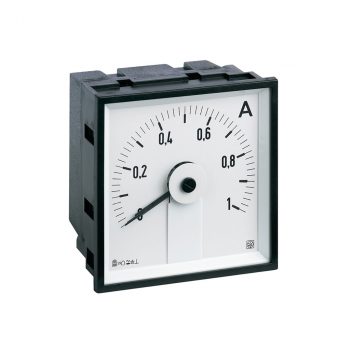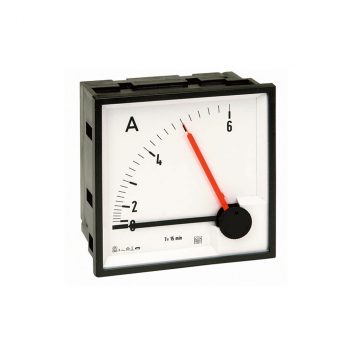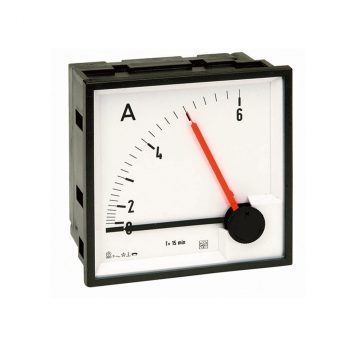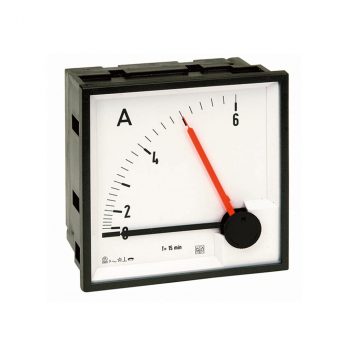


























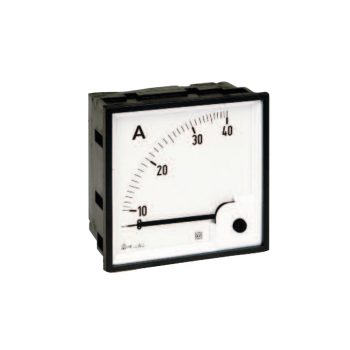
INSERTION direct
FORMAT 72x72 mm
CURRENT 30 A
TYPE A.C. ammeter (moving iron)
SCALE 0…In
OPTIONS tropicalized
Datasheet

INSERTION direct
FORMAT 96x96 mm
CURRENT 2,5 A
TYPE A.C. ammeter (moving iron)
SCALE overscale 5In
OPTIONS tropicalized-antivibration
 
Datasheet

  • Direct indication of input current or primary current of external CT
  • Moving coil equipment,
  • with rectifier accessory
  • Direct connection 1...5A
  • Input by external CT /5A or /1A
  • Version for starting motor 2In or 5In
  • Scale length 240°
  • Accuracy class 1,5
Datasheet

  • Direct indication of input current or primary current of external CT
  • Moving iron equipment
  • Direct connection 1...10A
  • Input by external CT /5A or /1A
  • Version for starting motor 2In or 5In
  • Scale length 240°
  • Accuracy class 1,5
Datasheet

  • Direct indication of input current or primary current of external CT
  • Moving coil equipment,
  • with rectifier accessory
  • Direct connection 1...5A
  • Input by external CT /5A or /1A
  • Version for starting motor 2In or 5In
  • Scale length 240°
  • Accuracy class 1,5
Datasheet

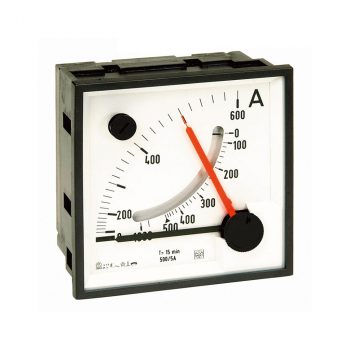
  • Detection of mean load
  • condition in a plant
  • Thermal equipment to show
  • the current demand value
  • Delay time 15 minutes
  • Current demand indication 0...1,2In
  • Max. current demand indication (red pointer)
  • Red pointer with reset knob (sealable)
  • Scale lenght 90°
Datasheet

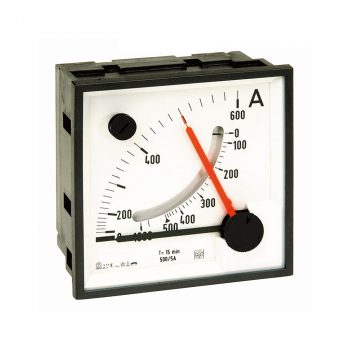
  • Detection of mean load
  • condition in a plant
  • Thermal equipment to show
  • the current demand value
  • Delay time 15 minutes
  • Current demand indication 0...1,2In
  • Max. current demand indication (red pointer)
  • Red pointer with reset knob (sealable)
  • Scale lenght 90°
 
Datasheet

  • Detection of mean load
  • condition in a plant
  • Thermal equipment to show
  • the current demand value
  • Delay time 15 minutes
  • Current demand indication 0...1,2In
  • Max. current demand indication (red pointer)
  • Red pointer with reset knob (sealable)
  • Scale lenght 90°
Datasheet

  • Detection of mean and instantaneous load
  • condition in a plant
  • Thermal equipment to show
  • the current demand value
  • Moving-iron equipment to show
  • the instantaneous current
  • Delay time 15 minutes
  • Current demand (thermal) indication 0...1,2In
  • Instantaneous current indication 0...In
  • Max. current demand indication (red pointer)
  • Red pointer with reset knob (sealable)
  • Scale lenght 90°
  • Thermal current accuracy class 3
  • Instantaneous current accuracy class 1,5
 
Datasheet

  • Detection of mean and instantaneous load
  • condition in a plant
  • Thermal equipment to show
  • the current demand value
  • Moving-iron equipment to show
  • the instantaneous current
  • Delay time 15 minutes
  • Current demand (thermal) indication 0...1,2In
  • Instantaneous current indication 0...In
  • Max. current demand indication (red pointer)
  • Red pointer with reset knob (sealable)
  • Scale lenght 90°
  • Thermal current accuracy class 3
  • Instantaneous current accuracy class 1,5
Datasheet

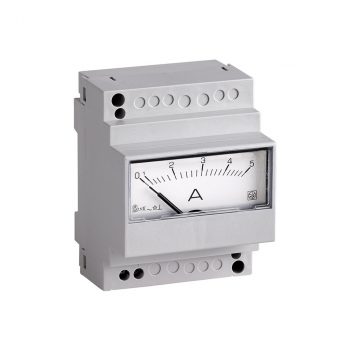
INSERTION on CT
FORMAT 4 DIN modules
CURRENT 800/1 A
TYPE A.C. ammeter (moving iron)
SCALE overscale 2In
Datasheet


Analog AC Panel Meters / Wechselstrom Einbaumessgeräte

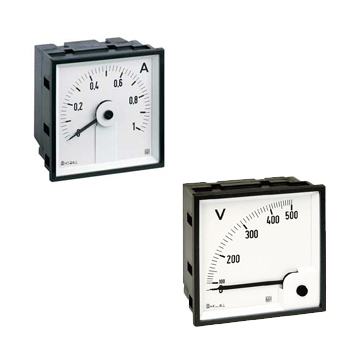
Analog AC panel meters are instruments designed for use in control cabinets, switchgear panels or distribution boards to display AC parameters such as voltage, current, frequency or power with a pointer on a dial. Without digital conversion or external power supply, they provide a continuous and intuitive real-time display, making them ideal for industrial applications where robust, direct and easy-to-read indication of AC network characteristics is required.

What is an analog AC panel meter?

An analog AC panel meter is a meter for alternating current parameters—such as voltage, current, frequency or power—that displays values continuously with a pointer over a calibrated scale. It does not rely on digital electronics or external supply, offering direct, real-time indication of the measured AC quantity.

Which AC quantities are typically displayed?

Commonly displayed parameters include RMS voltage (e.g., 230 V, 400 V), AC current (A), frequency (Hz), phase conditions or phase sequence, and in some cases active or apparent power or power factor, depending on meter type and wiring.

How does the measurement mechanism work in AC meters?

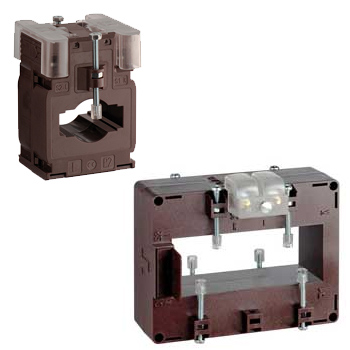
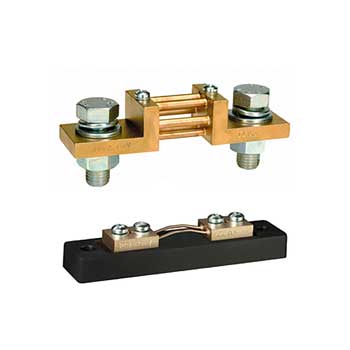
For AC measurement, a moving-iron (dynamometer) or similar AC-capable movement is used. Voltage measurement often involves a voltage transformer, while current measurement can use a current transformer or shunt resistor. The resulting magnetic or electromagnetic effect deflects the pointer proportionally to the RMS value of the measured quantity.

What are the advantages of analog AC panel meters?

They offer instant visual feedback even under fluctuating or pulsating loads, show peaks and fluctuations more clearly than digital averages, and are rugged, interference-resistant and typically maintenance-free. Because they do not require an auxiliary power supply, they are reliable and simple — ideal for basic monitoring tasks in industrial environments.

Where are analog AC panel meters used?

They are commonly used in switchgear cupboards, distribution panels, machine control panels, energy distribution boards, industrial facilities and control systems where continuous monitoring of AC parameters like voltage, current or frequency is needed — especially under variable loads or dynamic conditions.

Which form factors and panel sizes are common?

Standard front-panel sizes include 48×48 mm, 72×72 mm, 96×96 mm or 144×144 mm. Slim versions such as 48×24 mm, 72×24 mm or 96×24 mm also exist for compact installations. Meters can be mounted on front panels, DIN rails or within enclosures depending on installation requirements.

What are the limitations and downsides of analog AC meters?

They provide lower accuracy than digital instruments, are prone to parallax errors, lack automatic range switching, data logging or communication interfaces, and have limited functionality. Incorrect wiring or overload may damage the movement mechanism. They are therefore less suitable for precision measurement, documentation or long-term monitoring.

For which applications are analog AC panel meters most suitable?

They are suitable for continuous, straightforward monitoring of AC system parameters — particularly where real-time visual feedback and robustness are more important than high measurement precision. They excel in applications with fluctuating loads or where no auxiliary power for digital displays is available.

How do analog AC meters respond to load fluctuations or voltage peaks?

The pointer responds directly to signal changes and displays fluctuations or peaks immediately. This allows prompt detection of overloads or abnormal conditions — an advantage over digital devices that may show smoothed or averaged values. Immediate visual feedback supports quick operational decisions.

What must be considered when selecting and installing analog AC meters?

It is essential to choose the correct measurement ranges, appropriate meter movement for AC signals, correct wiring and matching panel cutout or enclosure size. Environmental conditions (dust, moisture, vibration), protective class, and relevant standards must be considered to ensure safe, reliable and durable operation.

Diese Website benutzt Cookies. Wenn du die Website weiter nutzt, gehen wir von deinem Einverständnis aus.