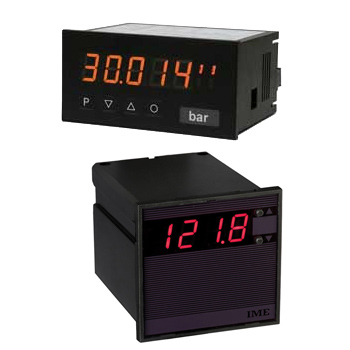
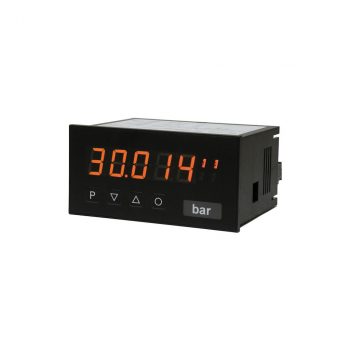
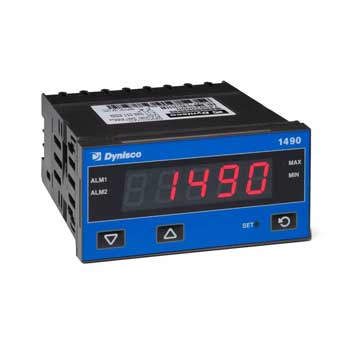
| Housing | 96 x 48 mm |
| Display | 5-digit 14 mm digit height Colour: red, green, orange or blue display |
| Range displayed | -19999 to 99999 |
| Operation | front panel keyboard protection class IP65 |
| Input | DMS / Weighing technology: 1 mV/V, 2 mV/V, 3.3 mV/V free to 4 mV/V Digital input: <2.4V OFF, >10V ON, max. 30 VDC |
| Analogue Output | – |
| Switch point | 2 relays (change-over contact) 250 V / 5 AAC, 30 V / 5 ADC |
| Interface | – |
| Power supply | 230 VAC 10-30 VDC galvanic isolated Other voltage supplies on demand! |
| Sensor supply | Bbridge feeding 10 VDC / 2-40 mA / 300-5000 Ohm |
| Software properties |
|
Datasheet
|
User Manual
|
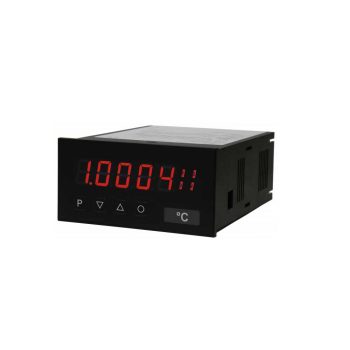
| Housing | 96 x 48 mm |
| Display | 5-digit 14 mm digit height Colour: red, green, orange or blue display |
| Range displayed | -19999 to 99999 |
| Operation | front panel keyboard protection class IP65 |
| Input | DMS / Weighing technology: 1mV/V, 2 mV/V, 3.3 mV/V free to 4 mV/V Digital input: <2.4V OFF, >10V ON, max. 30 VDC |
| Analogue Output | 2 analog outputs 0/4-20 mA / 0-10 VDC / 16 Bit |
| Switch point | 2 or 4 relays (change-over contacts) 250 V / 5 AAC, 30 V / 5 ADC or 8 PhotoMos outputs (NOC) 30 V / 0.4 A AC/DC |
| Interface | RS232 or RS485 galvanic isolated Alternatively to analog output 2 |
| Power supply | 100-240 VAC 50/60 Hz / DC +/- 10% 10-40 VDC / 18-30 VAC 50/60Hz |
| Sensor supply | Bbridge feeding 10 VDC / 2-40 mA / 300-5000 Ohm |
| Software properties |
|
Datasheet
|
User Manual
|
| Housing | 96 x 48 mm |
| Display | 5-digit 14 mm digit height Colour: red |
| Range displayed | -9999…99999 |
| Operation | front panel keyboard protection class IP65 |
| Input | Strain gauge / Weighing technology: 1mV/V, 2 mV/V, 3,3 mV/V frei bis 6 mV/V Digital input: <2.4V OFF, >10V ON, max. 30 VDC |
| Analogue Output | 0-20 mA Burden ≤500Ohm 12Bit 4-20 mA Burden ≤500Ohm 12Bit 0-10 VDC Burden ≥100kOhm 12Bit |
| Switch point | 2 or 4 relays (change-over contacts) 250 V / 5 AAC, 30 V / 5 ADC |
| Interface | RS232 or RS485 galvanic isolated |
| Power supply | 100-240 VAC 50/60 Hz / DC +/- 10% 10-40 VDC / 18-30 VAC 50/60Hz |
| Sensor supply | Bridge supply 10 VDC / 20-50 mA / 200-500 Ohm |
| Software properties |
|
Datenblatt
|
Bedienungsanleitung
|
Digital Panel Meters with Strain-Gauge / Load-Cell Input (Weighing / Pressure / Force Measurement)
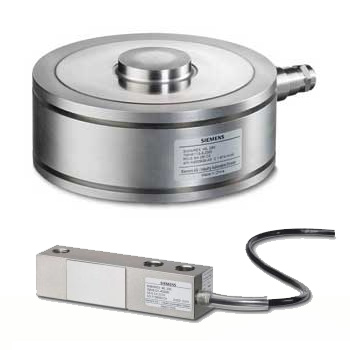
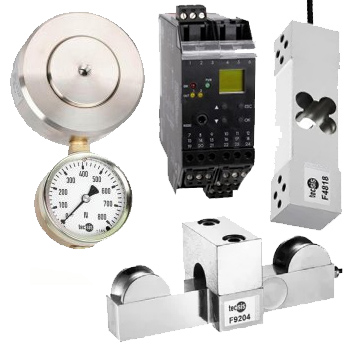
Digital panel meters with strain-gauge / load-cell input are instruments designed to read the small bridge output signals from strain gauges — such as those used in load cells, force sensors or pressure sensors — and convert them into meaningful physical values (weight, force, pressure). These meters amplify and digitize the sensor’s bridge signal and display the resulting value on an LED or LCD display. They are widely used in weighing systems, test rigs, industrial scale systems or pressure/load monitoring setups. Typical devices offer features such as zeroing (tare), scaling/calibration, min/max memory, limit/alarm outputs, analog or digital outputs, switching contacts and optionally serial or fieldbus communication.
F&A
What does “strain-gauge / load-cell input” mean?
Strain gauges (also referred to as DMS for the German term “Dehnungsmessstreifen”) detect small deformations of a mechanical structure — for example when a weight or force is applied. The deformation changes the resistance of the gauge, and in a bridge circuit (e.g. Wheatstone bridge) this leads to a small voltage signal that is proportional to the load. A load cell comprises such strain gauges, converting force or weight into a low-level electrical signal. A digital panel meter designed for load-cell input accepts this signal, amplifies and digitizes it, and displays the corresponding load, weight or pressure value. :contentReference[oaicite:0]{index=0}
Which physical quantities can be displayed?
Depending on the connected sensor and calibration, the meter can display weight (mass), force, pressure or any parameter derived from a strain-gauge sensor output. This makes them suitable for industrial scales, material testing machines, force measurement systems, pressure vessel monitoring or test stands. :contentReference[oaicite:1]{index=1}
How does the measurement and conversion process work?
When a load is applied to the sensor (load cell, force sensor or pressure transducer), the mechanical deformation causes a change in resistance in the strain-gauges. This leads to an unbalanced bridge output — a small voltage differential — which is first amplified, then digitized by an ADC and processed by the panel meter’s electronics. The meter then displays the calibrated value on a digital display. Many devices also allow zero-setting (tare), calibration via linearization points, and selection of units (e.g. kg, N, bar). :contentReference[oaicite:2]{index=2}
What are typical features and options?
Common features include: • Adjustable calibration / span and zero (tare) • Min/max value storage • Alarm or limit outputs (e.g. relays or switching contacts) • Analog or digital outputs for further processing (e.g. 4–20 mA, 0–10 V) • Interface options (e.g. RS-232, RS-485) or bus communication (optional) • Configurable display resolution (e.g. 4– or 5-digit displays) • Compact panel installation format (e.g. 96×48 mm) suitable for switchboards or control cabinets :contentReference[oaicite:3]{index=3}
Why use a digital load-cell panel meter instead of analog instrumentation?
Digital load-cell meters provide higher precision, stable and repeatable readings, and make calibration, tare and scaling easy. They eliminate analog reading errors and offer additional functionality (alarms, outputs, data interfaces). Their flexibility allows them to be used with different types of sensors and in diverse applications — from mobile weighing systems to heavy-duty industrial scales. :contentReference[oaicite:4]{index=4}
Where are such strain-gauge panel meters typically used?
Applications include industrial weighing systems (platform scales, conveyor belt scales), mobile weighing (forklift scales, crane scales), test and calibration devices, material testing machines, force or torque measurement systems, pressure vessel monitoring, quality control, process automation and anywhere precise measurement of weight, force or pressure is required. :contentReference[oaicite:5]{index=5}
What should be considered before selecting such a meter?
Important selection criteria are: the load-cell or strain-gauge type (resistance, bridge configuration), excitation voltage, expected measurement range, required resolution and accuracy, appropriate calibration and linearization options, display format, any required outputs or communication interfaces, environmental conditions (temperature, humidity, vibration) and proper wiring and grounding — as strain-gauge signals are small and sensitive. :contentReference[oaicite:6]{index=6}
Are there limitations or special precautions?
Yes — because the signals from strain gauges are very small, they are prone to electrical noise, temperature drift or interference. Accurate measurement requires careful wiring, calibration and often shielding or grounding. Rapid load changes or shocks can affect readings or cause overshoot. For best results, sensors and meters should be matched and calibrated correctly. :contentReference[oaicite:7]{index=7}


























Datasheet
Datenblatt