Analog Power Factor Panel Meters / Leistungsfaktormesser
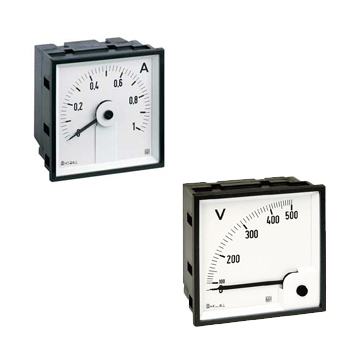
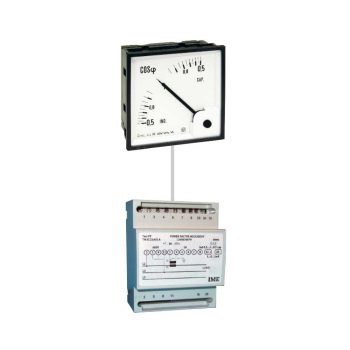
Analog power factor panel meters display the power factor (cos φ or PF) of an electrical system using a pointer and scale. Installed in control cabinets, distribution panels or operator consoles, they provide a continuous, real-time indication of the relationship between active power and apparent power. Thanks to their mechanical design, they offer a simple, robust and instantly readable way to monitor load efficiency and overall power quality.
What does a power factor panel meter display?
A power factor meter displays the power factor (cos φ or PF) on a calibrated scale, typically ranging from –1 to +1 or 0 to 1. The value indicates how effectively electrical power is being converted into useful work compared to the total supplied apparent power.
Why is power factor important?
Power factor directly influences network efficiency, conductor loading and energy losses. A PF close to 1 indicates efficient power usage, while a low PF suggests reactive loads that increase current flow and reduce efficiency. Monitoring power factor helps detect reactive power issues and supports compensation measures.
How does an analog power factor meter work?
Analog power factor meters typically use electrodynamic or magnetic measuring mechanisms that evaluate voltage, current and their phase relationship. By determining the phase-shift angle between current and voltage, the device positions the pointer at the corresponding power factor value.
What are the advantages of analog power factor meters?
They provide an immediate and easy-to-read visual indication of power factor, are mechanically robust, low-maintenance and do not require digital electronics. Their direct display supports quick assessment of system efficiency and reactive power behavior, which is especially useful in industrial and distribution environments.
Where are analog power factor meters used?
They are used in switchgear cabinets, industrial distribution systems, machine control centers, power distribution panels and monitoring consoles — wherever reactive power must be monitored, compensated or evaluated to maintain system efficiency and reliability.
Which mounting sizes and formats are available?
Common front-panel sizes include 48×48 mm, 72×72 mm, 96×96 mm and larger variants. Depending on the application, they can be mounted on front plates, DIN rails or within enclosures. Size selection depends on available space and wiring layout.
What are the limitations of analog power factor meters?
They generally offer lower accuracy than digital PF meters, provide no data logging or communication, and can be subject to pointer fluctuations under unstable load conditions. Incorrect wiring or overload may damage the internal movement. They are not suitable for precise or long-term PF data acquisition.
For which applications are they especially suitable?
They are ideal for straightforward, continuous power factor monitoring in industrial systems, distribution panels and control cabinets — particularly when fast visual assessment and mechanical robustness are prioritized over advanced measurement features.
How do analog PF meters respond to load or network changes?
The pointer reacts immediately to changes in voltage, current or phase angle. This makes shifts in active/reactive power ratio instantly visible — allowing quick detection of reactive power peaks, poor load conditions or network imbalances.
What should be considered when selecting and installing them?
Choose the correct measurement range and wiring scheme (single-phase or three-phase). Ensure correct polarity and proper wiring. Mounting dimensions, enclosure protection, and environmental factors such as temperature, humidity and vibration must be considered to guarantee accurate and long-lasting operation.

































Datasheet