


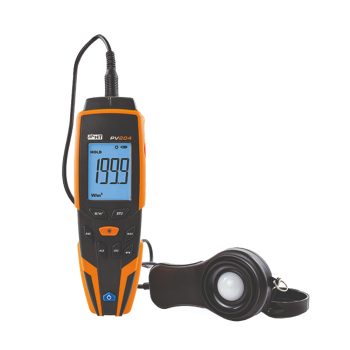
Mobile digital solar meter. PV204 is a digital solar meter for measurements of solar irradiation up to 2000W/m2, which can be used as an inspection device, typically in photovoltaic installations.
 Datasheet Datasheet |
| User Manual |
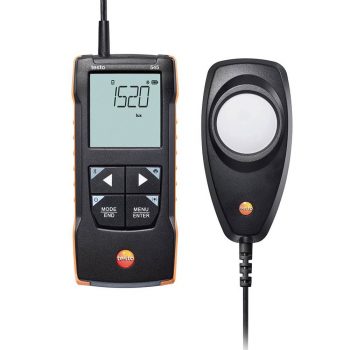
- Simple, fast and precise measurement of illuminance (Lux) according to the V-lambda curve for all common light sources
- Wide range of applications due to LED compatibility (except single-colour blue LED)
- Fast in-app configuration, graph history, second screen and measurement data memory in the testo Smart App
- Audible alarm sounds if a limit value is exceeded
| Datasheet |
| User Manual |
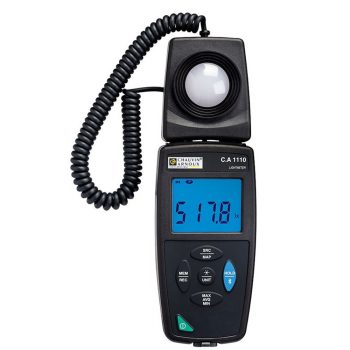
- Measurement range: 0.1 lx to 200,000 lx (lux)
- Intrinsic uncertainty (without compensation): ± 3% of the reading for incandescent sources (default) ± 6% of the reading for LEDs (3,000 K to 6,000 K) ± 9% of the reading for fluorescent sources
- Functions: Min, Max, Average, MAP and Hold; lx or fc / Backlighting
- Recording capacity: up to 1 million measurement points
- Interfaces: USB or Bluetooth
- Protection rating: IP50
- Dimensions: Casing: 150 × 72 × 32 mm Sensor: 67 × 64 × 35 mm
- Weight: 345 g (including batteries)
- Compatible with Multifix accessory
- Shockproof protective sheath available as an accessory
| Datasheet |
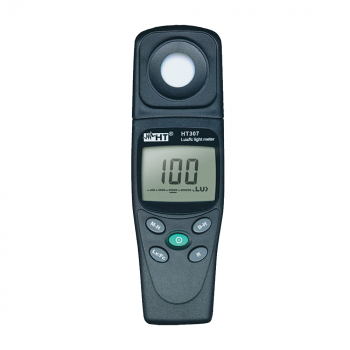
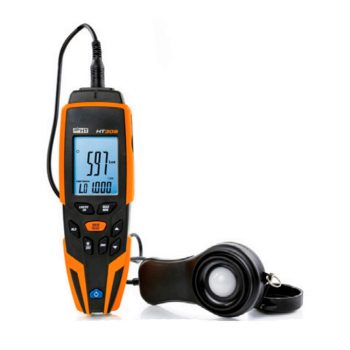
- Illumination measurement up to 200 klux (20 kfc)
- Manual zeroing with trimmer
- Correction of spectral response
- Manual range of measurement
- MAX/MIN function
- Data Hold function
- DC analogue output (mV)
- Selection between lux or ft measurement mode
- Low battery indication
|
Datasheet
|
|
Datasheet
|
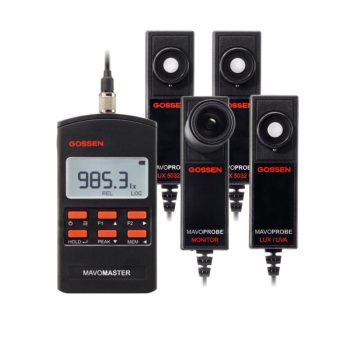
Each MAVOPROBE is balanced prior to shipment and can be connected immediately to any MAVOMASTER.
|
Datasheet
|
|
User Manual
|
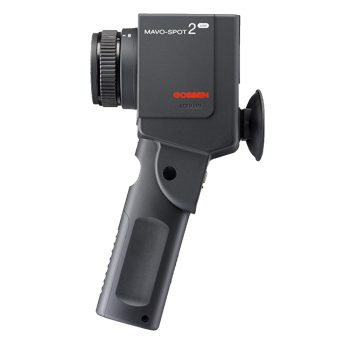
- Measuring angle : 1°
- Accuracy:
- Class B according to DIN 5032-7 in all chapters and DIN EN 13032-1, Appendix B
- Optical system : Stray light error ambient light (fs (u) < 2%)
- Field of view : 15° diagonal
- Focusing distance : 1 m to infinity - focusing with external ring at the lens
- Light sensor : Silicon photo diode with V() filter (f1 < 3%)
- Luminance measuring unit : cd/m² or fL (selectable with DIP switches)
- Measuring ranges :
- Automatic measuring range selection 0.01 cd/m² to 99 990 cd/m² in four ranges or 0,003 fL to 29 187 fL in four ranges
- Measuring functions
- Luminance in cd/m² or fL (selectable)
- Luminance percentage
- Memory MEM
- Correction Factor CORR
- Measuring the illuminance (Lux) with GOSSEN Reflexion
- Standard ( optional accessory)
|
Datasheet
|
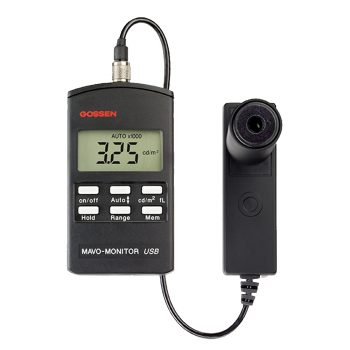
- Measuring Ranges: 0,01 cd/m² to 19 990 cd/m² subdivided in 4 measuring ranges
- Resolution :
- MR I 0.01 cd/m²
- MR II 0.1 cd/m²
- MR III 1 cd/m²
- MR IV 10 cd/m²
- Measuring Rate: 2 measurements/sec.
- Display: Digital, 3 ½ digits LCD
- Accuracy: Classified according DIN 5032-7, Class B
- Standard supply: Luminance meter in transport case, Adapter disk, gLux Software incl. meter driver, USB cable, battery and instruction manual
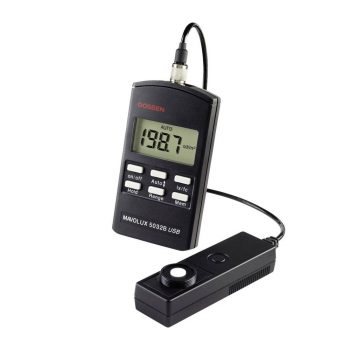
- Accuracy class per DIN 5032-7
- Mavolux 5032 C USB : Class C
- Mavolux 5032 B USB : Class B
- Light sensor : Silicon fotodiode with V(λ)-filter
- Functions :
- Luminous intensity 10 to 190 000 lx , Autorange, Range Hold, Manual Range, displays Lux (lx)/ Footcandle (fc), Hold function and Max function for display.
- Measuring range Mavolux 5032 C USB
- 0.1 lx to 199 900 lx and 1 cd/m² to 1 999 000 cd/m² in 4 ranges (with Luminance Attachment)
- Measuring range Mavolux 5032 B USB
- 0.01 lx to 199 900 lx and 0.1 cd/m² to 1 999 000 cd/m² in 5 ranges (with Luminance Attachment)
- Measurement rate : 2 measurements per second
|
Datasheet
|
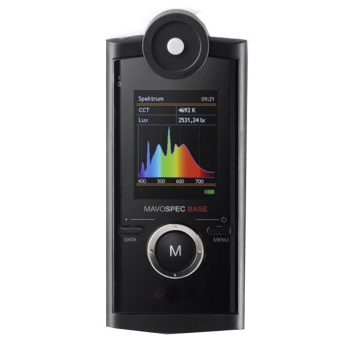
- Measuring functions Illuminance 10 lx to 100 000 lx
- Measuring ranges Color rendering index Ra, R1 - R15
- Correlated color temperature per CIE 13.3
- Duv
- Peak wavelength
- Dominant wavelength
- Purity per CIE 15
- Chromaticity coordinates [x,y] per CIE 1931
- Chromaticity coordinates [u',v'] per CIE 1976
- Chromaticity coordinates [u, v] per CIE 1960
- Flicker index, %, frequency
- Spectral range 380 - 780 nm (VIS)
- Physical resolution ~ 1.8 nm
- Reproducibility 0.5 nm
- Integration time 10 ms – 3000 ms
- Functions Flicker compensation, temperature sensor and automatic zero-point correction
- Interface USB 2.0
- Interface protocol Disclosed Memory 4 GB Micro SD in battery compartment
- Memory mode Manual, auto
- Data format CSV
- Mains power pack 100…240 V (50/60 Hz) 0.15A
- Ausgang USB Buchse 5 V, 1 A
- Rechargeable battery Li-Ion 3.7 V - 890 mAh, replaceable
- Rechargeable battery life > 8 hours continuous operation
- Charging time approx.. 1.5 hours
- Dimensions 139 x 60 x 30 mm
- Weight approx. 200 g
- Scope of delivery Aluminium case, wallet, rechargeable battery, USB cable, power pack, carrying strap, 4 GB micro SD card, instructions
|
Datasheet
|
|
User Manual
|

- For quick ‘n easy measurements in the workplace
- Sensor is modelled on the spectral sensitivity of the human eye
- Hold function, min/max values
- Protective cap for safe storage
The testo 540 light meteris a quick and easy-to-use entry level model designed for measuring lighting conditions in the workplace.
|
Datasheet
|
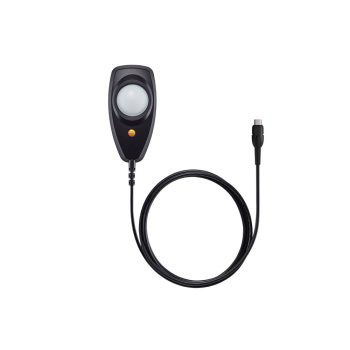
- Intuitive: clearly structured measurement menu for long-term measurement and determination of illuminance according to the V-lambda curve (suitable for all common light sources)
- Precise: standard-compliant accuracy according to DIN EN 13032-1 and class C according to DIN 5032-7
- Convenient: non-slip probe contact surface for convenient positioning at the measuring location
- Intelligent calibration concept
| Datasheet |
| Datasheet |
| User Manual |

Illuminance Meters / Light Measurement Instruments
Illuminance meters (lux meters) measure the amount of light incident on a surface in lux (lx) and are used for standardized evaluation of lighting installations in industry, offices, laboratories and building services. High-quality instruments provide V(λ)-matched spectral sensitivity, cosine correction for oblique incidence, wide measurement ranges from a few lux up to the kilolux range, as well as functions such as data logging, MIN/MAX and hold. Depending on the design, compact handheld units are available with integrated or remote sensors, sometimes featuring analog or digital outputs for connection to multimeters, data loggers or automation systems.
What is the difference between illuminance and luminous flux?
Illuminance describes the light incident on a surface in lux (lm/m²), whereas luminous flux is the total light output of a source in lumen (lm). Illuminance meters therefore measure the actual light level at the measuring point, not the overall output of the luminaire.
Why is illuminance measured in lux?
Lux is the SI unit of illuminance and defines lumen per square meter. It is based on the physiological sensitivity of the human eye and allows an objective assessment of brightness at workplaces, escape routes or public areas according to applicable standards.
What is the role of V(λ) matching in lux meters?
V(λ) matching describes the spectral sensitivity of the sensor relative to the standard photopic response of the human eye. A lux meter with good V(λ) conformity represents the perceived brightness of different light sources reliably and minimizes spectral measurement errors, especially for LED and fluorescent lighting.
What does cosine correction mean for illuminance meters?
Cosine correction ensures that the sensor correctly accounts for the angle of incidence of the light. Light hitting the sensor at oblique angles is physically less effective. A cosine-corrected input captures this effect and prevents measurement errors with diffuse or lateral illumination.
Which measurement ranges are typical for lux meters?
Typical ranges extend from 0.1 lx or less for very low illuminance up to 200,000 lx (200 kLux) for direct sunlight or very bright lighting systems. Modern instruments operate with manual or automatic range selection to accurately capture both low and very high light levels.
Where are illuminance meters used in practice?
Applications include testing of workplace lighting, safety and emergency lighting, quality control of lighting systems, energy optimization of lighting, validation in cleanrooms and laboratories, photographic measurements as well as environmental and daylight measurements indoors and outdoors.
How does a handheld lux meter differ from laboratory or system solutions?
Handheld lux meters are compact and mobile for on-site measurements with straightforward operation and direct display. Laboratory or system solutions often feature remote sensors, interfaces such as analog outputs or digital bus systems, higher accuracy and extensive configuration options, and are intended for continuous monitoring or automated test stands.
Why is regular calibration of illuminance meters important?
The spectral response and electronics of a lux meter may change slightly over time. Regular calibration against a traceable standard light source verifies and documents the measurement accuracy. This is particularly important in quality-critical environments and for audits.
Can lux meters reliably measure LED lighting?
Yes, modern lux meters are designed to measure a wide range of light sources including LEDs. The key factors are suitable spectral matching and a measurement range appropriate to the typical illuminance levels of the LED application. For strongly deviating spectra, the device specification may include additional correction data.
Which additional functions are useful for illuminance meters?
Useful functions include MIN/MAX capture, data hold, averaging, programmable measurement intervals, integrated data memory, USB or RS interfaces and analog outputs. These features support trend analysis, long-term recording and integration into existing measurement or control systems.
What is the difference between a lux meter and a luminance meter?
A lux meter measures illuminance on a defined surface, while a luminance meter measures luminance (cd/m²), i.e. the brightness of a luminous or reflecting area in a specific direction. Both quantities complement each other but answer different lighting-technical questions.
How does ambient temperature influence measurement accuracy?
Electronic components and sensors exhibit temperature-dependent behavior. High-quality lux meters feature temperature compensation and specified operating temperature ranges. Outside these limits, measurement deviations may occur, so ambient conditions should be taken into account when interpreting results.
What should be considered when positioning the sensor?
The sensor should be placed at the relevant measuring point, typically at eye or working-plane height, oriented horizontally and without shading. Reflections from bright surfaces, shadows from objects and direct glare must be consciously included or excluded depending on the measurement task.
Can a lux meter be used for continuous monitoring tasks?
Many devices with analog outputs or digital interfaces are suitable for continuous monitoring, for example for daylight-dependent lighting control, documentation of long-term exposure or compliance with normative limit values. This requires suitable sensor mounting and stable power supply.
Which accuracy classes are available for illuminance meters?
Accuracy is typically specified as a percentage of reading or full scale, supplemented by information on spectral mismatch and cosine error. For demanding measurements in standardized environments, instruments with low measurement uncertainty and documented calibration are preferred, while standard devices are sufficient for basic inspection tasks.