


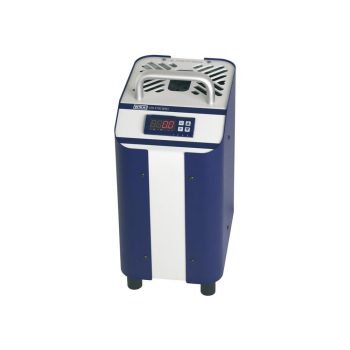
- Simple calibration of thermometers at 0 °C [32 °F]
- Tempering of thermocouple cold junctions
- Test benches and calibration laboratories
 Datasheet Datasheet |
| User Manual |

- Various temperature ranges
- Measurement uncertainties from 0.15 ... 0.8 K
- Compact design
- Simple operation
| Datasheet |
| User Manual |
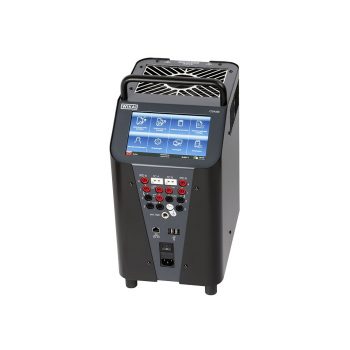
- Easy operation via intuitive, user-friendly menus
- Large, easy-to-read touchscreen
- Short response times due to optimised control
- Improved accuracy due to homogeneous dry-well temperature
- Creation of calibration tasks incl. preparation of a certificate
| Datasheet |
| User Manual |
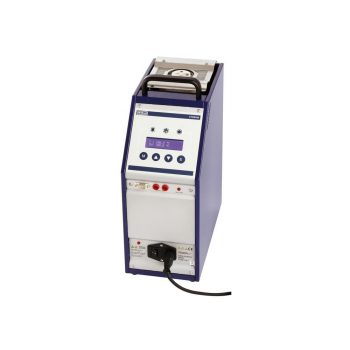
- High accuracy and stability at high temperatures
- Temperature range 200 ... 1,100 °C [392 ... 2,012 °F]
- Possibility to check temperature switches
- Low weight and compact design
- Simple operation
| Datasheet |
| User Manual |
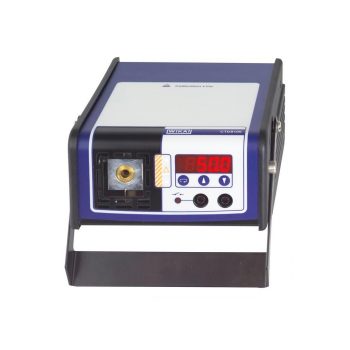
- High accuracy and stability
- Possibility for testing temperature switches
- Low weight and compact design
- Simple operation
| Datasheet |
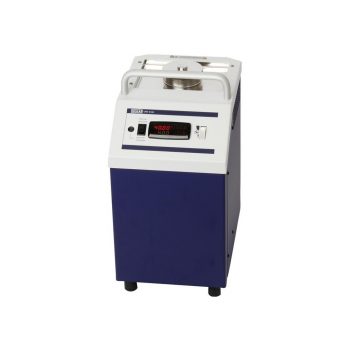
- Multifunctional device with four controller parameters
- Calibration with an external reference
- Low weight and compact design
- Simple operation
| Datasheet |
| User Manual |
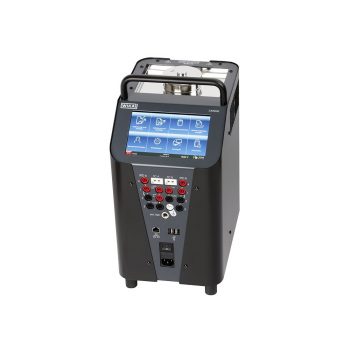
- Easy operation via intuitive, user-friendly menus
- Large, easy-to-read touchscreen
- Short response times due to optimised control
- Multi-function instrument with four controller parameter sets
- Creation of calibration tasks incl. preparation of a certificate
| Datasheet |
| User Manual |
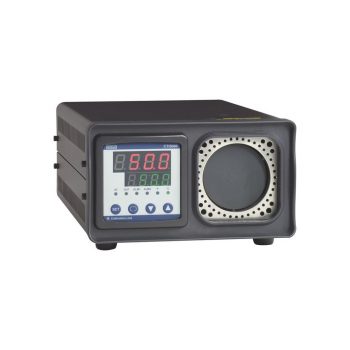
- Testing of infrared thermometers across a wide temperature range; 50 ... 500 °C [122 ... 932 °F]
- Large surface area of the black body (∅ 57 mm [2.24 in]) for all types of pyrometers
- Bore to accept a reference sensor
- Low weight and compact design
- Simple operation
| Datasheet |
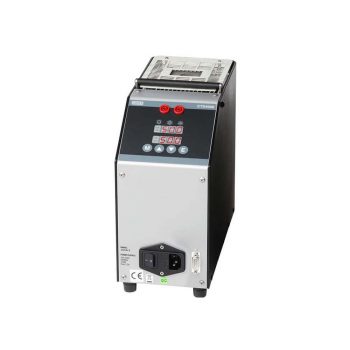
- High stability
- Possibility to check temperature switches
- Low weight and compact design
- Simple operation
| Datasheet |
| User Manual |

WIKA Temperature Calibrators – precise references for field, production & labs
WIKA temperature calibrators enable traceable testing, adjustment and documentation of RTD/thermocouple sensors, measurement loops and indicators. Depending on your task, choose from dry-well calibrators, liquid/micro baths, surface calibrators, blackbodies (IR) and high-temperature furnaces.
Key features (model-dependent): fast ramps, excellent stability/homogeneity, interchangeable block inserts, external reference input, automated sequences and interfaces (USB/RS-485/Modbus/Ethernet) for QA/IIoT integration.
ICS Schneider Messtechnik supports instrument selection, uncertainty budgeting, ISO/DAkkS calibrations, report workflows and integration with PLC/SCADA/cloud.
FAQ on WIKA Temperature Calibrators
Answers on device types, stability/homogeneity, references, inserts, sequences, IR/surface, uncertainty, documentation and safety.
1) Which device types does WIKA offer?
| Type | Typical range | Strengths | Use |
|---|---|---|---|
| Dry-well calibrator | ~ −35…+650 °C | mobile, clean, fast | service/production |
| Liquid/micro bath | ~ −80…+300 °C | best homogeneity | lab/QA |
| Surface calibrator | ~ 0…+450 °C | flat contact | surface probes |
| Blackbody (IR) | ~ −20…+1 000 °C | IR reference | IR thermometers |
| High-temperature furnace | to > +1 200 °C | very high T | TC/process |
2) What’s the difference between stability, homogeneity and accuracy?
- Stability: temporal fluctuation at the setpoint (e.g., ±0.02 K).
- Homogeneity/gradient: spatial differences within block/medium (axial/radial).
- Accuracy: deviation vs. true value incl. reference & calibrator indication.
3) Why use an external reference probe?
It measures right at the DUT and minimizes the impact of load, coupling and gradients—essential for low uncertainty and audit readiness.
4) Which block inserts/bores should I choose?
Single- and multi-bore inserts are available. Select bore diameter 0.2–0.5 mm larger than probe OD; include a reference channel for a repeatable reference position.
5) How deep should I immerse?
Rule of thumb: 15–20× probe diameter or until the sensing point is fully in the homogeneous zone; keep distance from bore bottom/bath basket.
6) How does “load” (number/size of probes) affect results?
More/larger probes increase gradients and stabilization time. Reduce count, optimize bore distribution, or use a bath for demanding cases.
7) Do WIKA units support automated sequences?
Yes—model-dependent sequences with ramps, dwell times and stability criteria for reproducible, time-saving workflows.
8) Which interfaces/protocols are available?
USB, RS-485/Modbus, and in some models Ethernet—for remote control, data capture and IIoT via gateways (e.g., MQTT/HTTPS).
9) How do I select calibration points?
Process-oriented: low/mid/high of the working range; consider 0 °C (ice point) and one point near the upper limit. For indicators, spread points across the scale.
10) What should I consider with thermocouples?
Set cold junction compensation correctly, keep junctions at uniform temperature, and run TC wires to the instrument (avoid dissimilar metals).
11) Tips for surface calibrations
Ensure flatness, defined contact force, a touch of thermal paste if needed, and shield from convection; the probe tip must fully contact the plate.
12) IR calibration with a blackbody—what matters?
Set emissivity (ε), observe D:S and focus, shield reflections; verify with a reference RTD when possible.
13) How do I build an uncertainty budget?
- Reference sensor (certificate/drift)
- Calibrator (stability/gradient/display)
- DUT (repeatability/hysteresis)
- Resolution/statistics
- Coupling/immersion/ambient effects
14) How do I document in an audit-ready way?
Log series with timestamp, set/actual, reference, load, operator and ambient; export CSV/PDF and store in a revision-safe system.
15) What software options exist?
PC software for remote operation, sequences, stability checks, pass/fail and report creation; interface cables/adapters available.
16) What safety rules apply in operation?
Mark hot surfaces, wear heat-protection gloves, ensure stable/ventilated setup, and never leave units unattended at high temperatures.
17) Maintenance & care of inserts/baths?
Keep bores clean, never use hard tools; change/cover bath fluids per manufacturer; swap inserts without stress to avoid distortion.
18) Calibration intervals for references?
Rule of thumb annually; for critical processes every 6 months or after events (drop/overheat). Track drift in the historian.
19) Which accessories are useful?
Block inserts (single/multi-bore), reference probes (Pt100/SPRT), surface plates, blackbody attachments, transport cases, holders/clamps, interface cables.
20) Do you provide selection, certificates & integration support?
Yes. We supply instruments preconfigured with factory or DAkkS calibration, prepare uncertainty budgets, define sequences and integrate with QA/IIoT.