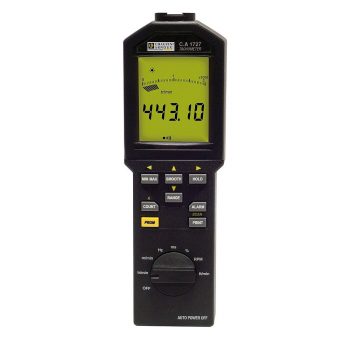
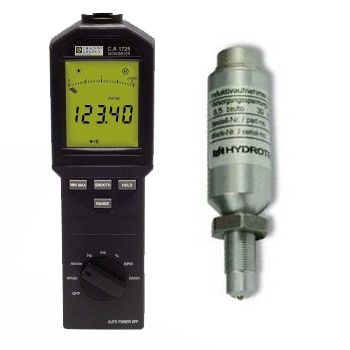
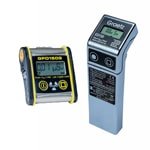
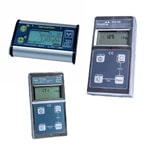
























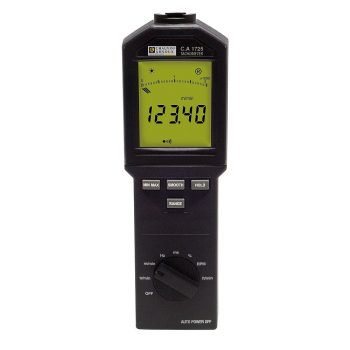
• Drehzahlmessung rotierender mechanischer Teile in Umdrehungen/ Minute (RPM) ohne Berührung
  • Drehzahlmessung rotierender mechanischer Teile in Umdrehungen/ Minute (rPm) mit Berührung
  • Drehzahlmessung (Umdrehungen/Sekunde) (HZ) mit Berührung und ohne Berührung
  • Geschwindigkeitsmessung auf Oberflächen in M/Min, Inch/Min, Ft/Min und Yd/Min.
  • Messung der Länge von beweglichen Teilen in M, Inch, Ft und Yd
  • Funktion Drehzahlzähler (REV)
  • MAX/MIN/AVG Funktionen
  • Laserpointer für Messungen ohne Berührung
  • Datenspeicherung und Displayaufruf
  • Hintergrundbeleuchtung des Displays

Specially designed for industrial applications, the CA 25 tachometer measures, at a distance or by contact, any rotation speed from 60 to 100 000 tr/min.

Datasheet

Specially designed for industrial applications, the CA 27 tachometer measures, at a distance or by contact, any rotation speed from 60 to 100 000 tr/min.

Datasheet

    • Extremely easy one-handed operation
    • Saves mean/max./min. values, as well as the last measuring value
    • Robust tachometer – thanks in particular to the protective case (SoftCase) supplied
    • Includes reflective markers

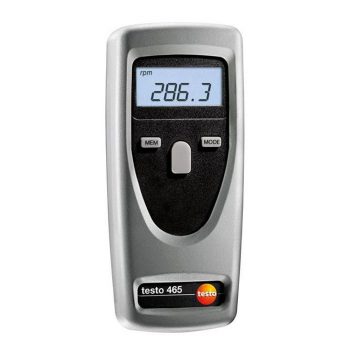
    You can use the testo 465 tachometer for quick and easy rpm measurement on rotating parts such as fans and shafts.

    Datasheet

      • Simple one-hand operation
      • Measurement of rpm, speeds and lengths
      • Storage of mean, max. and min. values as well as the last reading
      • Includes accessories such as reflective markers, protective case and transport case

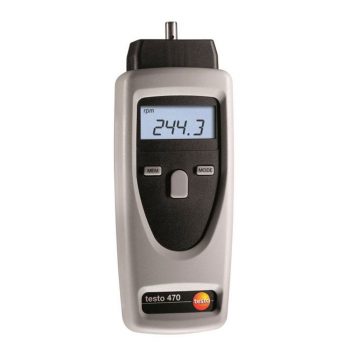
      One tachometer, multiple measurements: The testo 470 tachometer carries out rpm measurements on motors, shafts, fans, etc., but that’s not all. With this handy instrument, you can also determine speeds and lengths (e.g. of conveyor belts and rotors).

      Datasheet

        • High adjustment accuracy and stability thanks to dynamic setting dial
        • High light intensity thanks to high-performance xenon flashlamp
        • Powerful Li-Ion rechargeable battery pack for at least 2 hours of continuous operation
        • Extremely short flash duration (< 9 µs)

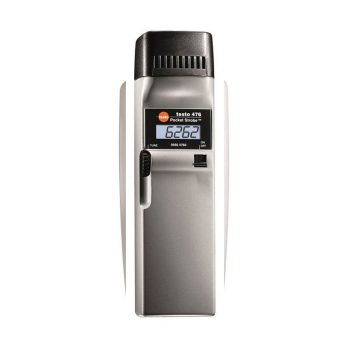
        Ideal for rpm measurement and for the inspection of parts moving at high frequencies: the testo 476 hand-held stroboscope with high-intensity light.

        Datasheet

          • Extremely high measurement range: up to 300 000 flashes per minute (fpm)
          • Very high illumination: up to 4800 Lux
          • Long operating times: battery power for up to 5 h
          • Trigger input and output for connectivity to external systems and control via external sensor

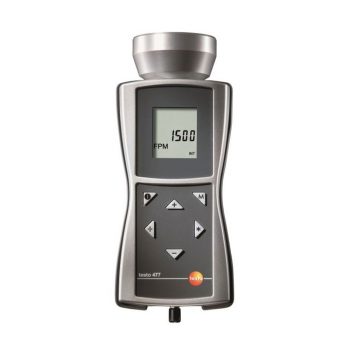
          Inspections and quality control of machines and systems, rotational speed measurements of hard-to-reach, small and fast-moving objects. And all while the machines are still running. No problem. No problem at all. With the testo 477 LED stroboscope.

          Datasheet

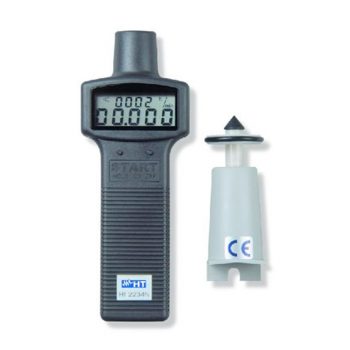
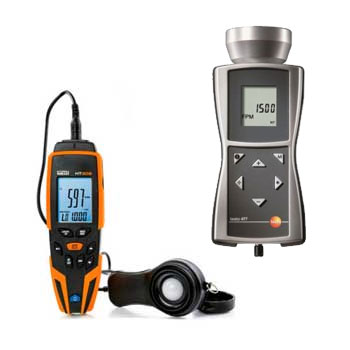
          Optical and contact portable digital revolution counter HT2234N is a digital revolution counter for measuring the speed of rotating mechanical parts (discs, drive shafts, etc…) both with and without contact, making use of a light beam transmitted and reflected by the target.   Not available anymore!  Successor model: HT2236

          Datasheet
          User Manual


          Tachometers / Rotational Speed Measuring Instruments

          Tachometers measure the rotational speed of machines and shafts in revolutions per minute (rpm) or in hertz (Hz). Depending on the measuring principle, contact and non-contact instruments are available, such as optical or laser tachometers using reflective targets, inductive sensors or mechanical contact types with tips and measuring wheels. Modern devices provide wide measuring ranges, high resolution, MIN/MAX and averaging functions as well as data storage and interface options for analysis and documentation of drives, fans, pumps and production machinery.

          What is a tachometer and which quantities are measured?

          A tachometer is an instrument used to measure the rotational speed of rotating parts. Typical quantities are revolutions per minute (rpm), revolutions per second (rps) or frequency in hertz (Hz). Many instruments can additionally calculate surface or linear speed when the diameter or travel distance is known.

          What is the difference between contact and non-contact tachometers?

          Contact tachometers transfer the motion from the shaft to the instrument via a measuring tip or wheel in direct mechanical contact. Non-contact tachometers operate, for example, optically with reflective targets, by laser, inductively or magnetically and detect speed without physical contact. Non-contact methods are wear-free and particularly suitable for hard-to-reach or high-speed rotating parts.

          How does an optical or laser tachometer work?

          Optical and laser tachometers emit light pulses onto a reflective mark on the rotating part and count the reflected pulses per unit of time. The device calculates the rotational speed from the pulse frequency. Proper reflective marking with sufficient contrast and a measuring distance within the specified range are essential for reliable operation.

          Which typical measuring ranges do tachometers cover?

          Depending on the design, measuring ranges extend from a few rpm for slowly rotating shafts to more than 100,000 rpm for high-speed spindles or turbines. Handheld instruments for general use typically cover ranges from about 5 to 100,000 rpm with manual or automatic range selection.

          What level of accuracy is common for rotational speed measurements?

          Accuracy is usually specified as a percentage of reading plus a certain number of digits. High-quality tachometers achieve typical accuracies in the range of ±0.02 % to ±0.05 % of reading plus 1–2 digits. The actual measurement uncertainty is also influenced by signal quality, target marking, misalignment and environmental conditions.

          Can tachometers also indicate surface speed or linear speed?

          Many tachometers can calculate linear speed from rotational speed and the entered diameter or circumference. The result is displayed, for example, in m/min, m/s or ft/min. Contact instruments use measuring wheels with defined circumference, while non-contact instruments calculate linear speed mathematically from rpm and diameter.

          Where are tachometers used in practice?

          Typical applications include testing of electric motors, combustion engines, fans, blowers, pumps, spindles, conveyors and drive trains. Tachometers are used for commissioning, maintenance, fault diagnosis, speed matching, process optimization and verification of speed control systems.

          What are the advantages of non-contact speed measurement?

          Non-contact measurements are wear-free, do not mechanically load the system and allow measurements from a safe distance. They are suitable for high rotational speeds, delicate shafts, small shaft ends and for difficult-to-access or enclosed drives where direct contact is not possible or not desired.

          Why is the number of pulses per revolution important?

          For sensor setups that generate several pulses per revolution (for example gear wheels or encoder discs), the number of pulses per revolution must be taken into account by the device. The tachometer calculates the correct speed from frequency and pulse count. An incorrect pulse-per-revolution setting directly results in a proportional measurement error.

          What must be considered when applying reflective tape for optical tachometers?

          The reflective mark should be sufficiently large, have high contrast and be securely attached to the rotating part. Shiny or very dark surfaces can impair the signal. For stable measurements, a clean, flat surface with firmly adhering reflective tape and a defined measuring angle is important.

          How do vibration and shaft runout influence speed measurement?

          Strong vibration, runout or wobble can cause unstable signals and fluctuating readings. Modern tachometers can compensate to some extent with averaging or digital filters. However, mechanical defects should be eliminated at the machine itself instead of being compensated only by signal processing.

          Which additional functions are useful for tachometers?

          Useful functions include MIN/MAX capture, averaging, peak hold, programmable measurement time, frequency and period measurement, memory for data series and interfaces such as USB, serial interfaces or analog outputs for integration into data acquisition systems.

          How often should tachometers be calibrated?

          Calibration intervals depend on usage frequency, environmental conditions and quality requirements. Intervals of one to two years are common. Traceable calibration verifies and documents measurement accuracy, which is often required in quality-critical processes and during audits.

          Which ingress protection rating and environmental limits should be considered?

          The required protection class (for example IP54 or IP65) depends on the application site and ambient conditions such as dust, moisture or splashing water. The specified temperature and humidity ranges must be respected to avoid measurement errors or damage, especially for outdoor use or harsh industrial environments.

          Can a tachometer be integrated into control or monitoring systems?

          Tachometers with analog outputs, pulse outputs or digital interfaces can be integrated into control or monitoring systems. They provide the speed signal for control loops, limit monitoring or synchronized acquisition together with other process variables.

          Which safety aspects must be considered when measuring rotational speed?

          When working near rotating parts, loose clothing, jewelry and long hair must be secured to prevent entanglement. Non-contact methods permit larger safety distances. In addition, protective guards, emergency stop devices and local safety regulations must be observed.

          Diese Website benutzt Cookies. Wenn du die Website weiter nutzt, gehen wir von deinem Einverständnis aus.