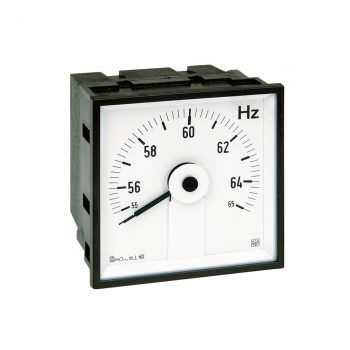
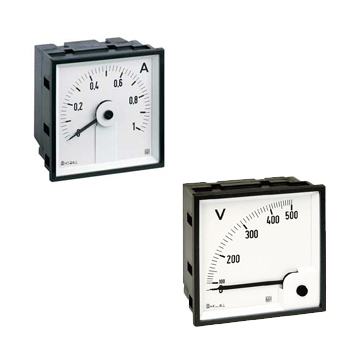
























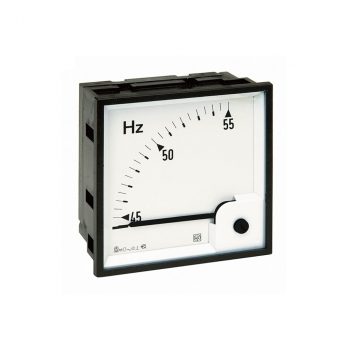
| FORMAT | 72x72 mm |
|---|---|
| VOLTAGE | 400…415 V |
| TYPE | Frequency meter |
| SCALE | 55…65 Hz |
| OPTIONS | protection IP54 (including tropicalization treatment) |
Datasheet |
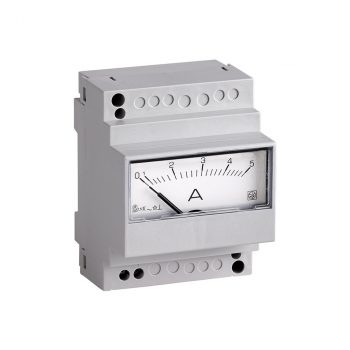
| FORMAT | 48x48 mm |
|---|---|
| VOLTAGE | 110…115 V |
| TYPE | Frequency meter |
| SCALE | 45…55 Hz |
| OPTIONS | protection IP54 (including tropicalization treatment) |
Datasheet |
Analog Frequency Panel Meters / Analog Einbaumessgeräte – Frequency
Analog frequency panel meters are devices for fixed installation in switchgear cabinets, distribution boards or control panels that display the frequency of an AC supply directly via a pointer and dial. They show the current network frequency (in Hertz, Hz) in real time — typically for 50 Hz or 60 Hz systems — and provide a simple, continuously readable indication without digital electronics or complex measurement networks. :contentReference[oaicite:9]{index=9}
What is an analog frequency meter?
An analog frequency meter is a built-in instrument that displays the frequency of an AC voltage using a mechanical pointer on a calibrated dial. It continuously indicates the number of cycles per second (Hz) of the supply voltage. :contentReference[oaicite:10]{index=10}
How does the measurement mechanism work?
Common principles include moving-iron or coil-based mechanisms, or vibrating-reed/resonance designs: two coils or a tuned mechanical system respond to the AC signal, and the resulting magnetic or mechanical interaction causes the pointer to deflect proportionally to the frequency. Some designs use orthogonal coils with reactance difference to derive phase-sensitive torque, which changes with frequency. :contentReference[oaicite:11]{index=11}
Which frequency range is typical?
Analog frequency panel meters are usually built for standard network frequencies — e.g., 45 – 65 Hz (50/60 Hz systems) — to monitor supply frequency and detect deviations from nominal values. :contentReference[oaicite:12]{index=12}
What are the advantages of analog frequency meters?
They offer immediate visual indication of the supply frequency, require no auxiliary power, and are robust against interference and waveform distortion. Their mechanical construction ensures reliability and low maintenance, making them well-suited for industrial switchgear, control cabinets and long-term monitoring. :contentReference[oaicite:13]{index=13}
Where are they typically used?
Applications include distribution panels, switchgear, energy and control cabinets, motor control centers and any installations where continuous frequency monitoring is required to ensure correct operation of AC equipment and network stability. :contentReference[oaicite:14]{index=14}
What are the limitations of analog frequency meters?
They provide limited accuracy and resolution, do not support data logging or remote communication, and are generally restricted to low-frequency applications (e.g., mains frequency). Rapid frequency fluctuations or high-frequency signals are not suitable for reliable analog indication. :contentReference[oaicite:15]{index=15}
How do analog frequency meters handle nonsinusoidal or distorted waveforms?
Because many analog designs rely on effect-based measurement (e.g., moving-iron or magnetic resonance), they are often tolerant to waveform distortion and harmonics — the meter responds to the fundamental frequency component, making them adequate even if the waveform deviates from an ideal sine wave. :contentReference[oaicite:16]{index=16}
Are analog frequency meters suitable for industrial use?
Yes — they are particularly useful in industrial and power distribution contexts for simple, robust and continuous monitoring of supply frequency. Their mechanical simplicity, immunity to many disturbances and ease of installation make them a reliable choice for frequency monitoring in switchgear, distribution cabinets or machine controls. :contentReference[oaicite:17]{index=17}


Datasheet