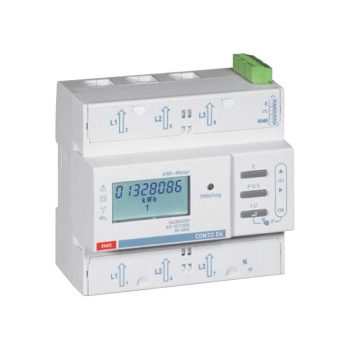
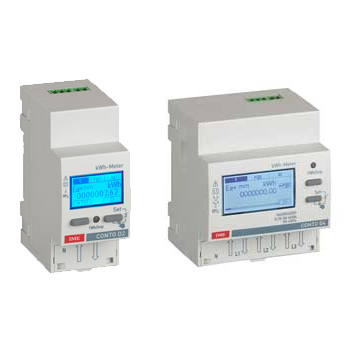
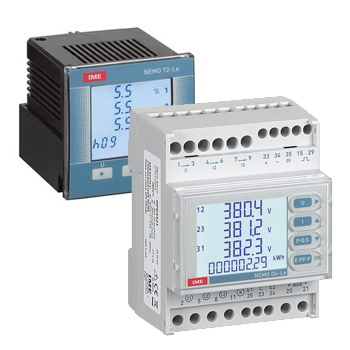
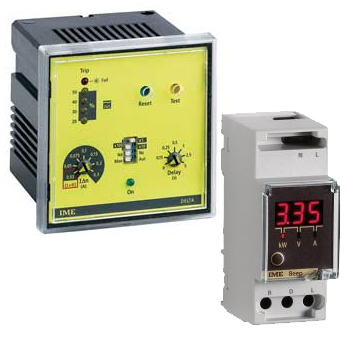
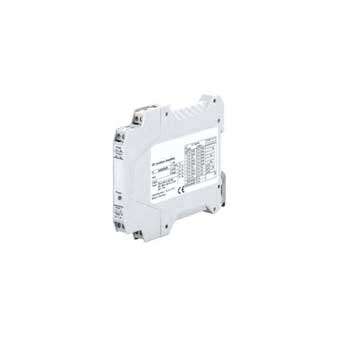
























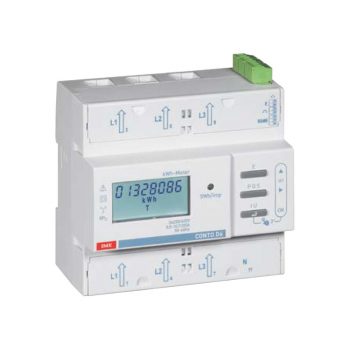
- Wirkenergie gesamt/Teilmenge oder Wirkenergie nach Tarif 1 und 2 Blindenergie gesamt/Teilmenge oder Blindenergie nach Tarif 1 und 2 Ströme
- Spannungen
- Leistungen und Leistungsbedarf
- Leistungsfaktor
- Frequenz
- Betriebsstundenzähler (Zählstart 0,4%...50% der Nennleistung)
Datenblatt
|
- Total active and reactive energy (positive)
- Partial active and reactive energy (resettable)
- Instantaneous current, voltage and frequency
- Active and reactive power (three-phase and single phase)
- Power Factor
- Run hour meter (count start 0,4...50% rated power)
Datasheet |
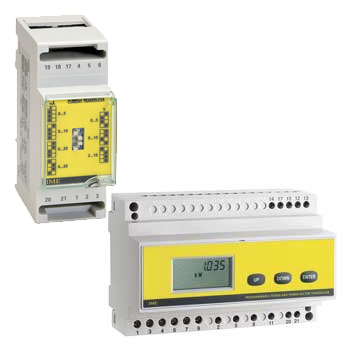
DIN-Rail Energy Meters (6-Module Version)
A 6-module DIN-rail energy meter is a comprehensive power meter that occupies six standard module widths on a DIN rail. It measures energy and a wide range of electrical and network parameters, and offers ample space for large displays, extensive electronics, robust terminals, and additional functions — ideal for complex measurement, monitoring or energy-management tasks. Such meters are particularly suited for multi-phase systems, high-current loads or installations requiring detailed power, quality and energy data plus communication capabilities.
Questions & Answers on 6-Module DIN-Rail Energy Meters
What does “6-module” refer to?
It indicates that the meter uses six adjacent module slots on the DIN rail — providing generous internal volume for enhanced measurement and interface capabilities.
What are the benefits of a 6-module meter?
Large, easy-to-read displays, extensive measurement and display options, robust wiring and connection terminals, and enhanced functionality such as data logging, network analysis and communication interfaces.
Which systems are suitable for a 6-module meter?
Single-phase and especially multi-phase AC networks — in particular setups with high currents, three-phase loads or when current/voltage transformers are used.
What electrical parameters can typically be measured and displayed?
Energy consumption or production (kWh), instantaneous and cumulative power, current, voltage, power factor, reactive/apparent power, network quality metrics, frequency and other detailed parameters depending on meter design.
How is a 6-module meter installed and wired?
It mounts on a standard 35 mm DIN rail. Connections to mains or external transformers are made via large, clearly accessible terminals — suitable for thicker cables or multi-input wiring.
Does the 6-module meter require much space in the switchgear?
Yes — the wide form factor uses six module widths. The trade-off is improved functionality, greater flexibility, and clearer wiring and layout for complex installations.
When should you choose a 6-module energy meter instead of a smaller one?
When you need advanced measurement, comprehensive analytics, network monitoring, energy management or multi-phase/high-load measurement — e.g. in industrial plants, energy control panels or detailed consumption monitoring systems.
Are there drawbacks compared to smaller meters?
Yes — larger space requirement, higher cost, and potentially over-sized for simple energy measurement tasks.
What additional capabilities do large DIN-rail meters often offer?
Wide multi-line displays, multi-parameter measurement (power, energy, current, voltage, quality), communication or pulse outputs, data logging, support for external CT/VT, and higher robustness and connection capacities.


Datenblatt