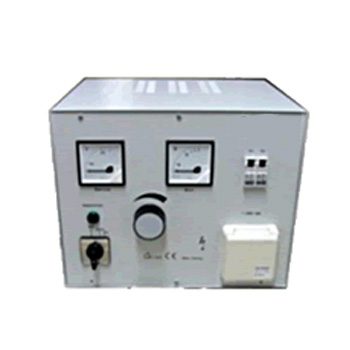
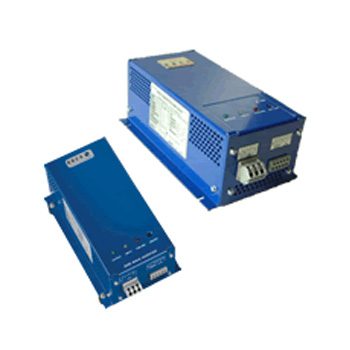
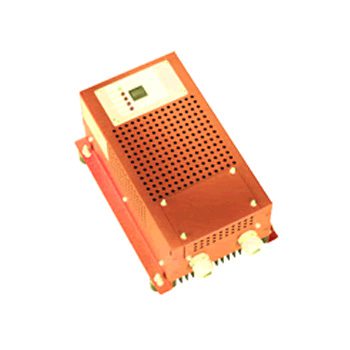
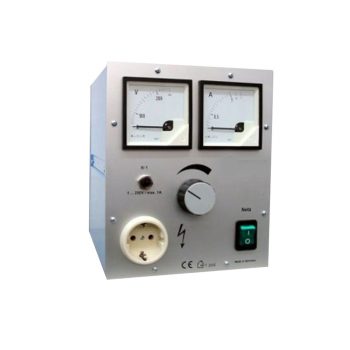
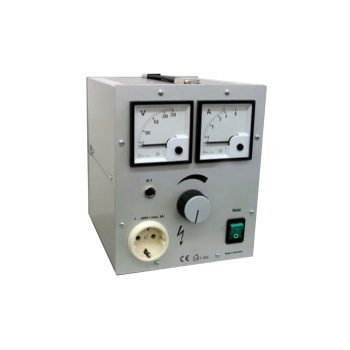
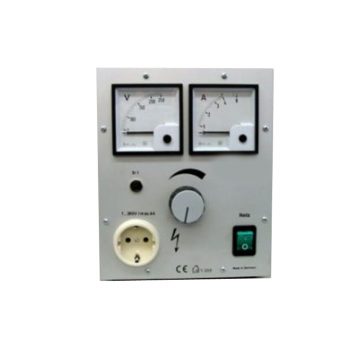
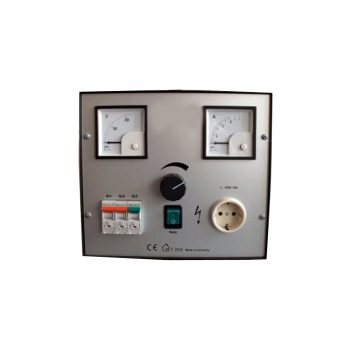
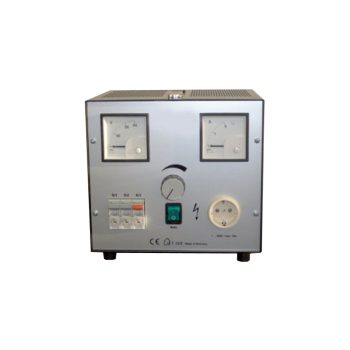
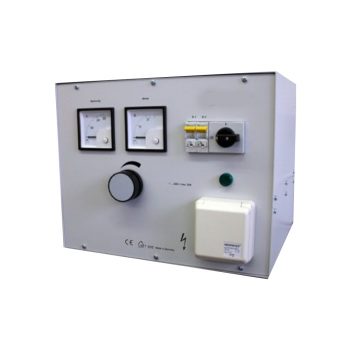
Autotransformers / Variable Autotransformer (Sparstelltransformer)

An autotransformer (often called “Sparstelltransformer” in German) uses a single winding with multiple taps to provide a variable output voltage. The output voltage can be adjusted stepwise or continuously. Unlike two-winding transformers, there is **no galvanic isolation** between primary input and output — primary and secondary are electrically connected. :contentReference[oaicite:11]{index=11}

Questions & Answers on Autotransformers

What is an autotransformer / variable autotransformer?

An autotransformer is a transformer with only one winding that has one or more taps. By selecting a tap (via a slider or switch), a variable AC output voltage is obtained. The device acts as a voltage-adjustable transformer with a compact build and comparatively low weight. :contentReference[oaicite:12]{index=12}

How does it differ from a dual-winding transformer?

In a dual-winding transformer the primary and secondary windings are separate, providing galvanic isolation between input and output. In an autotransformer both sides share the same winding, so there is a direct electrical connection. This makes autotransformers simpler and smaller but lacks isolation. :contentReference[oaicite:13]{index=13}

When is an autotransformer useful?

It is useful when a variable AC voltage is desired and galvanic isolation is not required. Typical applications are voltage adaptation for equipment, motor starting, test benches, lighting dimming, distributing equipment for different supply voltages — especially when loads are resistive, inductive or capacitive. :contentReference[oaicite:14]{index=14}

What output voltages and power levels are typical?

Depending on the design, the output can range from below mains voltage up to slightly above mains voltage. Due to the efficient use of winding, compact autotransformers can be designed for moderate power. For large voltage conversions or heavy loads the advantage diminishes. :contentReference[oaicite:15]{index=15}

How is the voltage adjustment performed?
Voltage is adjusted by changing the tap on the winding — often with a sliding brush or switch contacting different turns. This changes the number of active turns and thus the output voltage. :contentReference[oaicite:16]{index=16}

What are the advantages and drawbacks compared to dual-winding transformers?
Advantages: Reduced size and weight, lower material usage, efficient design, simple construction and easy voltage variation. :contentReference[oaicite:17]{index=17} Drawbacks: Lack of galvanic isolation means the output shares the mains potential — that can be a safety risk if the output is accessible. Therefore autotransformers are unsuitable for applications requiring isolation or protective low voltage. :contentReference[oaicite:18]{index=18}

What types of loads are suitable?

Resistive, inductive or capacitive loads — motors, heaters, lamps, test apparatus — can be powered. The output remains sinusoidal, which is beneficial compared to phase-angle regulators or thyristor dimmers that distort the waveform. :contentReference[oaicite:19]{index=19}

What safety aspects must be considered?
Because input and output share the same winding, the output is at mains potential and not isolated. Autotransformers must not be used where the user or exposed conductive parts could come into contact with the output — e.g. open lamps, welding equipment, or consumer devices with exposed metal parts. In such cases, a transformer with separated windings is required. :contentReference[oaicite:20]{index=20}

How is the output voltage affected under load?
The voltage remains sinusoidal, but due to resistive effects in the winding and contact resistances at the tap, some voltage drop under heavy load may occur. For standard industrial loads the performance is generally acceptable. :contentReference[oaicite:21]{index=21}

What are important technical parameters when selecting an autotransformer?

Key parameters are rated current or output current, power rating (VA), required input and output voltage range, contact (tap) quality and rating, winding quality, short-circuit current capacity, and mechanical stability. For inductive or fluctuating loads a safety margin should be considered.

Where should autotransformers not be used?

They should not be used when galvanic isolation is required — e.g. for protective low voltage, safety circuits, measuring systems with reference to earth or devices with earthed metal housings. Also, if sensitive electronics or high isolation are needed, a dual-winding transformer should be used instead.

Diese Website benutzt Cookies. Wenn du die Website weiter nutzt, gehen wir von deinem Einverständnis aus.