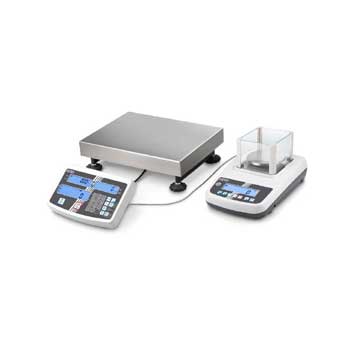
- Ideal as a salad scale, sweet scale, checkweigher, portion scale or zero-waste scale: Shopping without plastic or packaging waste in packaging-free supermarkets
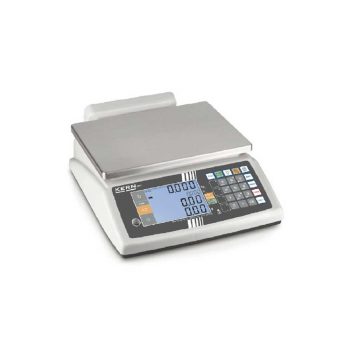
- Large LCD display with four displays for weight display (verifiable), unit price, total price and stored TARE or PRE-TARE value
- TARE value display: this shows a TARE or PRE-TARE value stored in a PLU, which enables this value to be stored in a legally binding way in accordance with the Weights and Measures Act
-
Second display on the rear of the balance
-
Column to elevate the display as standard, can be easily fitted or removed by the user . The power cable for the second display can be stored in the folding column which is hygienic and gives a tidy appearance. Height of stand approx. 395 mm
-
Thanks to easily-understandable, universal symbols e.g. for weight, piece weight, total price this balance can also be understood and operated easily all over the world
- Unit price can be switched from €/kg to €/100 g
- Auto-clear-key: Unit price entry is automatically set to zero when scale is unloaded
- Memory (PLU) for 100 article prices
- 4 direct price keys for frequently recurring article prices
- Item description can be entered, stored and shown on the display in clear text
- Headers and footers of the printout can be programmed directly on the balance
- High mobility: thanks to rechargeable battery operation (optional), compact, flat construction and low weight, it is suitable for use in several locations
- Recessed grips on the underside of the scale for easy transportation

Datasheet
|
User Manual
|
-
KERN RIB-HM: Elevated display backlit, on column, height of stand approx. 530 mm, must be ordered at purchase
-
KERN RIB-M: Second display on the rear of the balance (only with models without the elevated indicator)
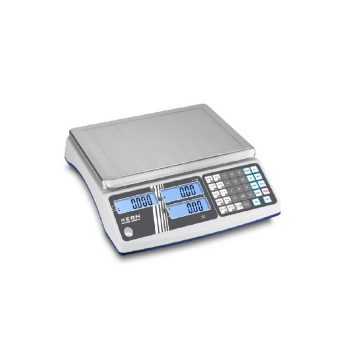
- Three displays for total weight (verifiable), unit price, total price
- 10 direct price keys for frequently recurring article prices
- Memory (PLU) for 20 article prices
- Energy management: Backlight turns off after 5 sec, can be switched off
- Soil-resistant construction with water channels at the edge of the housing and sealing rings over the upper housing inlets
- Protective working cover included with delivery
Datasheet
|
User Manual
|
- New: modern, ergonomic design and a housing which is even more compact, supporting efficient operation and saving space
-
RPB-HM: Elevated display backlit, revolving on column, height of stand approx. 480 mm, must be ordered at purchase
-
Second display on the rear of the balance , standard (only with models without the elevated indicator)
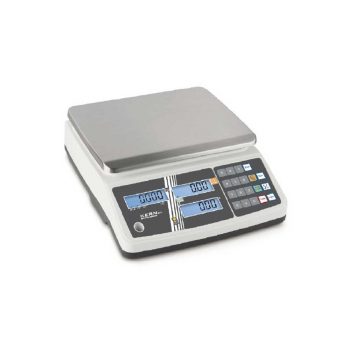
- Three displays for: total weight (verifiable), unit price, total price
- Unit price can be switched from €/kg to €/100 g
- Memory (PLU) for 10 article prices
- Auto-clear-key: Unit price entry is automatically set to zero when scale is unloaded
-
High mobility: thanks to battery operation (optional) and compact, flat construction, it is suitable for use in several locations
Datasheet
|
User Manual
|
Price-Calculating Scales – Scales That Calculate the Sale Price Based on Weight
Price-calculating scales are weighing systems used in retail or industrial environments where the price of an item is determined by its weight. You enter a price per unit weight (e.g., price per kilogram), place the goods on the scale, and the scale calculates the total price automatically.
These scales are often used in food retail (butchers, delicatessens, fruit/vegetable stands), bulk goods sales, or industrial sales where items are weighed and priced simultaneously. Key features include price memory (PLUs), dual display (weight, price), legal-for-trade versions, and interfaces for printing labels or connecting to POS systems. :contentReference[oaicite:0]{index=0}
FAQ about Price-Calculating Scales
Answers to typical questions on how these scales work, how to choose them, installation and usage.
How does a price-calculating scale work?
You input the unit price (e.g., €/kg). When you place the product on the scale, the scale reads the weight, multiplies by the unit price, and displays the total price. Some models can store multiple unit prices (PLU keys) for quick operation. :contentReference[oaicite:1]{index=1}
Where are these scales used?
They are typically used in sales of loose goods by weight (food retail, markets, produce stands), industrial sales by weight, and any scenario where goods are priced by weight. :contentReference[oaicite:2]{index=2}
What must I consider when selecting a price-calculating scale?
Important factors include:
- Maximum load and minimum division (resolution) – ensure the scale handles the weight range and resolution you need.
- Number of PLU keys or memory for unit prices.
- Dual display (for customer view and operator view) if required.
- Legal-for-trade (if used for commercial transactions) and local compliance.
- Interfaces for printer/labeling or POS/ERP system if required.
- Environment: food-safe surfaces, cleaning requirements, mobile/market use (battery), or stationary retail use. :contentReference[oaicite:3]{index=3}
What legal or compliance aspects are relevant?
If the scale is used for selling by weight, it often must comply with national regulations on weighing instruments and be verified/equipped with latest security functionalities (e.g., TSE in Germany). :contentReference[oaicite:4]{index=4}
How should a price-calculating scale be installed and used?
The scale must be placed on a stable, level surface. Ensure no mechanical interference or significant vibration. For mobile use (markets) ensure battery support, mobile power, and proper displays. The operator should program unit price correctly and check calibration periodically.
What are common error sources?
Common issues include:
- Incorrect unit price input – leads to wrong total price.
- Overload beyond the scale’s capacity or very small weight below resolution – may produce inaccurate results.

- Surface instability, vibrations or draft affecting weight reading.
- Non-compliant legal verification if used for trade – risk of regulatory issues.
What output or connectivity features are available?
Many models include: dual display (customer/operator), printing label functionality, RS-232/USB/Ethernet interface, memory for PLU codes, battery operation for mobile sale, remote display or POS connection. :contentReference[oaicite:5]{index=5}

How can I request a quotation?
Please provide ICS Schneider Messtechnik with your requirements: load capacity, resolution, number of PLU unit price memories, display requirements (dual display, external display), interface needs (printer, POS), environment (stationary or mobile, food safe), and legal-for-trade compliance. You will then receive a tailored offer.


































Datasheet