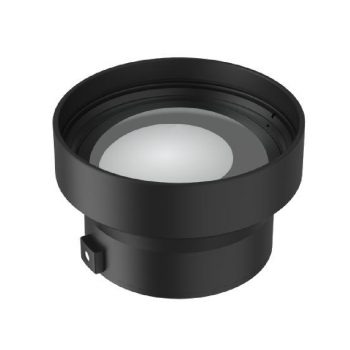








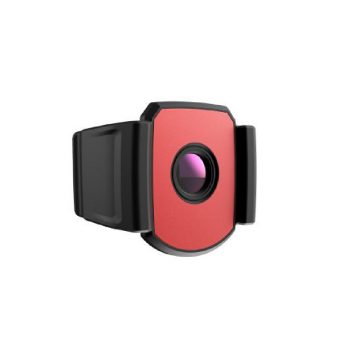
- Max. [+ 3°C/5.4°F, + 3%/, for object temperature between 0°C [32°F) to 150°C [302°]
- See Smaller: Small details are clearly visible, imaging the target as small as 100 jım x 100 jim
- Easy installation: Easy to attach the macro lens to compatible cameras
- No Calibration Required: Ready to use once installed, saves the hassle of sending the camera to the manufacturer to calibrate the lens
Datasheet |
User Manual |
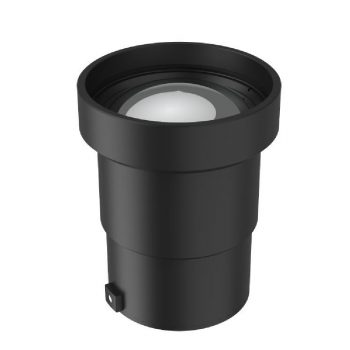
The interchangeable lens series is often used with handheld thermal cameras to expand the focal length of the original camera to different ranges, So as to obtain different FOVS and scene scopes.
- FOV (Field of View): 12.5° (H) x 10.0° [V) @ 660; 9.3° (H) x 7.0° [V] @ 640
- Compatible with 640, 660
Datasheet
|
User Manual
|
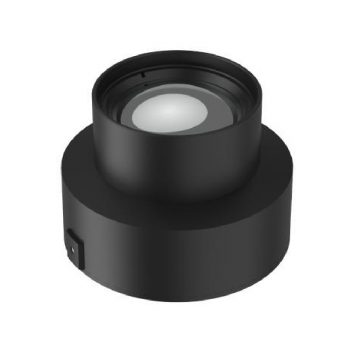
The interchangeable lens series is often used with handheld thermal cameras to expand the focal length of the original camera to different ranges, So as to obtain different FOVS and scene scopes.
- FOV [Field of View): 7.6° [H) x 6.1° (V} @ 660; 5.7° (H) x 4.3° [V] @ 640
- Compatible with 640, 660
Datasheet
|
User Manual
|
The interchangeable lens series is often used with handheld thermal cameras to expand the focal length of the original camera to different distances, in order to obtain different FOVs and scene scopes.
- FOV [Field of View]: 48.2° [H) x 38.5° [V] @ 660; 35.4° [H] x 26.2° [V] @ 640
- Compatible with 640, 660
Datasheet
|
User Manual
|
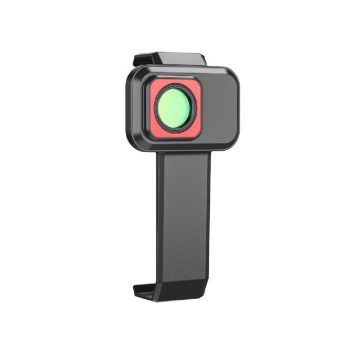
- High Accuracy: Max. [+ 3°C/5.4°F, + 3%], for object temperature between 0°C [32°F) to 150°C [302°F]
- See Smaller: Small details are clearly visible, imaging the target as small as 100 fm x 100 jim
- Easy installation: Easy to attach the macro lens to compatible cameras
- No Calibration Required: Ready to use once installed, saves the hassle of sending the camera to the manufacturer to calibrate the lens
Datasheet |
User Manual |
Thermal Camera Lenses – optimize field of view, detail & measurement reliability
IR lenses determine your camera’s field of view (FOV), spatial resolution (IFOV), working distance and ultimately the measurement quality. Depending on the task, choose from wide-angle, standard, telephoto, and macro/micro lenses as well as IR windows/protective panes and spectral filters (LWIR/MWIR).
ICS Schneider Messtechnik helps with lens selection, IFOV sizing, calibration (incl. window/filter compensation) and integration into QA/IIoT workflows.
FAQ on Thermal Camera Lenses
Answers on focal length, FOV/IFOV, MTF, hotspot size, focus, windows/filters, accuracy, cleaning and selection.
What lens types exist?
Wide-angle (large scene), standard (all-round), telephoto (small targets at distance), macro/micro (very small targets up close). Depending on camera: interchangeable or fixed.
How do focal length and field of view relate?
| Type | Typical FOV* | Use |
|---|---|---|
| Wide-angle | ~45–90° | Building envelope, large assets at close range |
| Standard | ~24–45° | Service, general electrical |
| Telephoto | ~6–24° | Panels/process from a distance, small hotspots |
| Macro/Micro | very small FOV | PCBs/components, fine structures |
* FOV depends on sensor size/pitch and exact focal length.
What is IFOV and why does it matter?
IFOV = pixel size on target (mrad or mm/pixel at a given distance). Smaller IFOV resolves finer details and smaller hotspots.
How big must a hotspot be to measure reliably?
Rule of thumb: cover at least 3×3 pixels (better 5×5). Otherwise surrounding background is averaged in and readings skew low.
What does MTF mean for thermography?
MTF (modulation transfer function) describes how well the lens transfers contrast of fine details. Good MTF supports clear edges and stable ΔT evaluations.
Do lenses influence measurement accuracy?
Yes. Transmission, stray light, vignetting, focus quality and windows/filters affect the signal. Radiometric calibration is lens/configuration specific.
Wide-angle or telephoto—when to use which?
- Wide-angle: large areas, short distances, overview scans
- Telephoto: small targets, safe distance, hotspot hunting at range
What are macro/micro lenses for?
Very small targets (electronics, microstructures). Short working distances, high magnification, often manual focusing for best precision.
What is working distance and minimum focus distance?
The distance where the lens focuses sharply. Below the minimum focus distance the image blurs → measurement errors. Always check the datasheet.
Autofocus or manual focus?
Autofocus is fast and repeatable; manual gives maximum control for tele/macro. Defocus directly biases temperatures.
Is every lens radiometrically calibrated?
With interchangeable optics, the camera applies per-lens calibration. Wrong lens ID/profile → wrong corrections. Always select the matching profile/LUT.
Which IR windows/protective panes make sense?
For switchgear/process use IR windows. Choose material by spectral band (e.g., germanium/chalcogenides for LWIR, CaF₂/ZnSe/sapphire for MWIR). Ensure temperature/chemical resistance.
How do window transmission and emissivity affect readings?
Windows attenuate and introduce reflections. Enable the camera’s window compensation (transmission/ε) or correct in software.
Are filters and spectral bands (LWIR/MWIR) interchangeable?
No. Lenses/filters are band-specific. Wrong band → heavy attenuation/mismeasurement. Always verify band compatibility.
What is boresight/parallax vs. the visual camera?
IR and visual channels rarely share the exact optical axis. During image fusion ensure alignment; micro parallax can misplace annotations.
What is vignetting and why avoid edge measurements?
Vignetting darkens edges and can cause edge radiometric deviations. Place critical ROIs near the center.
Does focus shift with temperature?
It can. Lens materials can shift focus with temperature. Refocus after thermal changes or allow the system to stabilize.
How do I clean IR optics correctly?
Use lint-free cloths and appropriate optic cleaners, no abrasives. Use caps, avoid dust/moisture, and do not “dry rub”.
Transport & storage—what to consider?
Shock protection, dry environment, avoid condensation (acclimatize). Store lenses in fitted cases; protect AR coatings.
How do I select the right lens (incl. quick IFOV cheat sheet)?
- Target size & distance → check IFOV/hotspot criterion
- Scene → pick needed FOV (wide/standard/tele)
- Spectral band → ensure LWIR/MWIR compatibility
- Environment → consider windows/protection & transmission
- Quick math: IFOV (mrad) ≈ pixel pitch / focal length; spot size ≈ IFOV × distance


Datasheet