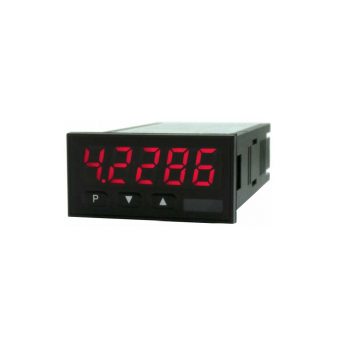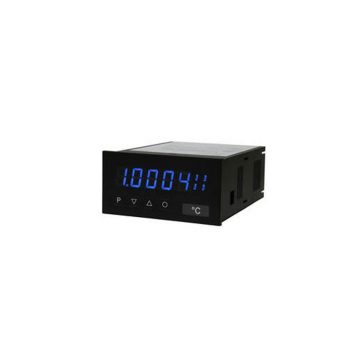
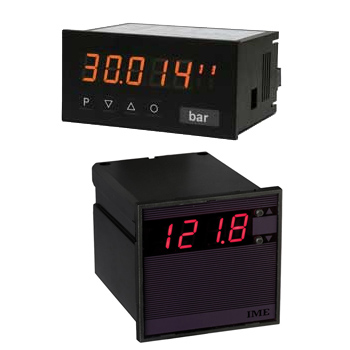
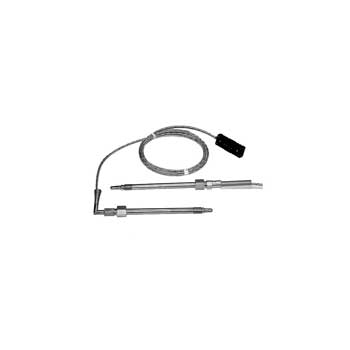
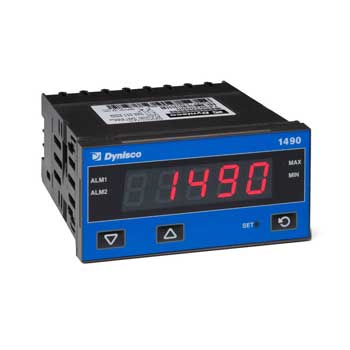
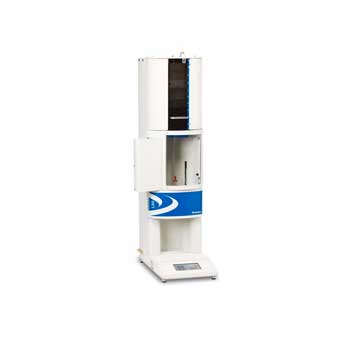
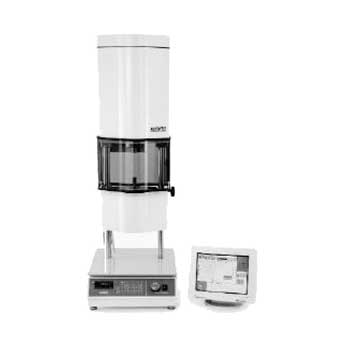





















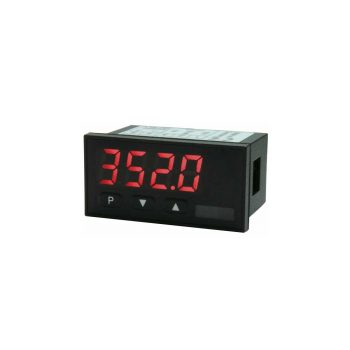
| Housing | 48 x 24 mm |
| Display | 4-digit 10 mm digit height Colour: red, green, orange or blue display |
| Range displayed | -200°C…850°C / -328°F…1562°F |
| Operation | front panel keyboard protection class IP65 |
| Input | Pt1000 2-wire |
| Analogue Output | – |
| Switch point | – |
| Interface | – |
| Power supply | 24 VDC +/-10% galvanic isolated Other voltage supplies on demand! |
| Sensor supply | – |
| Software properties |
|
Datasheet
|
User Manual
|
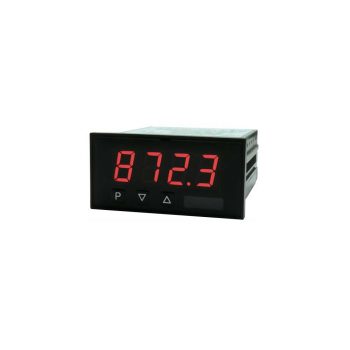
| Housing | 48 x 24 mm |
| Display | 5-digit 10 mm digit height Colour: red, green, orange or blue display |
| Range displayed | -200.0°C…850.0°C / -328.0°F…1562.0°F |
| Operation | front panel keyboard |
| Input | Pt1000 2-wire |
| Analogue Output | 0/4…20 mA 0…10 V 16 Bit switchable |
| Switch point | 2 PhotoMos outputs (NOC) 30 VDC/AC, 0.4 A |
| Interface | – |
| Power supply | 24 VDC +/-10% galvanic isolated 100-240 VAC 50/60 Hz / DC +/- 10% |
| Sensor supply | – |
| Software properties |
|
Datasheet
|
User Manual
|
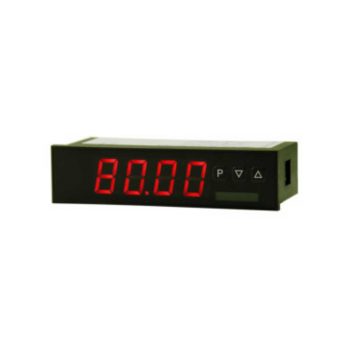
| Housing | 72 x 36 mm |
| Display | 4-digit 14 mm digit height Colour: red, green, orange or blue display |
| Range displayed | -200°C…850°C / -328°F…1562°F |
| Operation | front panel keyboard protection class IP65 |
| Input | Pt1000 2-wire |
| Analogue Output | – |
| Switch point | 2 relays (change-over contact) 250 V / 5 AAC, 30 V / 5 ADC |
| Interface | – |
| Power supply | 230 VAC 24 VDC +/-10% galvanic isolated Other voltage supplies on demand! |
| Sensor supply | – |
| Software properties |
|
Datasheet
|
User Manual
|
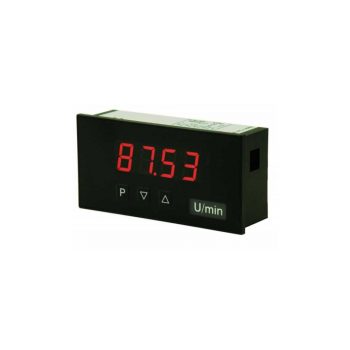
| Housing | 96 x 24 mm |
| Display | 4-digit 14 mm digit height Colour: red, green, orange or blue display |
| Range displayed | -200°C…850°C / -328°F…1562°F |
| Operation | front panel keyboard protection class IP65 |
| Input | Pt1000 2-wire |
| Analogue Output | – |
| Switch point | – |
| Interface | – |
| Power supply | 230 VAC 24 VDC +/-10% galvanic isolated Other voltage supplies on demand! |
| Sensor supply | – |
| Software properties |
|
Datasheet
|
User Manual
|
| Housing | 96 x 48 mm |
| Display | 4-digit 14 mm digit height Colour: red, green, orange or blue display |
| Range displayed | -200°C…850°C / -328°F…1562°F |
| Operation | front panel keyboard protection class IP65 |
| Input | Pt1000 2-wire |
| Analogue Output | – |
| Switch point | – |
| Interface | – |
| Power supply | 230 VAC 24 VDC +/-10% galvanic isolated Other voltage supplies on demand! |
| Sensor supply | – |
| Software properties |
|
Datasheet
|
User Manual
|
| Housing | 96 x 48 mm |
| Display | 5-digit 14 mm digit height Colour: red, green, orange or blue display |
| Range displayed | -200°C…850°C / -328°F…1562°F |
| Operation | front panel keyboard protection class IP65 |
| Input | Pt1000 2-wire |
| Analogue Output | 2 analog outputs 0/4…20 mA 0…10 V 16 Bit switchable |
| Switch point | 2 PhotoMos outputs (NOC) 30 VDC/AC, 0.4 A |
| Interface | RS232 or RS485 galvanic isolated Alternatively to analog output 2 |
| Power supply | 100-240 VAC 50/60 Hz / DC +/- 10% 10-40 VDC / 18-30 VAC 50/60Hz |
| Sensor supply | – |
Digital Panel Meters for PT1000 Sensors
Digital panel meters for PT1000 sensors measure the resistance — and thus the temperature — of a PT1000 probe and display the value on a multi-digit LED display. The instruments support 2-, 3- or 4-wire configurations to compensate for lead resistance and can output either linearized temperature (°C or °F) or raw resistance (Ω). With adjustable scaling, optional analog and relay outputs, and front protection up to IP65, they are suitable for accurate temperature indication and monitoring directly inside control cabinets.
Questions & Answers
What are typical applications for PT1000 panel meters?
They are used for temperature monitoring in heating, cooling and industrial process systems, as well as in pipelines, tanks, ducts or machinery where temperatures need to be displayed and supervised reliably.
Which wiring configurations (2-, 3-, 4-wire) are supported?
Most instruments support PT1000 sensors in 2-, 3- or 4-wire configuration. The 3- and 4-wire setups compensate for lead resistance, which is important when long cable runs or small cross-section wires are used.
How is the temperature range configured?
The temperature range is set via scaling. Typical PT1000 measurement ranges include –50…+150 °C or –200…+600 °C, depending on the used probe. The device can display temperature in °C/°F or raw resistance in ohms.
How accurate is the displayed value?
The instrument linearizes the measured resistance according to the PT1000 standard curve and shows the resulting temperature with high resolution. Accuracy depends on sensor and device quality; typical deviations are around ±0.1 °C or equivalent in resistance mode.
What display types are commonly used?
Common are 4- or 5-digit LED displays in colors such as red, green or orange. Digit heights of around 10 mm or 14 mm are typical, and brightness is often adjustable to match ambient lighting.
Is an analog output available for further processing?
Yes — many PT1000 panel meters offer freely scalable analog outputs such as 0/4–20 mA or 0–10 V, allowing the measured temperature to be forwarded to PLCs, controllers or data acquisition systems.
Are relay outputs included for limit monitoring?
Often one or two potential-free relays are integrated. These can be configured as lower, upper or window limits to trigger alarms or switching actions when defined thresholds are exceeded or undershot.
What supply voltage does the device require?
Devices typically operate from 24 VDC (galvanically isolated) or a universal power supply such as 100–240 VAC. The exact supply requirements are model-dependent.
How is configuration performed?
Configuration is carried out using the front keypad. Adjustable parameters include sensor type, wire configuration (2/3/4-wire), scaling, engineering units, decimal point, filtering, and the settings for analog and relay outputs.
How do long cable runs affect measurement?
In 2-wire mode, resistance from long or thin cables adds to the sensor resistance and can cause measurement errors. Using 3- or 4-wire measurement or enabling lead-wire compensation eliminates this effect.
What protection class and panel mounting sizes are typical?
The front panel usually meets IP65 protection, providing dust- and splash-proof operation. Typical panel sizes include 48×24 mm or 72×36 mm for standardized cut-outs.
Can the instrument display resistance (Ω) instead of temperature?
Yes — most models allow switching to raw resistance mode, where the device displays the measured value in ohms rather than temperature.
Can negative temperatures be displayed?
Yes — if the configured temperature range includes negative values (e.g. –50…+150 °C), the display will show negative temperatures correctly.
How are interference and measurement noise minimized?
Galvanic isolation, shielded cables, and 3- or 4-wire measurement improve accuracy. Additional digital filtering helps stabilize the display and suppress electrical noise.
How can the device be integrated into automation or monitoring systems?
Integration is achieved via analog outputs and relay contacts. Analog signals can be fed to PLC input modules or data loggers, while relay contacts can be used for alarms or control actions based on temperature thresholds.


Datasheet