


- Two process connections and two independent pointers
- Case from stainless steel
- Accuracy class 1.0 and 1.6 (NS 60)
- Scale ranges from 0 ... 6 bar to 0 … 16 bar
- Overload safety to 1.3 x full scale value
 Datasheet Datasheet |
| User Manual |
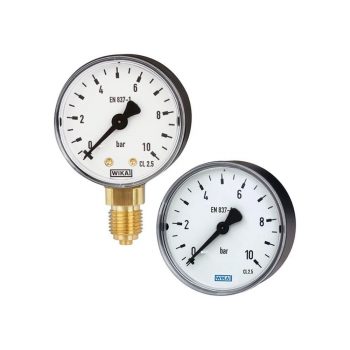
- Reliable and cost-effective
- Design per EN 837-1 or ASME B40.100
- Nominal size 40 [1 ½"], 50 [2"], 63 [2 ½"], 80 [3"], 100 [4"] and 160 [6"]
- Scale ranges to 0 ... 400 bar [0 ... 6,000 psi]
 Datasheet Datasheet |
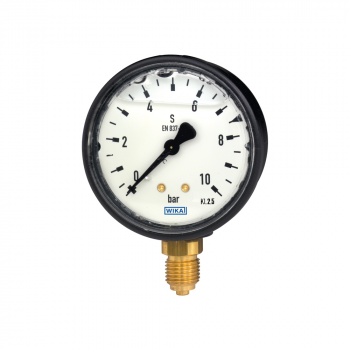
- Vibration and shock resistance
- Design per EN 837-1 or ASME B40.100
- Nominal size 40 [1 ½"], 50 [2"], 63 [2 ½"]
- Scale ranges to 0 ... 400 bar [0 ... 6,000 psi]
| Datasheet |
| User Manual |
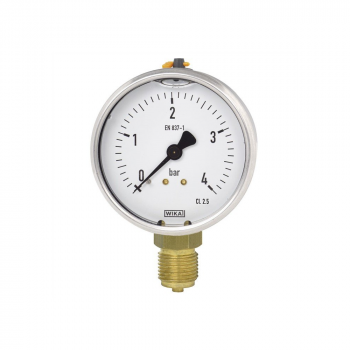
- Very good vibration and shock resistance
- Robust design
- Scale ranges to 0 ... 400 bar or 0 ... 6,000 psi
| Datasheet |
| User Manual |
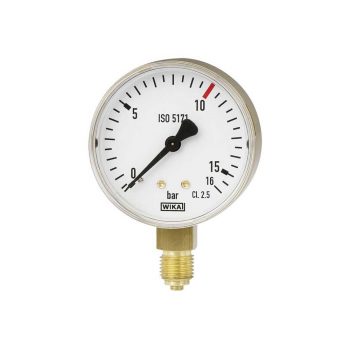
- Version per ISO 5171 or for acetylene per ISO 7291
- Safety features Model 111.11: With blow-out device in case back Model 111.31: With solid baffle wall (Solidfront)
- Nominal size (NS) of the case Model 111.11: NS 40, 50 and 63 Model 111.31: NS 50
- Scale ranges to 0 ... 400 bar or 0 ... 6,000 psi
|
Datasheet |
| User Manual |
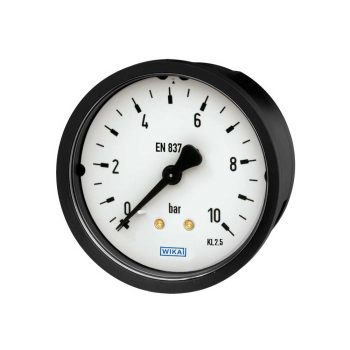
- Specifically for panel mounting
- Reliable and cost-effective
- Version per EN 837-1 or ASME B40.100
- Scale ranges to 0 ... 400 bar or 0 ... 6,000 psi
|
Datasheet |
| User Manual |
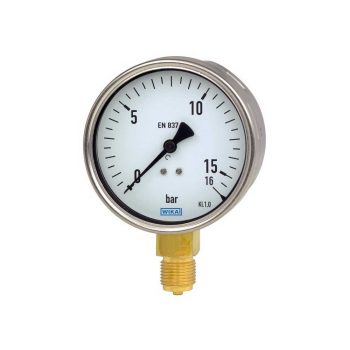
- Long service life, robust
- Cost-effective and reliable
- To combine with WIKA diaphragm seals
- German Lloyd approval
- Scale ranges up to 0 … 1,000 bar
| Datasheet |
| User Manual |

- Vibration- and shock-resistant
- Especially robust design
- NS 63 [2 ½"] and 100 [4"] with DNV GL approval
- Scale ranges from 0 … 0.6 to 0 … 1,000 bar [0 ... 10 to 0 ... 15,000 psi]
 Datasheet Datasheet
|
|
User Manual
|
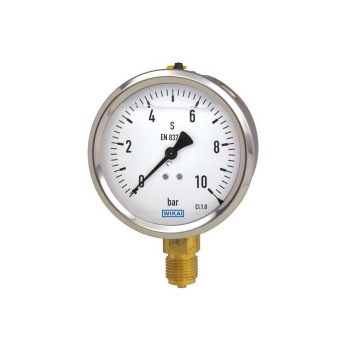
- Very good vibration and shock resistance
- Especially robust design
- Type approval for the shipbuilding industry
- Scale ranges to 0 ... 1,000 bar or 0 ... 15,000 psi
|
Datasheet
|
|
User Manual
|

- Combined indication for pressure and temperature
- Scale ranges to 0 … 10 bar [ 0 ... 150 psi] and 0 ... 120 °C [32 ... 248 °F]
- Shut-off valve included in delivery
| Datasheet |

Industrial Bourdon Tube Pressure Gauges – versatile, robust, easy to read
Industrial Bourdon tube pressure gauges are the standard for local pressure indication in plant engineering, hydraulics, pneumatics, HVAC, water/wastewater, and process industries. They provide a clear, low-vibration display, high mechanical strength, and are available in many dial sizes (e.g., DN 63/100/160), connection positions (bottom/back), and materials (brass/stainless steel). Options include glycerin filling, safety design, and calibration certificate.
ICS Schneider Messtechnik supports you with selection, range sizing, damping (snubber/restrictor), process connection, media compatibility, and calibration — including documentation to EN 837-1 and optional integration into measurement chains (e.g., parallel-mounted transmitter).
FAQ on Industrial Bourdon Tube Gauges
Answers on selection, accuracy, installation, damping, protection classes, materials, scales, and maintenance.
What are industrial Bourdon gauges designed for?
For local pressure indication on machines and systems — from hydraulics and pneumatics to water/wastewater, HVAC, and general process applications.
Which standards apply?
EN 837-1 (Bourdon tube gauges) defines construction, classes, test pressures, and safety requirements. Optional safety concepts include blow-out and solidfront.
What accuracy classes are common?
| Application | Class | Note |
|---|---|---|
| General indication | 2.5 – 1.6 | Cost-effective, good readability |
| Process/quality | 1.0 | Finer scale |
| Test tasks | 0.6 | Alternatively use a Digitalmanometer |
How do I size the measuring range?
Select span as working pressure × 1.3–2.0. For pulsation/spikes, choose a larger range or add damping (snubber/restrictor).
Which materials are available and for what?
| Material | Use | Example |
|---|---|---|
| Brass | Neutral media (air/water/oil) | General machinery |
| Stainless steel 316L | Demanding media/environments | Process/outdoor |
| Special alloys* | Highly corrosive media | With diaphragm seal |
*e.g., Hastelloy®, Monel®, Tantalum in combination with diaphragm seals.
When is glycerin filling useful?
With vibration and pressure shocks — it damps pointer flutter, protects the movement, and improves readability.
Which process connections are available?
| Connection | Standard | Position |
|---|---|---|
| G 1/4 / G 1/2 | ISO 228 | bottom or back |
| ¼" NPT / ½" NPT | ASME | bottom or back |
| Flange / Hygienic* | EN/ASME / EHEDG | project-specific |
*Hygienic connections usually via diaphragm seals.
What should I consider during installation?
- Mount with low vibration; ensure dial is clearly visible.
- Avoid applying lever forces via the process fitting.
- For steam/coolants, add a siphon/cooling section.
How do I protect against pulsation and water hammer?
Use a restrictor/snubber, capillaries, diaphragm seal, or remote mounting. Do not size the range too tightly.
What protection classes are available?
Typically IP54–IP65; higher IP ratings may be possible depending on design. For washdown areas, check front seals and housing design.
How do I choose the dial size?
| Dial size | Use | Benefit |
|---|---|---|
| DN 63 | Compact machinery | Small, flexible |
| DN 100 | All-round/process | Good readability |
| DN 160 | Long distance/vibration | Very good readability |
Scales and units — what is common?
Scales in bar, psi, kPa, or dual. Use one unit consistently and document conversions. Custom scales on request.
Temperature limits — what to watch?
| Component | Range (typ.) | Note |
|---|---|---|
| Ambient | −20…+60 °C | Dial/mechanics |
| Medium | up to ~100 °C directly | Higher: use siphon/cooling section |
| Glycerin filling | −20…+60 °C | Alternative silicone filling |
Are safety versions available?
Yes: blow-out back, safety glass, and solidfront. Select based on risk assessment and medium.
How often should I calibrate?
Rule of thumb: annually; for QA/safety loops semi-annually/quarterly or after events (overload/vibration). Store certificates securely.
Can I integrate industrial gauges into measurement chains?
Yes, e.g., as a dual measuring point (gauge + transmitter/switch). The transmitter provides 4–20 mA/HART/RS-485; an edge gateway enables dashboards/alarms.
Typical faults & remedies?
- Pointer flutter: vibration → add filling/restrictor.
- Zero drift: temperature/overload → adjust/calibrate.
- Sluggish indication: damping too strong → check settings.
- Leaks: verify seals/torque.
What options are common?
- Glycerin/silicone filling
- Marker rings/drag pointer
- Custom scales/logo
- Cleanable front (hygienic)
- Calibration certificate (DAkkS/ISO)
Do you offer selection and calibration services?
Yes. We review medium/temperature, size range/damping, choose connection/materials, supply calibration certificates, and document to EN 837-1 — with mounting accessories on request.