

 Datasheet
Table of Contents
- What Is the PACE6000E?
- Why Choose the PACE6000E Instead of the PACE5000E?
- Modular Instrument Concept
- PACE Control Modules
- Advantages of Optional CM3 Control Modules
- Auto-Ranging Explained
- Dual-Channel Operation Explained
- Control Speed and Stability
- User Interface
- Applications and Industries
- Integration and Calibration Systems
- Optional Test Methods
- Frequently Asked Questions
What Is the PACE6000E?
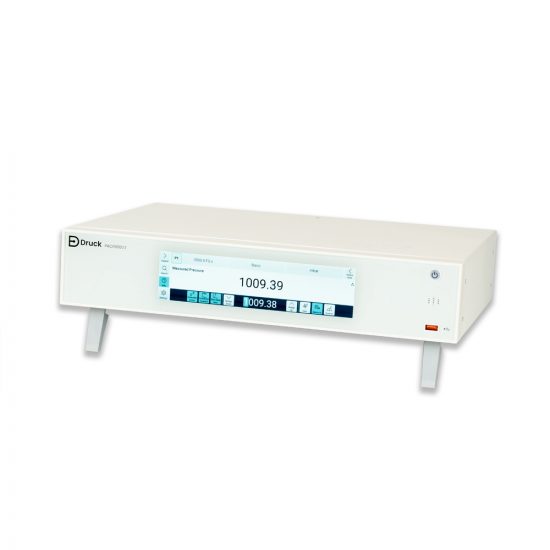
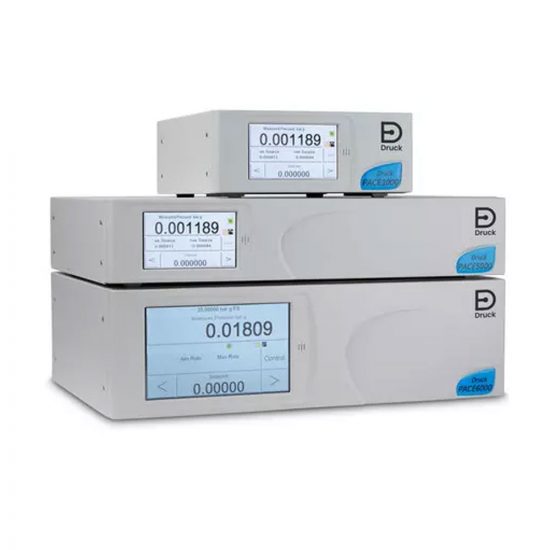
The PACE6000E is a modular high-precision pressure controller for automatic pressure generation, control, and measurement. Unlike the PACE5000E, the PACE6000E is designed as a dual-channel system and can be operated with up to two independently controlled pressure channels.
The instrument is particularly suitable for calibration laboratories, automated test benches, research and development departments, and end-of-line testing in production. Thanks to its modular design, the PACE6000E can be flexibly adapted to different pressure ranges, accuracy requirements, and test applications.
Depending on the installed PACE CM or optional CM3 control module, different pressure ranges and measurement uncertainties can be achieved. This makes the PACE6000E a powerful solution for applications requiring high accuracy, fast pressure control, and flexible multi-channel functionality.
Why Choose the PACE6000E Instead of the PACE5000E?
Although the PACE5000E is already a very powerful single-channel pressure controller, the PACE6000E offers additional capabilities for more demanding test and calibration applications. The PACE6000E provides clear advantages especially for multi-channel applications, parallel test procedures, or complex automated test benches.
PACE6000E vs. PACE5000E Comparison
| Feature | PACE5000E | PACE6000E |
|---|---|---|
| Control Channels | 1 | Up to 2 independently controlled channels |
| Instrument Concept | Single-channel pressure controller | Dual-channel pressure controller |
| Simultaneous Pressure Control | No | Yes |
| CM3 Control Modules | Optionally available | Optionally available |
| TERPS Technology | With optional CM3 modules | With optional CM3 modules |
| Auto-Ranging | Depending on configuration | Especially suitable with two modules |
| Testing Multiple Devices Simultaneously | Limited | Very well suited |
| Typical Application | Single test station, calibration laboratory, service | Multi-channel test bench, production, R&D, end-of-line testing |
When Does the PACE6000E Make Sense?
- When two independent pressure channels are required
- When multiple devices under test need to be tested simultaneously
- When auto-ranging across multiple modules is required
- When test benches are operated automatically
- When high test speed and flexible pressure ranges are required
- When future expansion is planned
Modular Instrument Concept
PACE6000E Chassis
- Dual-channel pressure controller chassis
- Operation with up to two interchangeable PACE CM or CM3 control modules
- Operation in single, auto-ranging, or dual-channel mode
- No pressure ratio limitation between channels
- High flexibility for industrial applications, calibration laboratories, and test benches
For applications with only one pressure channel, the PACE5000E is available as an alternative.
PACE Control Modules
The interchangeable PACE Control Modules contain the essential components for pressure control and pressure measurement, including valves, sensors, and manifolds. This allows the system to be flexibly adapted to different pressure ranges.
- Interchangeable control modules for different pressure ranges
- Easy adaptation to new test and calibration tasks
- Module replacement without removing the complete instrument
- Only the module needs to be serviced or calibrated
- The base unit can remain permanently installed in the test bench
Advantages of Optional CM3 Control Modules
For the highest requirements in accuracy, stability, and measurement uncertainty, PACE6000E systems can be equipped with optional CM3 control modules. These modules combine pressure sensor, control technology, and calibration data in one interchangeable unit.
TERPS Technology for Maximum Precision
The optional CM3 control modules use TERPS technology developed by Druck. TERPS stands for Trench Etched Resonant Pressure Sensor and enables particularly precise and stable pressure measurement.
- Very high resolution
- Excellent repeatability
- Low hysteresis
- Excellent long-term stability
- High temperature stability
High Long-Term Stability
The optional CM3 control modules are designed for low drift and long-term stable measurement results. This reduces the need for intermediate checks and can lower calibration costs over time.
- Fewer recalibrations
- Lower operating costs
- Higher availability
- Long-term stable measurement results
Low Measurement Uncertainty
By combining precise sensor technology, stable pressure control, and modular calibration capability, the PACE6000E with optional CM3 modules is particularly suitable for demanding reference measurements.
- Suitable for calibration laboratories
- Suitable for factory calibrations
- Suitable for research and development
- Suitable for automated end-of-line test benches
Auto-Ranging Explained
What Does Auto-Ranging Mean?
With auto-ranging, the PACE6000E can automatically manage multiple pressure ranges. Depending on the current test pressure, the system selects the appropriate measurement range to achieve the best possible accuracy across a wide pressure span.
This is especially useful when a calibration laboratory regularly tests different pressure sensors with significantly different measuring ranges.
Practical Example: Calibration of Different Pressure Sensors
A calibration laboratory tests sensors with the following ranges on a daily basis:
- 0 … 1 bar
- 0 … 10 bar
- 0 … 100 bar
Without auto-ranging, multiple reference instruments or manual switching would be required. With auto-ranging, the PACE6000E can automatically select the optimal measurement range.
- Automatic selection of the appropriate pressure range
- Reduced setup effort
- Lower risk of operator error
- Improved measurement accuracy across different pressure ranges
- Faster calibration procedures
Dual-Channel Operation Explained
Two Independent Pressure Controllers in One Instrument
The PACE6000E can be equipped with two independent control channels. Each channel has its own control module, pressure range, control loop, and measurement processing system.
- Two independent pressure channels
- Different pressure ranges possible
- Parallel test tasks in one instrument
- Reduced space requirement compared to two separate instruments
- More efficient test procedures in laboratories and production
Practical Example: End-of-Line Testing
In a production line, two pressure sensors need to be tested simultaneously. Sensor A has a measuring range of 0 … 10 bar, while Sensor B has a measuring range of 0 … 100 bar.
Using two separate instruments would require two pressure controllers, more wiring, and more installation space in the test bench. With one PACE6000E, both test tasks can be performed in parallel in a single instrument.
- Simultaneous testing of two sensors
- Reduced wiring effort
- Smaller footprint
- Faster test cycles
- Reduced system costs in the test bench
Control Speed and Stability
The PACE6000E combines fast pressure control with high stability. This makes the instrument suitable for both manual calibration tasks and automated test procedures with short cycle times.
- Response time in high-speed mode: approx. 1.5 seconds*
- Response time in high-accuracy mode: ≤ 3 seconds**
- Stability down to ≤ 0.001 % FS
- High repeatability in automated test cycles
* Under optimum conditions, external volume < 100 ml
** For larger volumes, control time may increase by up to 2 seconds
User Interface
The intuitive touchscreen interface enables easy operation of the PACE6000E and provides quick access to the most important functions.
- Display of measured pressure and pressure range
- Easy range and unit selection
- Direct setpoint entry
- Single-channel or dual-channel operation
- Clear display of active control channels
Applications and Industries
The PACE6000E is suitable for laboratory, production, research, and calibration applications in many industrial sectors.
- Aerospace
- Defense
- Energy
- Healthcare and pharmaceutical industry
- Electronics and semiconductor industry
- Transport
- Metrology and calibration
- Environmental technology
- General industry
Integration and Calibration Systems
The PACE6000E can be integrated into automated calibration and test systems. This makes the instrument suitable for both laboratory workstations and industrial test benches.
LXI™ LAN Extension
- Seamless integration into existing networks
- Remote maintenance and fault diagnosis
- Updates via LAN
4Sight2 Calibration Software
- Management of test equipment and calibration status
- Automated calibration and test runs
- Measurement uncertainty calculation
- Certificate generation
- Paperless calibration processes
- Trend and drift analysis
4Sight2 enables, for example:
- Calibration of pressure sensors
- Calibration of pressure transmitters
- Calibration of pressure switches
- End-of-line testing
- Calibration of third-party equipment
- Standardization of calibration processes within a company
Optional Test Methods
Leak Test
The leak test determines the pressure loss of a system using defined pressure steps. After stabilization, the pressure difference and leak rate are displayed.
Burst Pressure Test
During burst pressure testing, a device under test is pressurized until failure occurs. The exact burst pressure point is recorded and can be documented.
Frequently Asked Questions About the PACE6000E
What Is the Difference Between the PACE5000E and the PACE6000E?
The PACE5000E has one control channel. The PACE6000E can be equipped with up to two independently controlled pressure channels.
Can the PACE6000E Control Absolute Pressure?
Yes. Depending on the installed control module, absolute pressure, gauge pressure, or differential pressure applications can be implemented.
Does the PACE6000E Support Auto-Ranging?
Yes. The PACE6000E is particularly suitable for auto-ranging applications with multiple modules.
What Is TERPS Technology?
TERPS stands for Trench Etched Resonant Pressure Sensor. This technology is available in optional CM3 control modules and enables particularly precise and stable pressure measurement.
Can Existing PACE Modules Be Reused?
This depends on the specific module generation. Compatibility should be checked for each individual case.
Which Interfaces Are Available?
Depending on the configuration, Ethernet, USB, RS232, and IEEE-488/GPIB are available.
Is the PACE6000E Suitable for Automated Test Benches?
Yes. The PACE6000E was developed for automated calibration and testing tasks and is particularly suitable for complex test benches.
Can I Test Two Devices Simultaneously?
Yes. In dual-channel operation, two independent pressure tasks can be performed in parallel.
When Should I Choose the PACE5000E Instead of the PACE6000E?
The PACE5000E is the more cost-effective solution when only one pressure channel is required and no parallel test tasks are needed.