

 Datasheet
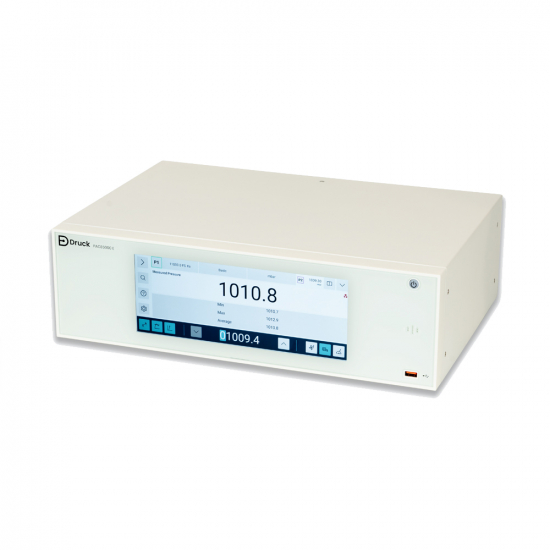
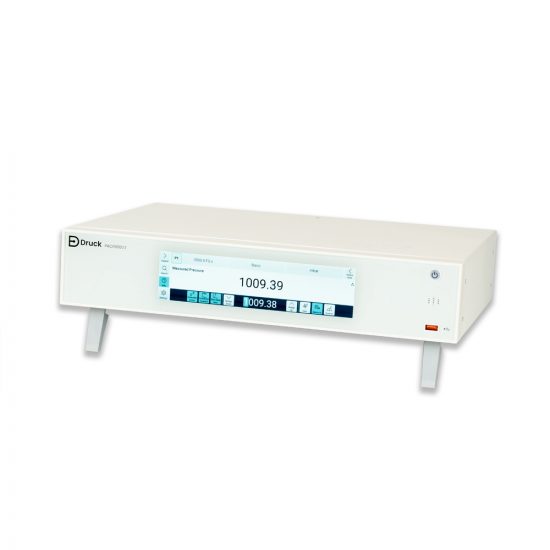
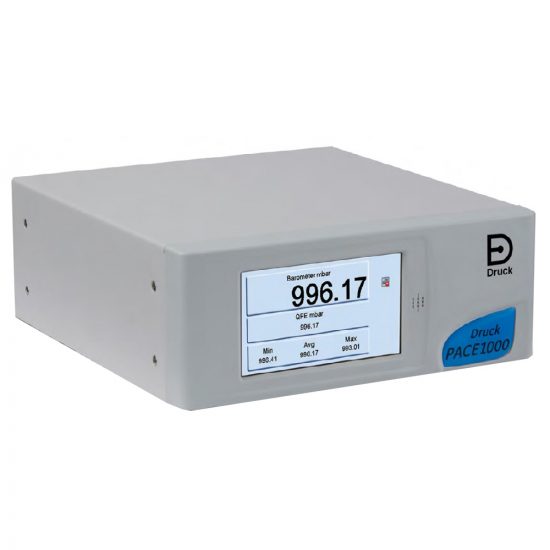
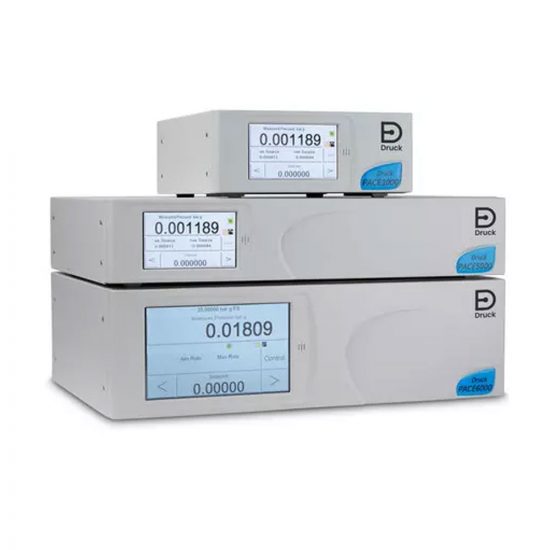
The PACE Tallis by Druck represents the latest generation of precision digital transfer standards, setting new benchmarks for accuracy, robustness, and versatility. Ideal for both in-situ testing and interlaboratory comparisons, this compact solution provides exceptional measurement stability and reliability.
Main Features:
- Total accuracy of 3 Pa / 0.03 mbar utilizing Druck TERPS resonant silicon technology
- Configurable with 1, 2, or 3 reference sensors covering ranges from 200 kPa up to 21.1 MPa
- Full-featured, user-friendly platform suitable for laboratory barometry and calibration standards
- Compact and robust, ideal for field use and safe transportation
- Precision of 10 ppm Full Scale (FS)
- Long-term stability up to 15 ppm FS per year
- Optional barometric reference sensor available
Performance Advantages:
- Minimizes user errors through automated measurement software
- No effects from external variables such as local gravity or medium density
- Easy setup and low maintenance—no piston cleaning required
- Lower total cost of ownership and reduced calibration expenses
- Minimal servicing requirements
Optional Features:
- Leak Test: Automatic measurement of leak rates in selectable units (per second or minute)
- Switch Test/Analogue Output: Automated pressure switch calibration and integration with external systems, programmable analogue outputs (0–10 V, 0–5 V, -5–5 V, 0/4–20 mA)
- Switch Test/Volt-Free Contacts: Automatic control of peripheral devices such as vacuum pumps or ovens
- Aeronautical Option: Calibration capability for aeronautical instruments with display units in feet, meters, knots, km/h, and Mach number
Applications:
- Calibration laboratories and metrological institutes
- On-site calibration in industry and aviation
- Interlaboratory comparisons and proficiency testing
- Reliable measurements in harsh environmental conditions
Benefits Over Traditional Systems (e.g., Deadweight Testers):
- Automated procedures reducing user-induced errors
- No influence from gravity or medium density variations
- No complex maintenance requirements like piston cleaning
- Lower operational costs and minimal servicing
The PACE Tallis provides unmatched precision, versatility, and ease of use, defining a new standard for modern pressure calibration solutions.
Deadweight Tester vs. Digital Pressure Gauge – Is It Time to Upgrade?
1. Why are deadweight testers (DWT) still used today?
Deadweight testers have been relied on for decades as highly accurate primary standards.
They provide exceptional metrological precision and are still widely used in laboratories
for reference calibrations—especially where the highest accuracy levels are required.
2. What disadvantages does a traditional DWT have in daily operation?
Using a DWT is often time-consuming and physically demanding. Weights must be manually placed
and changed, stabilization must be monitored, and operating errors—such as incorrect weight
combinations or piston friction—can easily occur.
3. What makes a digital pressure gauge (DPG) more attractive?
Digital pressure gauges work quickly, precisely, and conveniently. Pressure is measured
electronically and displayed instantly. This reduces operator error, shortens calibration
time, and greatly simplifies documentation.
4. Can a DPG really replace the accuracy of a DWT?
Modern digital reference gauges achieve accuracies down to ±0.01 % FS or better.
For industrial applications and factory calibrations, this is more than sufficient.
Many users keep their DWT as a top-level reference while using a digital device as
their everyday working standard.
5. Which common error sources can be avoided with a DPG?
Digital instruments eliminate errors caused by incorrect weights, piston friction,
contamination of hydraulic fluids, or reading inaccuracies. Temperature compensation
and automatic corrections ensure consistently reliable measurement results.
6. How does a digital pressure gauge improve daily work in the test field?
Calibration routines become faster, easier, and less prone to error. Serial tests can be
performed more efficiently—without heavy weights, manual mechanical adjustments, or long
stabilization times.
7. What does the transition mean for documentation and traceability?
Digital reference gauges enable simple, automated data handling. Readings can be saved,
exported, or integrated into calibration software—ideal for ISO 9001 compliance,
audits, and customer documentation.
8. Can the existing DWT still be used?
Yes. Many users keep their DWT as a laboratory or primary reference while implementing
a digital gauge as their daily working standard. This provides a combination of maximum
accuracy and optimal efficiency.
9. When is investing in a digital pressure gauge most beneficial?
Especially when performing frequent calibrations, working across multiple pressure ranges,
needing improved documentation, or wanting to reduce working time and error risk. Digital
gauges are ideal for test benches, workshops, and service applications.
10. What criteria are important when selecting a digital pressure gauge?
Key factors include pressure range, accuracy class, long-term stability, temperature limits,
media compatibility, and communication interfaces such as USB, RS-485, or Ethernet for
software integration and documentation.
Comparison: Deadweight Tester (DWT) vs. Digital Pressure Gauge (DPG)
| Feature | Deadweight Tester (DWT) | Digital Pressure Gauge (DPG) |
|---|---|---|
| Measurement principle | Weight force applied to a piston area | Electronic pressure sensor with digital output |
| Accuracy level | Very high, primary standard | Very high, suitable for most industrial calibrations |
| Operating effort | High – manual weights, stabilization required | Low – connect, read, and document |
| Measurement time | Longer, especially with multiple points | Short, ideal for serial testing |
| Error susceptibility | Friction, contamination, incorrect weights | Low, automatic compensation |
| Ergonomics | Heavy weights, physical strain | Lightweight, compact, intuitive |
| Documentation | Mainly manual | Digital, exportable, software-compatible |
| Typical use | Laboratory, primary/secondary standard | Test bench, workshop, service |
Would you like to reduce the workload on your deadweight tester or complement it with a digital
reference gauge? We are happy to support you with selection, integration, and documentation.