


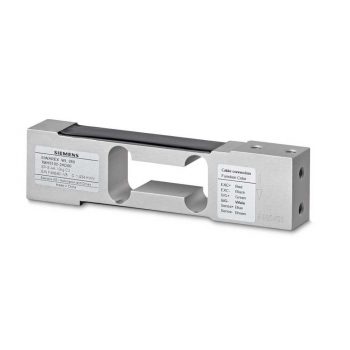
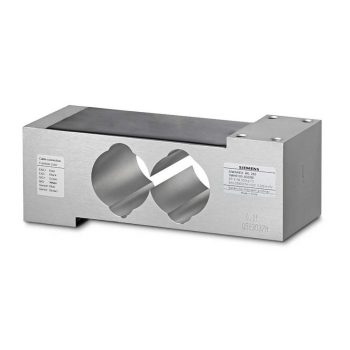

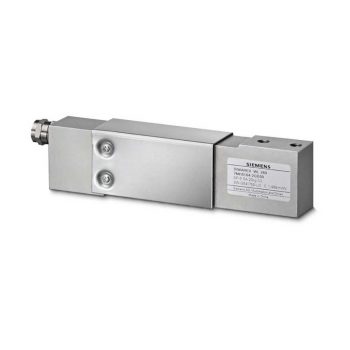
- Stainless steel, hermetically sealed, IP67
- particularly suitable for harsh environments
- platform size up to 400x400mm
 Datasheet Datasheet
|

-
Stainless steel, hermetically sealed, high degree of protection IP68
-
Use in commercial scales with class III
-
Accuracy class C3 according to OIML R60
|
Datasheet
|
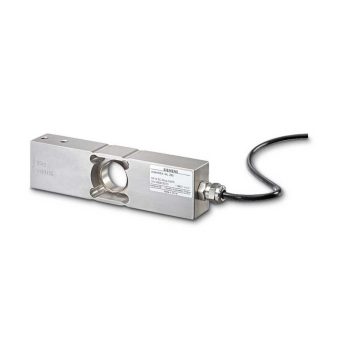
-
Low deflection from 0,03mm to 0,19mm
-
Stainless steel, hermetically sealed, high degree of protection IP68/69K
-
High-precision measuring with the option C4 MR and Y=40.000
 Datenblatt Datenblatt
|

Siemens Platform Load Cells
The platform load cells of the Siemens WL series are designed specifically for weighing platforms or floor scales. They use strain-gauge-based measuring bodies and output a defined electrical signal proportional to the applied load. Depending on the model, they cover small to medium scales with single load points (single-point) up to larger platforms with multiple cells — offering robust designs, often stainless steel and high ingress protection, for industrial or harsh environments.
FAQ
What distinguishes a platform load cell from other load cell types?
Platform load cells are designed for scales where a stable, flat platform rests directly on the cell. Unlike shear-beam, bending-beam or compression cells, they are often single-point type and tailored for smaller platform sizes and defined load points.
When is using a platform load cell appropriate?
When a compact platform scale with a single load point is sufficient — e.g. lab, bench or check scales — or when the platform is small, stable and the load is evenly distributed.
What load ranges do typical platform load cells cover?
Depending on model, the range goes from a few kilograms up to several hundred kilograms. For small platforms, rated loads in the lower kilogram range are common; larger platforms may support several hundred kilograms, making them suitable for light- to medium-duty weighing.
How are platform load cells mounted and wired?
The platform must be rigid and flat on the load cell to avoid shear stress. Electrical connection is usually via a four- or six-wire shielded cable. For longer cables or humid environments, proper protection and grounding are essential.
What happens if the platform is too large?
If the platform is too large or loaded asymmetrically, accuracy may suffer, because the cell is designed for defined, centered loads. Linearity or corner-load errors can occur.
Are platform load cells suitable for legal-for-trade scales?
Yes — certain variants are designed for trade-authorized use, provided they are used with correct construction and compliant rated values. The design and stability of the platform are crucial.
How accurate are platform load cells typically?
For single-point platform load cells, appropriately built scales can reach good accuracy — depending on load, cell, and calibration. Accuracy depends on the specific model and classification.
How is a platform scale calibrated when using a platform load cell?
With a single-point cell, calibration often requires only a test load; for multiple cells, calibration weights and possibly corner-load adjustment are needed. The platform should be empty and load evenly distributed.
What environmental and protection aspects should be considered?
Many platform load cells are hermetically sealed and made of stainless steel, making them suitable for humid, dusty or industrial environments. Still, protection against overload, shear forces and mechanical damage is necessary.
For which applications are platform load cells especially suitable?
Lab, bench or check scales, small industrial platform scales, dosing or packing stations — basically everywhere a compact, stable scale with defined load points is required.