
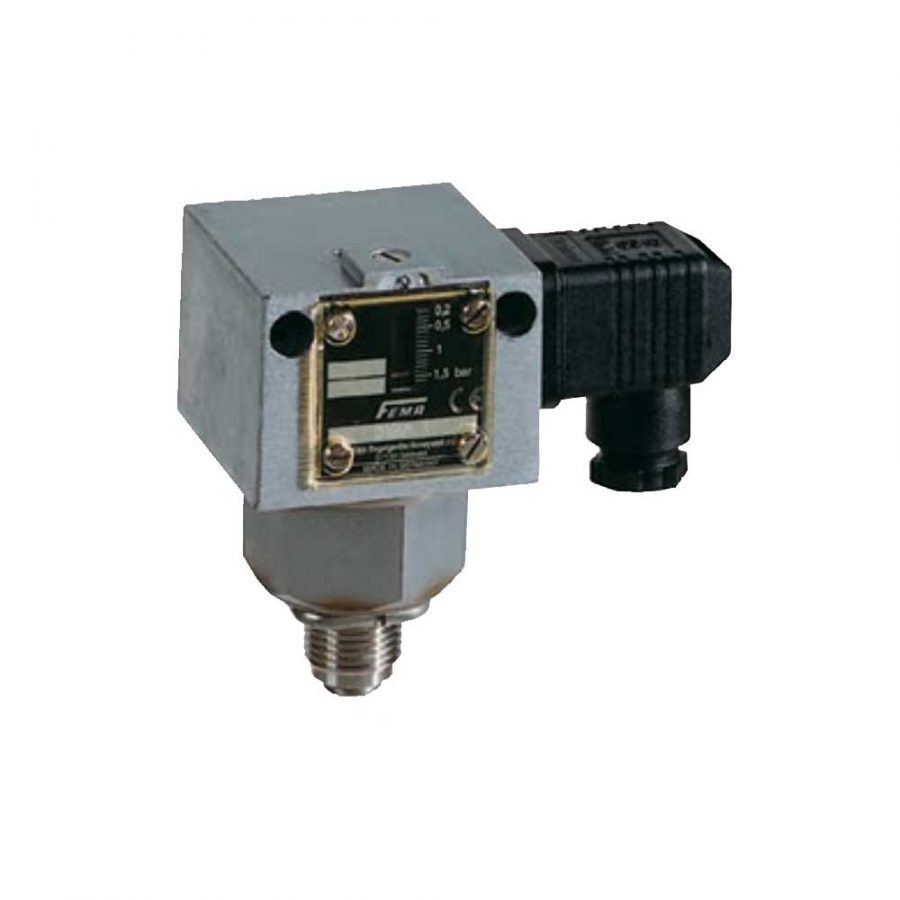
DCM16 Universal Pressure Switch 1…10 bar | FEMA Pressure Switch


  • Universal pressure switch
  • Setting range: 1…10 bar
  • Switching differential: 0,2 … 0,4 bar
  • max. pressure: 25 bar
  • with service function

Datasheet

The DCM/DNM series is designed for monitoring overpressure in industrial applications. The devices have a robust construction and can be adjusted externally using a screwdriver. Depending on the version, different materials are used for the pressure-wetted parts.

Technical data

  • Pressure connection: Male thread G 1/2 (pressure gauge connection) according to DIN 16 288 and female thread G 1/4 according to ISO 228 Part 1.
  • Switching device: Robust housing (200) made of seawater-resistant die-cast aluminium GD Al Si 12.
  • Protection class: IP54 with vertical installation position.
  • Pressure sensor materials: Cu + brass.
  • Installation position: Vertical upwards and horizontal. DCM4016 and DCM4025 vertical upwards.
  • Ambient temperature at the switching device: -25 to +70 °C, except DCM4016, DCM4025 and DCM1000: -15 to +60 °C.
  • Max. medium temperature: The maximum medium temperature at the pressure sensor must not exceed the permissible ambient temperature at the switching device. Short-term temperatures up to 85 °C are permissible.
  • Mounting: Directly on the pressure line (pressure gauge connection) or on a flat surface using 2 screws, 4 mm diameter.
  • Switching pressure: Externally adjustable using a screwdriver.
  • Switching differential: Not adjustable for DCM types.
  • Contact configuration: Single-pole changeover contact.
  • Switching capacity: 250 V AC resistive 8 A, 250 V AC inductive 5 A, 250 V DC resistive 0.3 A, 24 V DC 8 A.


Technical advice: 03303 / 50 40 66

Technical advice for this product


    In accordance with the General Data Protection Regulation (GDPR), we are obliged to inform you about the collection of data. We meet this obligation by referring to our privacy notice.


    DCM16 Universal Pressure Switch 1…10 bar | FEMA Pressure Switch

    • Universal pressure switch
    • Setting range: 1…10 bar
    • Switching differential: 0,2 … 0,4 bar
    • max. pressure: 25 bar
    • with service function

    Datasheet

    The DCM/DNM series is designed for monitoring overpressure in industrial applications. The devices have a robust construction and can be adjusted externally using a screwdriver. Depending on the version, different materials are used for the pressure-wetted parts.

    Technical data

    • Pressure connection: Male thread G 1/2 (pressure gauge connection) according to DIN 16 288 and female thread G 1/4 according to ISO 228 Part 1.
    • Switching device: Robust housing (200) made of seawater-resistant die-cast aluminium GD Al Si 12.
    • Protection class: IP54 with vertical installation position.
    • Pressure sensor materials: Cu + brass.
    • Installation position: Vertical upwards and horizontal. DCM4016 and DCM4025 vertical upwards.
    • Ambient temperature at the switching device: -25 to +70 °C, except DCM4016, DCM4025 and DCM1000: -15 to +60 °C.
    • Max. medium temperature: The maximum medium temperature at the pressure sensor must not exceed the permissible ambient temperature at the switching device. Short-term temperatures up to 85 °C are permissible.
    • Mounting: Directly on the pressure line (pressure gauge connection) or on a flat surface using 2 screws, 4 mm diameter.
    • Switching pressure: Externally adjustable using a screwdriver.
    • Switching differential: Not adjustable for DCM types.
    • Contact configuration: Single-pole changeover contact.
    • Switching capacity: 250 V AC resistive 8 A, 250 V AC inductive 5 A, 250 V DC resistive 0.3 A, 24 V DC 8 A.


    Technical advice: 03303 / 50 40 66

    Technical advice for this product


      In accordance with the General Data Protection Regulation (GDPR), we are obliged to inform you about the collection of data. We meet this obligation by referring to our privacy notice.


      Diese Website benutzt Cookies. Wenn du die Website weiter nutzt, gehen wir von deinem Einverständnis aus.