

 Datenblatt
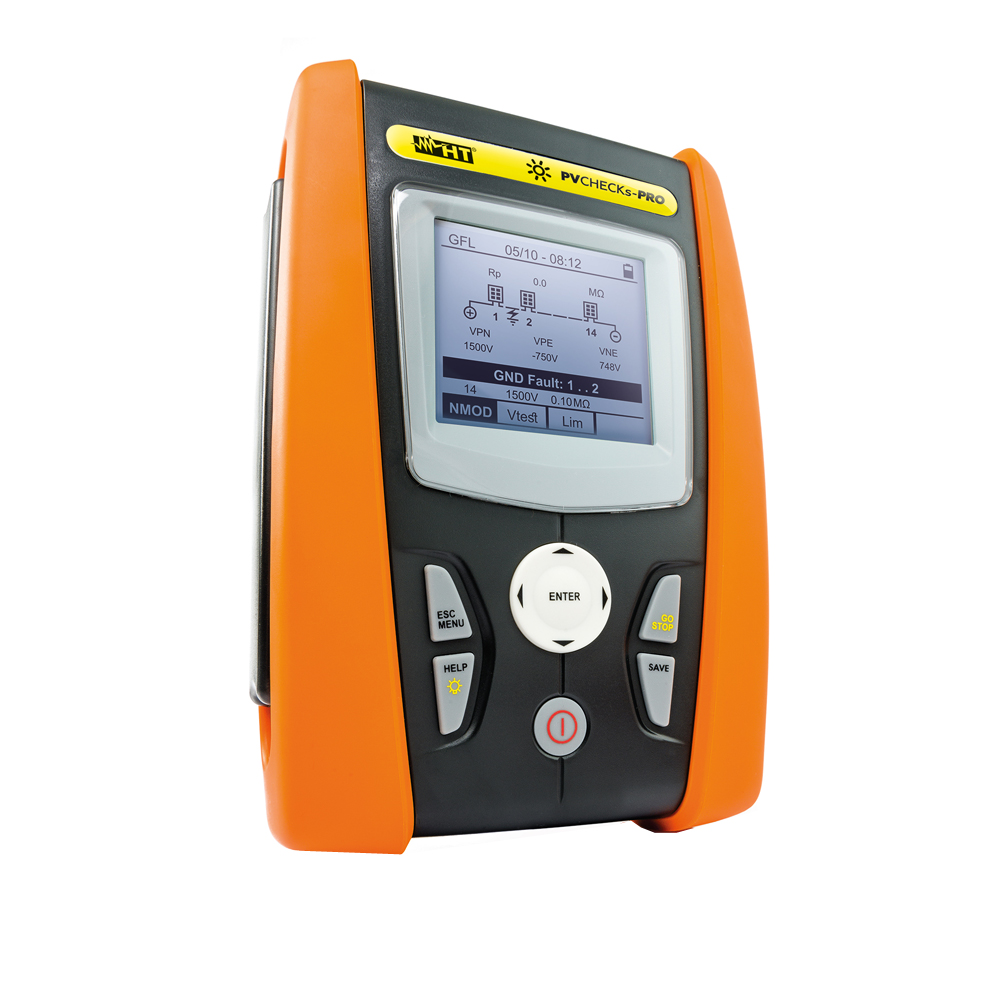
The PV-CHECKs Pro is an installation tester for photovoltaic systems that can be used both in the 1000-volt and 1500-volt ranges with short-circuit currents up to 40 A DC, setting a new benchmark in its class!
PV-CHECKs Pro is the complete solution for fulfilling the IEC 62446-1 standards (DIN VDE 0126-23) for all common tests in Category 1.
PV-CHECKs Pro performs all required tests for commissioning a PV system according to IEC 62446-1 on both monofacial and bifacial PV modules in an automatic sequence.
With a single press of the GO-STOP button, the following measurements are carried out in sequence:
- Polarity test
- Continuity of the protective/bonding conductor
- Measurement of insulation resistance (Riso)
- Measurement of open-circuit voltage Voc up to 1500 V DC
- Measurement of short-circuit current Isc up to 40 A DC
- Mono- & bifacial PV modules
According to EN 62446-1, PV-CHECKs Pro compares the newly measured string with previously measured strings to assess voltage and current deviations that fall outside the defined tolerances.
By measuring solar irradiance (optional reference cell required) and PV module temperature (optional temperature sensor required) using the external data logger SOLAR 03, the PV-CHECKs Pro can convert the measured Voc-OPC and Isc-OPC values to STC (Standard Test Conditions: 1000 W/m², 25°C, AM 1.5). These corrected values can then be compared to the nominal values specified in the manufacturer’s module datasheets.
After each measurement, the PV-CHECKs Pro displays the result directly on the screen with the corresponding evaluation (OK / Not OK).
Special function GFL: Localization of insulation faults on a PV string (Ground-Fault-Location)
In addition to its wide operating range (1500 V DC / 40 A DC), the PV-CHECKs Pro stands out due to its new GFL function for pinpointing insulation faults. Using the Ground Fault Locator (GFL) function, insulation faults can not only be detected but also precisely located. The PV-CHECKs Pro displays the suspected fault position within the string directly on the screen.