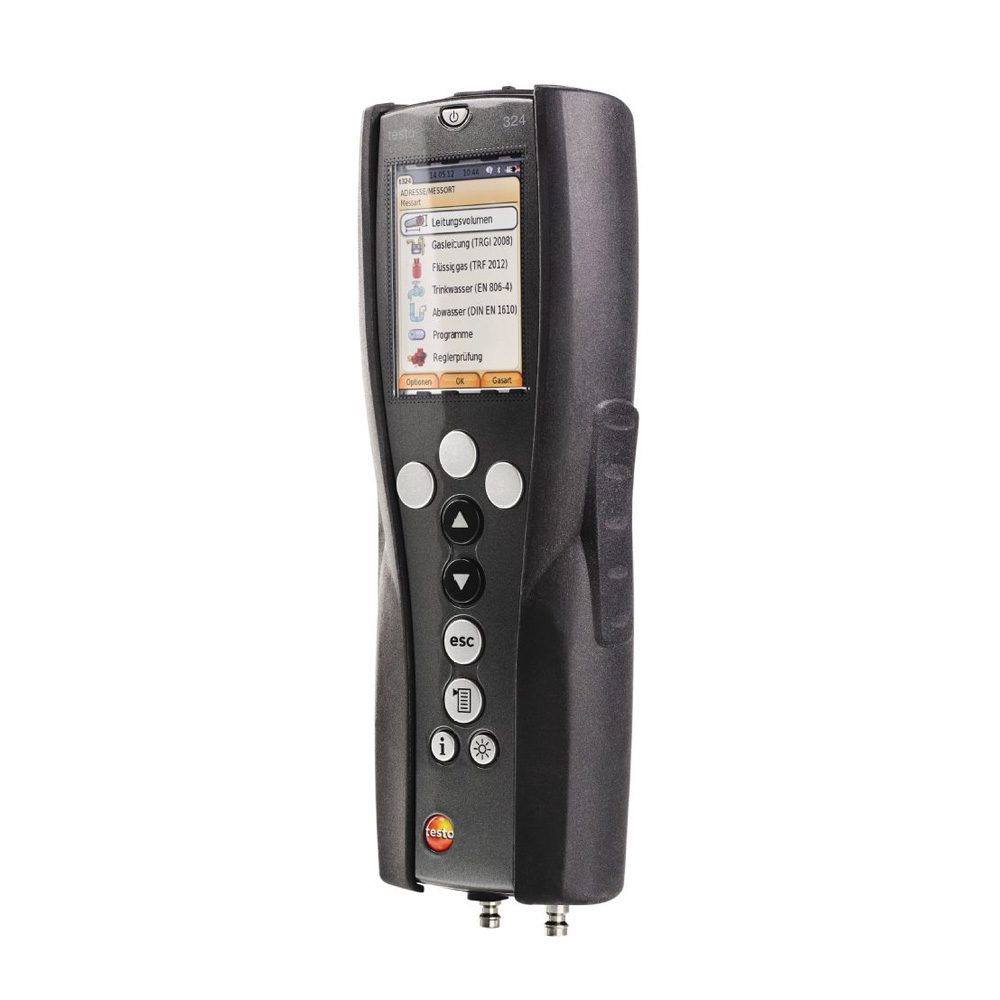
testo 324 – Pressure and leakage rate measuring instrument


  • All-round measuring instrument for legally compliant tests on gas and water pipes

  • Leak tightness testing on gas pipes according to TRGI 2018 and on LPG pipes according to TRF 2012

  • Intuitive and legally compliant menu navigation

  • Software-supported creation of test reports

  • Direct calculation of the pipe volume

  • Safe operation thanks to the single-hose connection

The professional instrument for installation, servicing and maintenance of water pipes and gas pipes: leak tightness testing, load testing, serviceability testing and temperature measurement – with the testo 324 leakage rate measuring instrument, you can perform all important and legally required measurements quickly and reliably.

Datasheet
User Manual
Videos

Product Description

The DVGW-tested measuring instrument is an all-rounder that supports you in your everyday work in many ways: the testo 324 leakage rate measuring instrument is suitable for all tests on gas pipes and water pipes. Whether load tests, leak tightness tests or serviceability tests – with the testo 324 you can cover all important measurements.

Use the testo 324 leakage rate measuring instrument for these applications

  • Leak tightness tests on gas pipes (leak tightness test and load test according to TRGI 2018 and DVGW G 5952)
  • Serviceability test according to TRGI 2018 on gas pipes
  • Pressure tests on water pipes (drinking water according to ZVSHK EN 806-4, wastewater according to DIN EN 1610)
  • Leak tightness testing of LPG pipes according to TRF 2012
  • Testing of gas pressure regulators
  • Pipe volume determination
  • Further applications such as temperature measurement on radiators and pressure measurement at the burner (nozzle pressure, gas flow pressure, etc.)

Great technology, excellent usability

Despite its sophisticated technology, the testo 324 leakage rate measuring instrument is very easy to use: a single-hose connection, a high-resolution graphic colour display and a menu in which important programs such as “Gas pipe TRGI 2018” are already stored and can be started very easily ensure smooth and fast work. Automatic pressure build-up also makes operation simple.
The optionally available accessories have been developed for professional everyday use: from the quick printer for immediate on-site printout of the measurement results to the instrument case with gas bladder, which prevents the formation of a dangerous gas-air mixture.

Scope of delivery

  • testo 324 leakage rate measuring instrument including rechargeable battery and calibration protocol.
  • Laminated connection diagrams: gas pipe, drinking water, wastewater and LPG pipe tests

Technical Data

Temperature – NTC

Measuring range

-20 to +100 °C

Temperature – TC Type K (NiCr-Ni)

Measuring range

-40 to +600 °C

Accuracy

±0.5 °C or ±0.5 %

Absolute pressure

Measuring range

600 to 1150 hPa

Accuracy

±3 hPa

Overload

up to 1200 hPa

Leakage rate measurement

Measuring range

0 to 10 l/h

Accuracy

±0.2 l/h or ±5 % of measured value

Resolution

0.1 l/h

Pressure measurement

Measuring range

0 to 1000 hPa

Accuracy

±0.5 hPa or ±3 % of measured value

Pressure measurement (external probe)

Measuring range

0 to 25 bar

Accuracy

±0.6 %fs (0 to 10 bar)

±0.6 %fs (> 10 to 25 bar)

Pipe volume calculation

Measuring range

max. 1200 l

Accuracy

±0.2 or ±5 (1 to 200 l)

General technical data

Overpressure

1200 hPa

Weight

1070 g

Dimensions

270 x 90 x 75 mm

Operating temperature

+5 to +40 °C

Protection class

IP40 according to EN 60529

Additional probe sockets

2 Hirschmann sockets for connecting pressure probes and temperature probes

Gas connections

2 pressure nipples DN 5

DVGW approval according to 5925

Device class L up to volume = 200 litres

Display type

Colour display, representation of graphical trends

Data transmission

USB, IRDA, Bluetooth® (option)

Rechargeable battery / battery life

approx. 5 h measuring time, mains operation possible

Storage temperature

-20 to +50 °C


Applications

Leakage rate testing on gas pipes (leak tightness test, load test)

The Technical Rules for Gas Installations, known as TRGI, are binding and important regulations for specialist trades. TRGI specifies how gas systems must be planned, installed, serviced and maintained. All gas systems are affected by these regulations. The German Technical and Scientific Association for Gas and Water (DVGW) is responsible for these regulations. The current version is TRGI 2018. Among other things, it states that gas pipes must be tested depending on the stage of construction, such as shell construction phase, completion or repairs. For this application, the following tests in particular are relevant:

Load test
This test checks the material for strength and the connections for durability; it is carried out before the gas pipes are plastered over or covered. During the load test, the newly installed pipe is tested without fittings and without gas appliances using a test pressure of 1 bar. The test medium is air or an inert gas. During the test period of at least 10 minutes, no pressure drop must be detected.

Leak tightness test
This test determines the tightness of the pipe with fittings and without gas appliances. At a test pressure of 150 mbar (previously 110 mbar) and a test duration depending on the system volume of at least 10 minutes, no pressure drop must be visible on the measuring instrument.

Leakage rate testing on gas pipes in the boiler room

A gas installation created according to the legal regulations of the German Technical and Scientific Association for Gas and Water (DVGW) and TRGI 2018 provides the basis for proper long-term operation. During operation of the gas installation, however, operating conditions or other general conditions can affect the safety of gas installations. Technical systems in daily use are subject to wear and contamination. Such safety-relevant changes can only be identified, assessed and repaired by a qualified specialist. The leak tightness test, more precisely referred to as a serviceability test or leakage rate measurement, of the pipe system must be carried out repeatedly every 12 years using a measuring instrument and documented with a result protocol. This provides the operator with technical proof. Some building insurers include these inspections and records in their general insurance terms. During the serviceability test or leakage rate measurement, the gas pipe is always tested under operating conditions / operating pressure, not with an increased test pressure. During this test, a measuring instrument determines whether gas is escaping from the pipe and in what quantity.

Pressure measurements at the burner (nozzle pressure, gas flow pressure, etc.)

Checking the gas pressure at burners is one of the standard measurements during maintenance of domestic heating systems. The gas flow pressure and gas static pressure of the system are measured. The flow pressure, also called connection pressure, refers to the pressure of the flowing gas, while the static pressure refers to the pressure of the gas when it is not flowing. If the flow pressure in gas boilers is outside the range of approximately 18 to 25 mbar, no adjustments may be made and the appliance must not be put into operation. If operation nevertheless takes place, the burner may not work properly and deflagrations can occur during flame formation, ultimately resulting in faults that cause the burner to shut down and the heating system to fail.

Temperature measurements on radiators

When measuring temperatures on radiators, the flow and return temperatures in particular are recorded and evaluated by the specialist. The flow temperature refers to the temperature of the heat transfer medium, such as water, which is supplied to a system. The temperature of the medium flowing out of the system is referred to as the return temperature. To avoid losses within the heat distribution system or to achieve improved efficiency, point-by-point recording of flow and return temperatures is necessary. The implementation of the corresponding measures ultimately leads to hydraulic balancing based on knowledge of the flow and return temperatures. Hydraulic balancing is a procedure by which every radiator or heating circuit of an underfloor heating system within a heating system is supplied with exactly the amount of heat required to achieve the desired room temperature in each individual room at a defined flow temperature. Non-optimal operating behaviour results in significantly higher electricity and heating energy consumption. For this reason, the Energy Saving Ordinance in Germany requires hydraulic balancing for systems to be newly installed or renovated.

Pressure tests on water pipes (drinking water, wastewater)

According to the legal requirements of DIN EN 806-4, DIN 1988-7 and DIN 1610, drinking water and wastewater pipes must be tested for tightness before commissioning by means of a pressure test with air, inert gas or water and must also undergo a load test with air or inert gas. For hygienic reasons, however, it is advantageous if the pipes remain dry until shortly before commissioning and are not subjected to a leak tightness test with water. Pressure testing with air is also recommended in order to avoid corrosion of metallic materials. The pressure test is divided into two pressure-dependent tests, whereby the test pressure and test duration depend on the objective, either load or tightness. Leaks usually become noticeable very quickly acoustically. If the leaking points are difficult to locate, the usual aids for gas pipes are used, such as spraying or brushing with foaming solutions.



Technical advice: 03303 / 50 40 66

Technical advice for this product


    In accordance with the General Data Protection Regulation (GDPR), we are obliged to inform you about the collection of data. We meet this obligation by referring to our privacy notice.


    testo 324 – Pressure and leakage rate measuring instrument

    • All-round measuring instrument for legally compliant tests on gas and water pipes

    • Leak tightness testing on gas pipes according to TRGI 2018 and on LPG pipes according to TRF 2012

    • Intuitive and legally compliant menu navigation

    • Software-supported creation of test reports

    • Direct calculation of the pipe volume

    • Safe operation thanks to the single-hose connection

    The professional instrument for installation, servicing and maintenance of water pipes and gas pipes: leak tightness testing, load testing, serviceability testing and temperature measurement – with the testo 324 leakage rate measuring instrument, you can perform all important and legally required measurements quickly and reliably.

    Datasheet
    User Manual
    Videos

    Product Description

    The DVGW-tested measuring instrument is an all-rounder that supports you in your everyday work in many ways: the testo 324 leakage rate measuring instrument is suitable for all tests on gas pipes and water pipes. Whether load tests, leak tightness tests or serviceability tests – with the testo 324 you can cover all important measurements.

    Use the testo 324 leakage rate measuring instrument for these applications

    • Leak tightness tests on gas pipes (leak tightness test and load test according to TRGI 2018 and DVGW G 5952)
    • Serviceability test according to TRGI 2018 on gas pipes
    • Pressure tests on water pipes (drinking water according to ZVSHK EN 806-4, wastewater according to DIN EN 1610)
    • Leak tightness testing of LPG pipes according to TRF 2012
    • Testing of gas pressure regulators
    • Pipe volume determination
    • Further applications such as temperature measurement on radiators and pressure measurement at the burner (nozzle pressure, gas flow pressure, etc.)

    Great technology, excellent usability

    Despite its sophisticated technology, the testo 324 leakage rate measuring instrument is very easy to use: a single-hose connection, a high-resolution graphic colour display and a menu in which important programs such as “Gas pipe TRGI 2018” are already stored and can be started very easily ensure smooth and fast work. Automatic pressure build-up also makes operation simple.
    The optionally available accessories have been developed for professional everyday use: from the quick printer for immediate on-site printout of the measurement results to the instrument case with gas bladder, which prevents the formation of a dangerous gas-air mixture.

    Scope of delivery

    • testo 324 leakage rate measuring instrument including rechargeable battery and calibration protocol.
    • Laminated connection diagrams: gas pipe, drinking water, wastewater and LPG pipe tests

    Technical Data

    Temperature – NTC

    Measuring range

    -20 to +100 °C

    Temperature – TC Type K (NiCr-Ni)

    Measuring range

    -40 to +600 °C

    Accuracy

    ±0.5 °C or ±0.5 %

    Absolute pressure

    Measuring range

    600 to 1150 hPa

    Accuracy

    ±3 hPa

    Overload

    up to 1200 hPa

    Leakage rate measurement

    Measuring range

    0 to 10 l/h

    Accuracy

    ±0.2 l/h or ±5 % of measured value

    Resolution

    0.1 l/h

    Pressure measurement

    Measuring range

    0 to 1000 hPa

    Accuracy

    ±0.5 hPa or ±3 % of measured value

    Pressure measurement (external probe)

    Measuring range

    0 to 25 bar

    Accuracy

    ±0.6 %fs (0 to 10 bar)

    ±0.6 %fs (> 10 to 25 bar)

    Pipe volume calculation

    Measuring range

    max. 1200 l

    Accuracy

    ±0.2 or ±5 (1 to 200 l)

    General technical data

    Overpressure

    1200 hPa

    Weight

    1070 g

    Dimensions

    270 x 90 x 75 mm

    Operating temperature

    +5 to +40 °C

    Protection class

    IP40 according to EN 60529

    Additional probe sockets

    2 Hirschmann sockets for connecting pressure probes and temperature probes

    Gas connections

    2 pressure nipples DN 5

    DVGW approval according to 5925

    Device class L up to volume = 200 litres

    Display type

    Colour display, representation of graphical trends

    Data transmission

    USB, IRDA, Bluetooth® (option)

    Rechargeable battery / battery life

    approx. 5 h measuring time, mains operation possible

    Storage temperature

    -20 to +50 °C


    Applications

    Leakage rate testing on gas pipes (leak tightness test, load test)

    The Technical Rules for Gas Installations, known as TRGI, are binding and important regulations for specialist trades. TRGI specifies how gas systems must be planned, installed, serviced and maintained. All gas systems are affected by these regulations. The German Technical and Scientific Association for Gas and Water (DVGW) is responsible for these regulations. The current version is TRGI 2018. Among other things, it states that gas pipes must be tested depending on the stage of construction, such as shell construction phase, completion or repairs. For this application, the following tests in particular are relevant:

    Load test
    This test checks the material for strength and the connections for durability; it is carried out before the gas pipes are plastered over or covered. During the load test, the newly installed pipe is tested without fittings and without gas appliances using a test pressure of 1 bar. The test medium is air or an inert gas. During the test period of at least 10 minutes, no pressure drop must be detected.

    Leak tightness test
    This test determines the tightness of the pipe with fittings and without gas appliances. At a test pressure of 150 mbar (previously 110 mbar) and a test duration depending on the system volume of at least 10 minutes, no pressure drop must be visible on the measuring instrument.

    Leakage rate testing on gas pipes in the boiler room

    A gas installation created according to the legal regulations of the German Technical and Scientific Association for Gas and Water (DVGW) and TRGI 2018 provides the basis for proper long-term operation. During operation of the gas installation, however, operating conditions or other general conditions can affect the safety of gas installations. Technical systems in daily use are subject to wear and contamination. Such safety-relevant changes can only be identified, assessed and repaired by a qualified specialist. The leak tightness test, more precisely referred to as a serviceability test or leakage rate measurement, of the pipe system must be carried out repeatedly every 12 years using a measuring instrument and documented with a result protocol. This provides the operator with technical proof. Some building insurers include these inspections and records in their general insurance terms. During the serviceability test or leakage rate measurement, the gas pipe is always tested under operating conditions / operating pressure, not with an increased test pressure. During this test, a measuring instrument determines whether gas is escaping from the pipe and in what quantity.

    Pressure measurements at the burner (nozzle pressure, gas flow pressure, etc.)

    Checking the gas pressure at burners is one of the standard measurements during maintenance of domestic heating systems. The gas flow pressure and gas static pressure of the system are measured. The flow pressure, also called connection pressure, refers to the pressure of the flowing gas, while the static pressure refers to the pressure of the gas when it is not flowing. If the flow pressure in gas boilers is outside the range of approximately 18 to 25 mbar, no adjustments may be made and the appliance must not be put into operation. If operation nevertheless takes place, the burner may not work properly and deflagrations can occur during flame formation, ultimately resulting in faults that cause the burner to shut down and the heating system to fail.

    Temperature measurements on radiators

    When measuring temperatures on radiators, the flow and return temperatures in particular are recorded and evaluated by the specialist. The flow temperature refers to the temperature of the heat transfer medium, such as water, which is supplied to a system. The temperature of the medium flowing out of the system is referred to as the return temperature. To avoid losses within the heat distribution system or to achieve improved efficiency, point-by-point recording of flow and return temperatures is necessary. The implementation of the corresponding measures ultimately leads to hydraulic balancing based on knowledge of the flow and return temperatures. Hydraulic balancing is a procedure by which every radiator or heating circuit of an underfloor heating system within a heating system is supplied with exactly the amount of heat required to achieve the desired room temperature in each individual room at a defined flow temperature. Non-optimal operating behaviour results in significantly higher electricity and heating energy consumption. For this reason, the Energy Saving Ordinance in Germany requires hydraulic balancing for systems to be newly installed or renovated.

    Pressure tests on water pipes (drinking water, wastewater)

    According to the legal requirements of DIN EN 806-4, DIN 1988-7 and DIN 1610, drinking water and wastewater pipes must be tested for tightness before commissioning by means of a pressure test with air, inert gas or water and must also undergo a load test with air or inert gas. For hygienic reasons, however, it is advantageous if the pipes remain dry until shortly before commissioning and are not subjected to a leak tightness test with water. Pressure testing with air is also recommended in order to avoid corrosion of metallic materials. The pressure test is divided into two pressure-dependent tests, whereby the test pressure and test duration depend on the objective, either load or tightness. Leaks usually become noticeable very quickly acoustically. If the leaking points are difficult to locate, the usual aids for gas pipes are used, such as spraying or brushing with foaming solutions.


    Technical advice: 03303 / 50 40 66

    Technical advice for this product


      In accordance with the General Data Protection Regulation (GDPR), we are obliged to inform you about the collection of data. We meet this obligation by referring to our privacy notice.


      Diese Website benutzt Cookies. Wenn du die Website weiter nutzt, gehen wir von deinem Einverständnis aus.