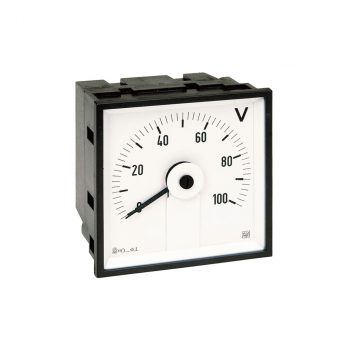
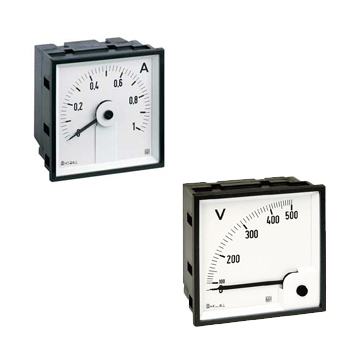
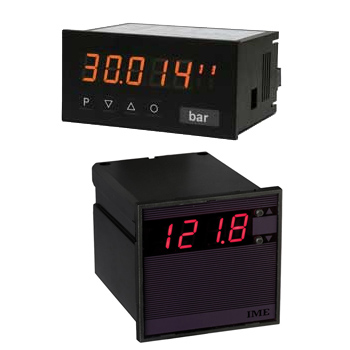
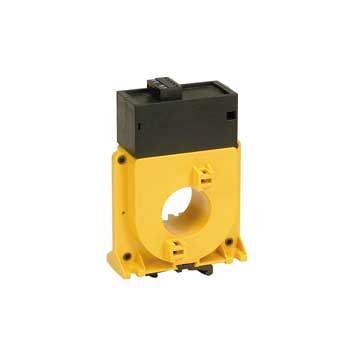
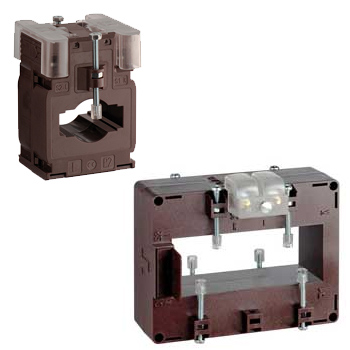

























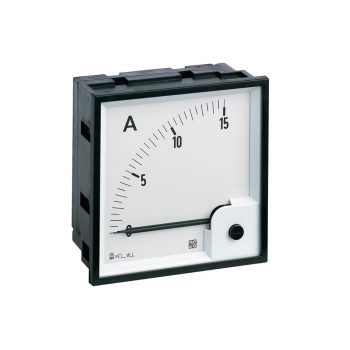
• RQ analog indicator for direct current, moving-coil measuring mechanism
  • Dimensions: DIN 48x48 mm or 72x72 mm or 96x96 mm
  • Pointer deflection: 90°
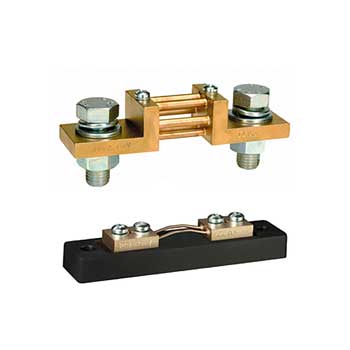
  • Direct connection (0…In) or via 100 mV shunt (0…In)
  • On request: zero point in the center of the scale (-In…0…+In), 240° pointer deflection, other values and graduations, tropicalized version, vibration-resistant, front protection rating IP54, red set pointer
Datasheet

  • Insertion: direct
  • Format: 72x72 mm
  • Current: 1,5...0...1,5 A
  • Type: D.C. ammeter (moving coil)
  • Scale: In…0…In
  • Options: protection IP54 (including tropicalization treatment)
Datasheet

  • Insertion: direct
  • Format: 96x96 mm
  • Current: 0...1,5 A
  • Type: D.C. ammeter (moving coil)
  • Scale: 0…In
  • Options: without
Datasheet

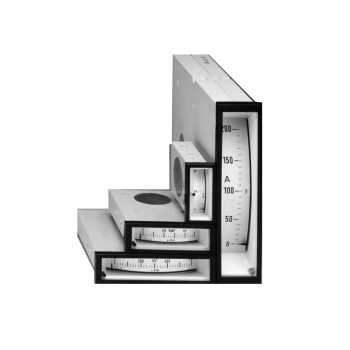
  • Direct indication of input current or primary current of external shunt
  • Indication of any quantity, directly proportional to signals coming from transducers or sensors
  • Moving coil equipment
  • Direct connection 2...5A
  • Connection by external shunt 1A/60mV...6000A/60mV
  • Connection by transducers or sensors 1...600mA – 0...5/10/20 – 4...20mA
  • Lateral zero or central zero version
  • Live zero or mechanically suppressed (4...20mA)
  • Scale lenght 240°
  • Accuracy cl.1,5
Datasheet

  • Direct indication of input current or primary current of external shunt
  • Indication of any quantity, directly proportional to signals coming from transducers or sensors
  • Moving coil equipment
  • Direct connection 2...5A
  • Connection by external shunt 1A/60mV...6000A/60mV
  • Connection by transducers or sensors 1...600mA – 0...5/10/20 – 4...20mA
  • Lateral zero or central zero version
  • Live zero or mechanically suppressed (4...20mA)
  • Scale lenght 240°
  • Accuracy cl.1,5
Datasheet

  • Direct indication of input current or primary current of external shunt
  • Indication of any quantity, directly proportional to signals coming from transducers or sensors
  • Moving coil equipment
  • Direct connection 2...5A
  • Connection by external shunt 1A/60mV...6000A/60mV
  • Connection by transducers or sensors 1...600mA – 0...5/10/20 – 4...20mA
  • Lateral zero or central zero version
  • Live zero or mechanically suppressed (4...20mA)
  • Scale lenght 240°
  • Accuracy cl.1,5
Datasheet

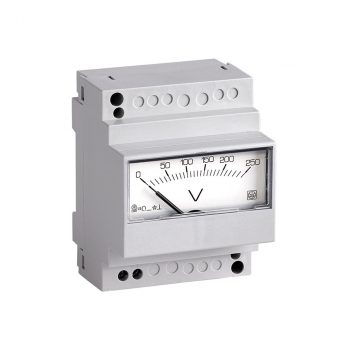
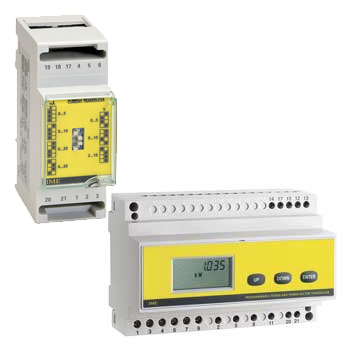
  • Application: for transformers or devices with DC output
  • Format: 4 DIN modules
  • Current: 20…0…20 mA
  • Type: DC ammeter (moving coil)
  • Scale: center zero on request
Datasheet


Analog DC Panel Meters / Gleichstrom-Einbaumessgeräte

Analog DC panel meters are built-in measuring instruments used to display direct-current parameters such as DC voltage, DC current or load values in a simple, robust and immediately readable form. Installed permanently in control cabinets, distribution panels or DC systems, they show values continuously via a pointer on a scale — without digital electronics or auxiliary power. This makes them ideal for monitoring DC supplies, battery systems, controls and industrial DC distribution.

What is an analog DC panel meter?

An analog DC panel meter is a panel-mounted instrument that displays direct-current parameters such as voltage (V) or current (A) in real time using a pointer and a calibrated scale. It operates without digital conversion and provides a continuous, always-visible reading — ideal for simple and reliable DC monitoring.

Which DC parameters can be displayed?

Typical values include DC voltage (e.g., 12 V, 24 V, 48 V, 110 V, 220 V), DC current, battery charging or load conditions, and current flow in DC distribution systems. Depending on the model, the meter may be designed specifically for voltage or for current measurement.

How does the measuring movement work?

DC meters usually use a moving-coil mechanism. Current flows through a small coil, creating a magnetic field that deflects the pointer proportionally to the measured voltage or current. This simple principle ensures high robustness and direct, stable readings.

What are the advantages of analog DC panel meters?

They offer immediate visual feedback, are highly resistant to electromagnetic interference, require no external power supply, and are typically very durable. Their clear, direct display provides fast assessment of system status — even if digital electronics fail. They are ideal for DC power supplies, battery circuits, photovoltaic systems and general DC distribution.

Where are analog DC meters typically used?

Common applications include DC power supplies, control circuits, battery systems, chargers, photovoltaic installations, machine DC distribution, switchboards and other installations where DC voltage or current needs to be monitored continuously.

Which mounting sizes and form factors are available?

Standard front dimensions include 48×48 mm, 72×72 mm, 96×96 mm and 144×144 mm, as well as slim versions such as 48×24 mm or 72×24 mm for compact control panels. They can be mounted on front plates, enclosures or control desks depending on space and application.

What are the limitations of analog DC meters?

They offer lower accuracy compared to digital meters, may suffer from parallax reading errors, and lack features such as auto-range, data logging or communication interfaces. Incorrect wiring or overload can damage the movement. Therefore, they’re not suited for precise documentation or long-term data recording.

For which applications are analog DC meters especially suitable?

They are ideal for continuous, straightforward monitoring of DC voltages and currents — for example in battery systems, DC supplies, chargers, controls or photovoltaic systems — especially where simple visualization and robustness are more important than high measurement precision.

How do analog DC meters respond to load or voltage changes?

The pointer responds instantly to any change, showing fluctuations, drops or increases in real time. This helps identify load variations, discharge behavior or sudden voltage dips quickly — without the delay or averaging typical in digital displays.

What should be considered during selection and installation?

The selected meter must match the intended voltage or current range. Proper wiring, correct polarity, suitable mounting dimensions, and environmental protection (dust, humidity, vibration) are essential. Compliance with installation standards and protection classes ensures safe and reliable operation.

Diese Website benutzt Cookies. Wenn du die Website weiter nutzt, gehen wir von deinem Einverständnis aus.