




























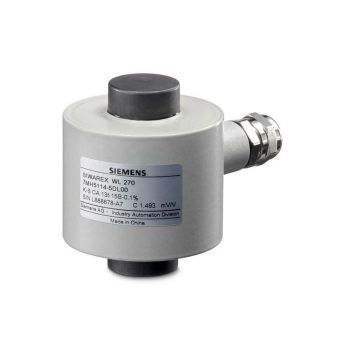
• legal for trade

  • easy and quick installation with SIWAREX mounting units

  • options for use in hazardous areas are in preparation

Datasheet

  • Legal for trade

  • Quick and simple installation with SIWAREX mounting devices

  • Option for use in hazardous areas are in preparation

Datasheet

  • Very low installation dimension

  • Extremely high load classes up to 500t

  • High temperature option up to 250°C and option with double bridge increase application security

  • Ex-protection, zone 2, 22


Datasheet


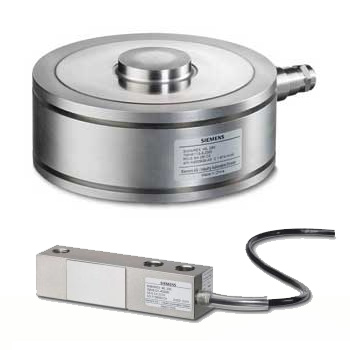
Siemens Compression Load Cells for Industrial Weighing Applications

Siemens compression load cells measure static and dynamic forces using strain-gauge based Wheatstone bridges on a mechanically stressed sensor body. They are designed for tank, silo, hopper and vehicle scales, offer high overload capability, very good linearity and repeatability, and feature a robust, often hermetically sealed stainless-steel design with high ingress protection ratings and optional ATEX-certified variants.

FAQ on Siemens Compression Load Cells

What is the basic operating principle of a Siemens compression load cell?

The load cell consists of an elastic metal body with bonded strain gauges connected as a Wheatstone bridge. When a load is applied, the body deforms slightly, changing the resistance of the strain gauges. This generates a load-proportional bridge output signal which is amplified and converted into weight by the weighing electronics.

How does a compression load cell differ from a tension load cell?

Compression load cells are mechanically designed for compressive loading with the force applied from above via mounting kits or load feet. Tension load cells are stressed in tension using threaded or clevis connections. A compression load cell must not be used in tension unless it is explicitly approved for combined tension and compression operation.

What are typical applications for Siemens compression load cells?

Typical applications include tank and silo scales, process vessels, hopper and bunker scales, platform and vehicle scales as well as batching, dosing and level-by-weight systems where vertically acting forces have to be measured with high precision.

Which accuracy classes are available?

Depending on the type, industrial accuracy classes according to OIML R60, for example C3 or C6, are available. These classes define maximum permissible error, repeatability and creep and thus qualify the load cells for legal-for-trade applications when the complete weighing chain is designed accordingly.

What overload capacity can be expected from a compression load cell?

The safe mechanical overload is typically in the range of 150 % to 200 % of the rated capacity, while the ultimate load is considerably higher. The exact values are type-specific and must be taken from the data sheet, because they are essential for mechanical design and safety margins.

Why are side loads and moments critical for compression load cells?

Compression load cells are optimized for vertical force introduction. Lateral forces and bending moments can cause measurement errors and may overstress the sensor body. Special mounting kits with load feet, rocker pins or pendulum mounts minimize side loads and compensate for thermal expansion in the steel structure.

Which materials and protection classes are commonly used?

Corrosion-resistant stainless steel is commonly used for industrial applications. The sensor bodies are often hermetically welded and reach protection classes up to IP68 or IP69K to withstand moisture, aggressive cleaning procedures and harsh environments.

What are the typical operating and compensated temperature ranges?

The compensated temperature range is usually around -10 °C to +40 °C, while the permissible operating temperature range can be wider, for example -30 °C to +70 °C. Within the compensated range, the temperature effects on zero and span are minimized by design and electronic compensation.

How are Siemens compression load cells electrically connected?

The load cells are connected using 4- or 6-wire technology. In 6-wire systems, additional sense leads compensate cable resistance and voltage drops, which is particularly beneficial with long cable runs and improves stability and accuracy of the measurement.

Are Siemens compression load cells available for hazardous areas?

Selected models are available with ATEX or IECEx approvals, allowing installation in gas or dust hazardous areas with defined zone classifications, provided that the associated weighing electronics also complies with the required protection concepts.

How are multiple compression load cells combined in one scale?

For tank and platform scales, three or four load cells are usually connected in parallel. The weighing electronics sums the signals and provides corner load adjustment and calibration functions to ensure that load shifts do not significantly affect the weighing result.

Which calibration steps are required after installation?

After mechanical installation, zero and span are calibrated using certified test weights or a reference scale. The weighing terminal typically offers functions for corner adjustment, zero and span calibration and entry of calibration factors or digital parameters according to the load cell data sheet.

How do temperature changes influence the measurement?

Temperature changes affect both the elastic properties of the metal body and the resistance of the strain gauges. Through temperature-compensated strain-gauge arrangements and a suitable sensor design these effects are largely compensated. Remaining errors are specified as temperature coefficients for zero and sensitivity in the data sheet.

How can electromagnetic interference be minimized?

Proper EMC design includes shielded cables with correct shield termination, equipotential bonding and grounding. Signal cables should be routed separately from power cables, and the weighing electronics should provide EMC filters and surge protection to ensure stable measurement signals in industrial environments.

Diese Website benutzt Cookies. Wenn du die Website weiter nutzt, gehen wir von deinem Einverständnis aus.