

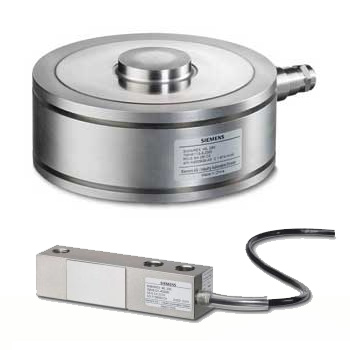
































• Capable of calibration to OIML

  • Quick and simple installation with SIWAREX mounting devices

Datasheet


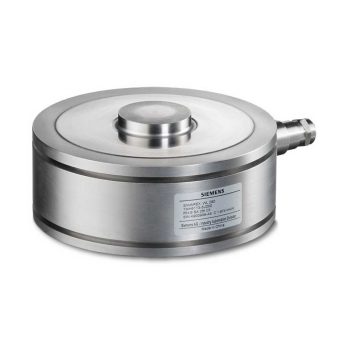
Siemens Ring Torsion Load Cells for Conveyor, Hopper and Platform Scales

Siemens ring torsion load cells use a circular spring element which is twisted under load. Strain-gauge spirals on the upper and lower faces of the ring form a Wheatstone bridge, generating an output signal proportional to the applied force. The design combines very low installation height, high resolution, accuracy classes up to C3, integrated overload protection on selected rated loads and a robust stainless-steel construction with high protection classes such as IP66/IP68, making it ideal for belt scales, hopper and container scales and platform or roller conveyor scales.

FAQ on Siemens Ring Torsion Load Cells

What is the basic mechanical principle of a ring torsion load cell?

The sensor body is a stainless-steel ring acting as a torsion spring. The vertical load is introduced centrally and produces a torsional deformation in the ring cross section. Spiral strain gauges bonded to the upper and lower faces of the ring change their resistance according to the torsion and, connected as a Wheatstone bridge, provide a load-proportional output voltage.

Which advantages does the ring torsion design offer compared to conventional compression or shear beam cells?

Ring torsion load cells feature very low construction height, high stiffness and a largely symmetrical deformation field. This results in excellent linearity, low corner load sensitivity and very good long-term stability. The ring geometry also allows compact mounting kits with integrated overload protection and guiding elements to be implemented.

For which applications are ring torsion load cells particularly suitable?

Typical applications include belt and conveyor scales, platform and roller table scales, hopper and bunker scales as well as batching and dosing systems where vertical forces must be measured precisely while the available installation height is limited.

What accuracy can be achieved with Siemens ring torsion load cells?

Depending on the type, the load cells are available in legal-for-trade accuracy classes according to OIML R60, typically in class C3. This enables both demanding process weighing tasks and applications which require certifiable weighing, provided that the complete weighing chain is designed accordingly.

Which rated load ranges are typically covered?

Ring torsion load cells cover a wide range of rated loads from a few tens of kilograms up to several tens of tons, depending on the size. This allows light belt and platform scales as well as heavy container and roller conveyor scales to be equipped with the same basic technology.

How is overload protection implemented in ring torsion load cells?

For many sizes, mechanical overload protection is integrated in the mounting assembly. It limits the maximum deflection of the force application system so that torsion angles and stresses in the ring remain within the specified range. This protects the load cell against short-term overload without affecting the measuring behavior in the nominal load range.

Which materials and protection classes are used?

The spring element is usually made of corrosion-resistant stainless steel. Hermetically welded designs achieve high protection classes such as IP66 and IP68, ensuring reliable operation in humid, dusty or regularly cleaned environments. The strain-gauge bridge is permanently sealed against moisture and chemical influences.

How does the low installation height influence mechanical design?

The flat design allows weighing structures with a low center of gravity and minimal build-up height. This simplifies integration into existing conveyor or vessel structures, reduces lever arms and bending moments and improves stability under dynamic loads, for example in conveyor and roller table scales.

How are side loads and thermal expansion of the structure handled?

Ring torsion load cells are typically used together with dedicated mounting kits that limit horizontal forces and absorb thermal expansion of the steel structure. Guiding elements, elastomer bearings and self-centering load plates ensure that the vertical force component dominates and that side loads have only a negligible influence on the measured signal.

What are the typical operating and compensated temperature ranges?

Depending on the type, the permissible operating temperature range extends from well below 0 °C to above 60 °C. Within a specified compensated temperature range, changes of zero and span caused by temperature are largely minimized by the strain-gauge arrangement and the design of the ring spring. Remaining errors are specified as temperature coefficients in the data sheet.

How is a ring torsion load cell electrically connected?

The electrical connection is made using a shielded cable in 4- or 6-wire configuration. In 6-wire systems, additional sense leads compensate cable resistance and voltage drops in the excitation leads, which is particularly beneficial for long cable runs and results in higher accuracy and long-term stability.

Are ring torsion load cells suitable for dynamic applications such as belt scales?

Yes. The high stiffness of the ring spring and the very small elastic deflection provide short settling times and good dynamic behavior. This makes ring torsion load cells very well suited for continuously operating belt scales, weighfeeders and checkweighers with rapidly changing loads.

Can ring torsion load cells be used in legal-for-trade weighing systems?

If the load cell is certified in an appropriate accuracy class and the associated weighing electronics and mechanical design fulfill the legal metrology requirements, ring torsion load cells can be used in legal-for-trade scales, for example in filling, dosing or custody transfer applications.

What should be considered for EMC-compliant installation?

Recommended practices include the use of shielded cables with proper shield termination at both ends, an effective equipotential bonding between the load-cell structure and the weighing terminal, and separate routing of signal and power cables. The weighing electronics should provide suitable EMC filtering and surge protection to ensure stable signals even in harsh industrial environments.

How are multiple ring torsion load cells combined in one weighing system?

In belt, platform or container scales, several load cells are usually connected in parallel to a common weighing terminal. Corner load adjustment and calibration functions in the electronics ensure that load shifts do not cause unacceptable measurement errors and that the overall system delivers reproducible results.

Diese Website benutzt Cookies. Wenn du die Website weiter nutzt, gehen wir von deinem Einverständnis aus.