







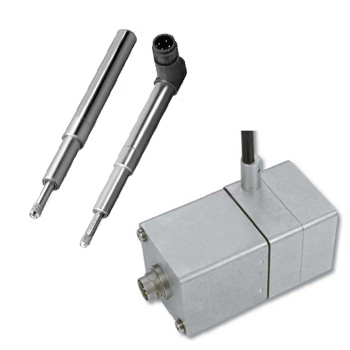


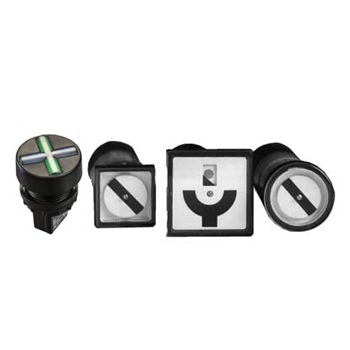
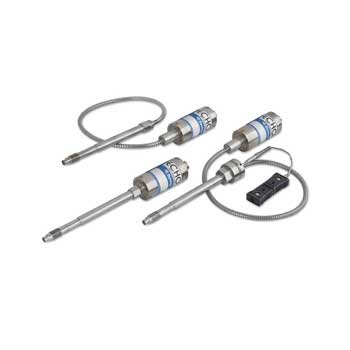
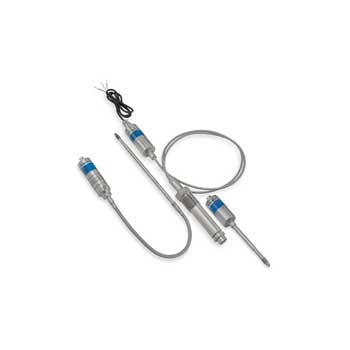
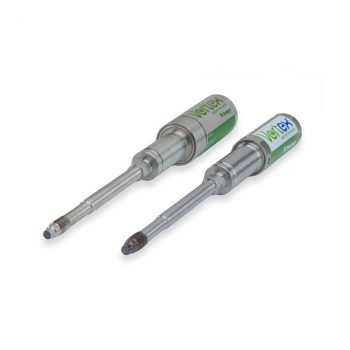
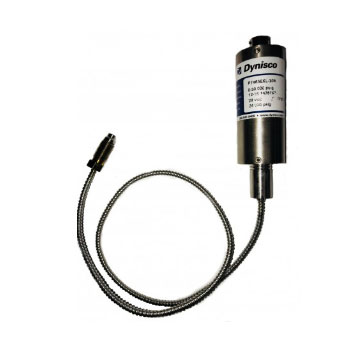
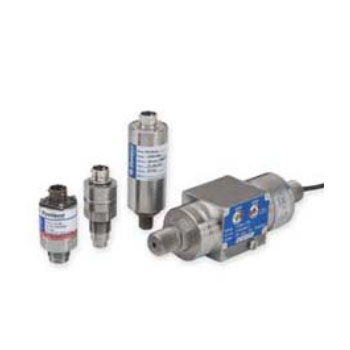
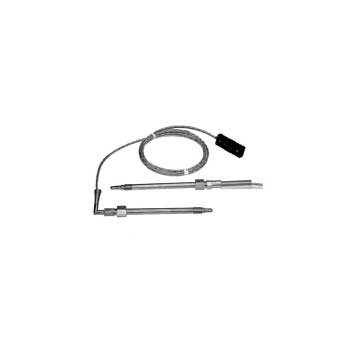
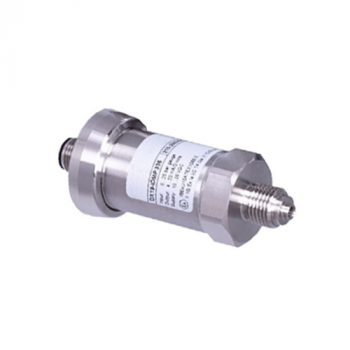


























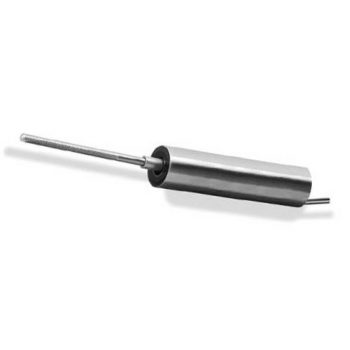
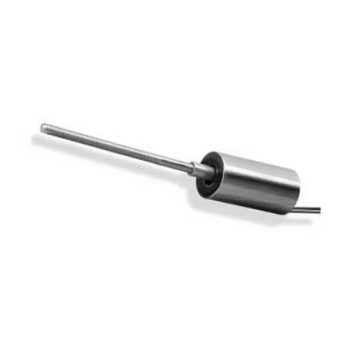
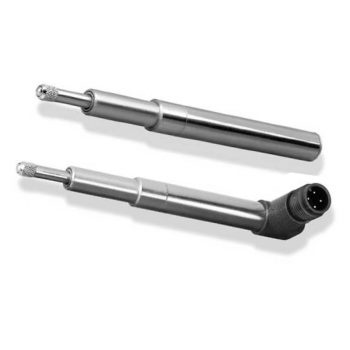
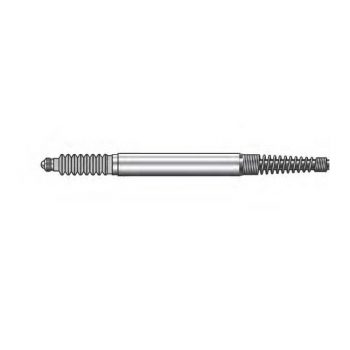

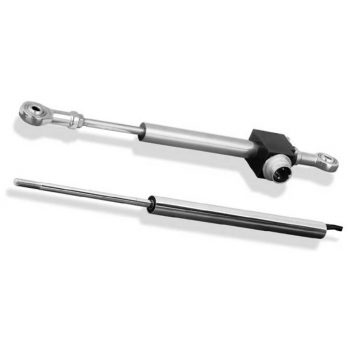
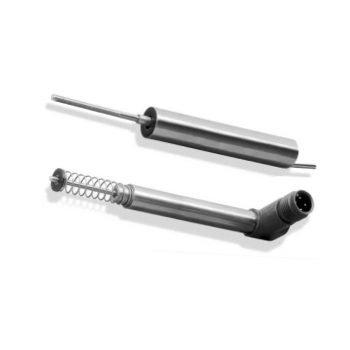
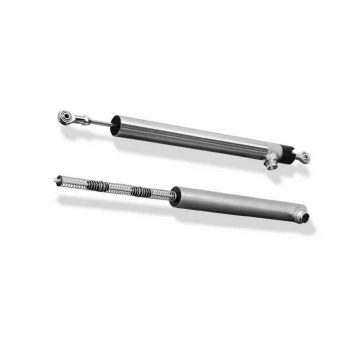
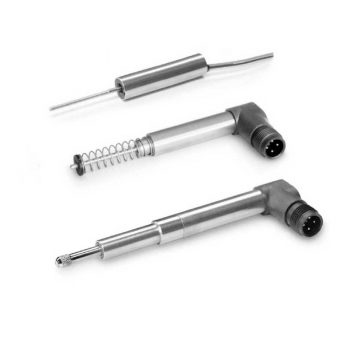
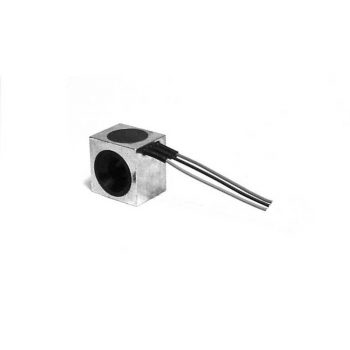
- Stroke up to 20 mm
- Housing diameter 10 mm
- Integral electronic
- Small operating current
- Accuracy ≤ ± 0,5 % or ≤ ± 0,25 %
- Protection class up to IP67
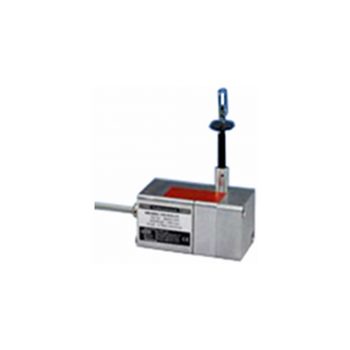
- SchutzartIP67
- Meßbereiche: 0...100mm bis 0...3000mm
- MitAnalogausgang0…10V,4…20mA,Poti oderA/D-Wandler-Ausgangsynchron-seriell(SSI)
 Datasheet Datasheet |

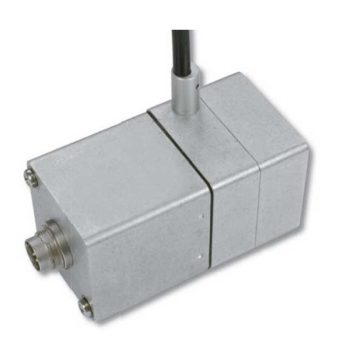
The position sensor HySense® PO 180 works on the measuring wire principle. It can be easily mounted and does not need linear guiding. At the measuring wire principle, a specially manufactured and calibrated wire is tightly wound around a high-precision drum that is driven against the pulled direction by a spring motor. Through the detection of the winding process the sensor converts the linear movement into an electrical signal. All mechanical and electronic components are protected by a solid casing. It is available for several measurement ranges from 0-3000 mm. Areas of application could be e. g.: Load cranes Hydraulic presses Your benefit at a glance: Compact High resolution and accuracy High dynamic Insensitive to environmental influences

Displacement Sensors – linear position measurement for machinery, hydraulics & automation
Displacement sensors capture linear position, stroke and speed—from microns up to several meters. Available as LVDT, magnetostrictive linear sensors, potentiometric transducers, draw-wire (cable) sensors, Hall/magnet-tape systems, optical scales and capacitive/eddy-current probes for ultra-small motions.
Outputs & interfaces: 4–20 mA, 0–10 V, SSI/BiSS, IO-Link, CANopen, incremental A/B/Z. Options include IP65–IP68, ATEX, high-temperature, rod ends/joints, magnet/slider pickups, connectors and calibration certificates.
ICS Schneider Messtechnik supports principle selection, sizing, mechanical integration, signal conditioning, factory/DAkkS calibration and PLC/NC/IIoT integration.
FAQ on Displacement Sensors
Answers on principles, accuracy, selection, mounting, environmental effects, interfaces and calibration.
Which principle fits my application?
| Principle | Strengths | Typical applications |
|---|---|---|
| LVDT (inductive) | Contactless, very robust, high resolution | Test rigs, valve lift, high T/vibration |
| Magnetostrictive | Wear-free, absolute, long strokes (meters) | Hydraulic/pneumatic cylinders, presses |
| Potentiometric | Cost-effective, simple, direct analog | Machine building, short to mid strokes |
| Draw-wire (cable) | Very long ranges, flexible mounting | Stage/hoist systems, vehicles |
| Hall/magnet tape | Compact, dynamic, absolute/incremental | Handling, axis position, doors/slides |
| Optical scales | Ultra-high resolution/accuracy | Metrology tables, precision axes |
| Capacitive/eddy-current | µm/nm range, contactless | Gaps, vibration amplitude, runout |
How do I choose measuring range and resolution?
Size the useful stroke with 10–20 % headroom. Resolution depends on the control/positioning task; for NC/servo typically ≤10 µm, for process travel 0.05…0.1 % FS is sufficient.
What accuracy is realistic?
LVDT/optical up to ±0.1…0.25 % FS, magnetostrictive ±0.02…0.1 % FS (model-dependent), potentiometric ±0.3…0.5 % FS, draw-wire depends on encoder ±0.1…0.5 % FS.
Absolute vs. incremental—what’s the difference?
Absolute sensors report position immediately on power-up; incremental types need a home/reference move but often offer high dynamics and simplicity.
Which interface suits my controller?
4–20 mA/0–10 V for PLC analog input, SSI/BiSS for high-resolution absolute values, A/B/Z incremental for drives, IO-Link/CANopen for diagnostics and parametrization.
What mounting rules should I follow?
- Ensure axis alignment; use rod ends for plungers.
- Guide without play/binding; avoid side loads.
- Provide cable strain relief/shielding.
How do I integrate magnetostrictive sensors in cylinders?
Mount the rod coaxially to the piston rod; set the magnet slider/ring per air-gap spec; observe seals/pressure/medium temperature; route cables per EMC best practice.
What drives measurement uncertainty?
Temperature drift, mechanical play, misalignment, EMC, vibration, sensor linearity and the reader’s resolution/noise.
How to handle temperature & environment?
Select sensors with suitable temperature range and IP rating. For gradients, add thermal decoupling and temperature compensation.
Can I measure high dynamics/vibration?
For high bandwidth (vibration amplitude), use LVDT with fast electronics or eddy-current/capacitive systems; ensure stiff mechanical coupling.
How long can the cables be?
Use shielded analog lines; beyond 10–20 m prefer 4–20 mA or digital interfaces. For LVDT observe excitation/phase requirements.
Maintenance: potentiometer vs. contactless?
Potentiometers are wearing parts (lifetime matters) but simple. LVDT/magnetostrictive/Hall/optical are contactless and low-maintenance.
How do I verify/calibrate displacement sensors?
Use dial gauges/calipers/gauges (coarse), precision scales, CMM or laser interferometer (fine). Document as-found/as-left with k=2 uncertainty.
What power supplies are common?
Typically 10–30 V DC (magnetostrictive/Hall/electronics). LVDT requires AC excitation and a demodulator; observe EMC/PE and bonding.
How do I protect the sensor mechanically?
Provide end stops in the actuator, don’t overrun the stroke, add dust/chip guards (bellows). For draw-wire, keep the retract spring unobstructed.
Any special notes for draw-wire sensors?
Lead the cable straight, use large-radius pulleys for rerouting, verify pretension, avoid side pull; select encoder resolution to meet accuracy.
Can I combine multiple measurement points?
Yes—e.g., displacement + force for process monitoring, or two displacement sensors to assess parallelism/torsion; correlate values in PLC/DAQ.
Do you support sizing & commissioning?
Yes—we specify principle/range, define mounting & EMC, supply conditioners/cabling and prepare calibration & test plans.